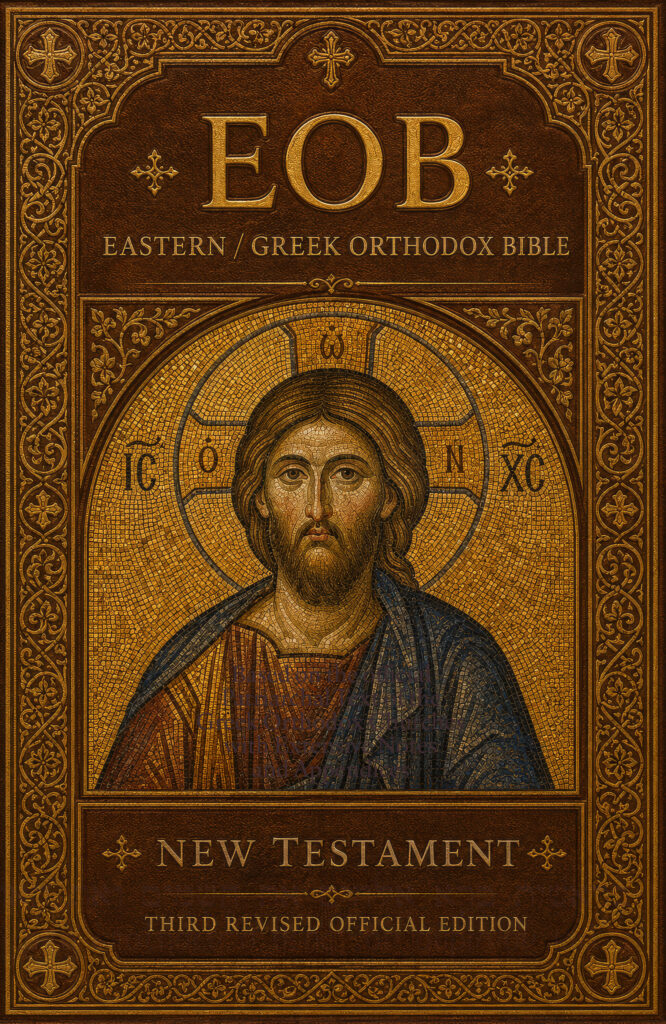
EOB: Official Site of the Eastern / Greek Orthodox Bible (Old and New Testament)

Genesis 1:1

EOB (Eastern / Greek Orthodox Bible):

In the beginning God made the heaven and the earth.

EOB Footnote:

The LXX manuscripts (Alexandrinus, Vaticanus, Sinaiticus) are in substantial agreement for this verse, with only minor orthographic variations. The MT reads identically in meaning to the LXX. A DSS witness exists (4QGen-Exod^a), which preserves this verse and agrees with the MT. No significant textual variants affect translation.

Other Translations:

KJV (King James Version):

In the beginning God created the heaven and the earth.

WEB (World English Bible):

In the beginning, God created the heavens and the earth.

Benton LXX (Vaticanus):

In the beginning God made the heaven and the earth.

Douai-Rheims (Vulgate):

In the beginning God created heaven, and earth.

Apostoliki Diakonia (LXX):

In the beginning, God created the heaven and the earth.

YLT (Young Literal Translation )(MT):

In the beginning, God created the heavens and the earth.

BBE (Bible in Basic English):

In the beginning God made the heaven and the earth.

EOB COMMENTARY:

EOB Commentary:

Genesis 1:1 Commentary

Theological Significance: The opening words of Scripture establish the foundational truth of Orthodox theology: God exists eternally and creates freely out of nothing (ex nihilo). The Hebrew bereshit (“in the beginning”) points not merely to a temporal starting point but to the absolute origin of all created existence. This verse stands as the Church’s primary witness against both ancient pagan cosmologies that posited eternal matter and modern materialist philosophies that deny divine creation.

Christological Reading: The Fathers consistently read this verse through the lens of John 1:1, where the Evangelist deliberately echoes Genesis with “In the beginning was the Word.” Saint Basil the Great, in his Hexaemeron, teaches that the Father creates through the Son and in the Holy Spirit. The “beginning” (arche) is thus understood as referring to Christ Himself, the eternal Logos through whom all things were made. Saint Ambrose similarly interprets the beginning as the Son, citing Colossians 1:16-17. This Christological reading transforms the creation account into a revelation of the Trinity’s creative activity.

Patristic Witness: Saint Basil’s nine homilies on the six days of creation remain the definitive Orthodox commentary on Genesis 1. He emphasizes that “In the beginning God created” refutes those who claim the world is without beginning or that matter is co-eternal with God. Saint John Chrysostom stresses the condescension (synkatabasis) of Scripture in accommodating divine mysteries to human understanding. Saint Gregory of Nyssa develops the distinction between the eternal, uncreated nature of God and the temporal, created nature of the cosmos.

Liturgical Connections: Genesis 1:1 is read during the Vespers of Pascha, linking creation with the new creation accomplished in Christ’s Resurrection. The Church understands the Paschal mystery as the renewal and fulfillment of the original creation. The reading of Genesis at the beginning of the Paschal Vigil proclaims that the Risen Christ is the same Logos through whom all things were made. Additionally, the theme of creation pervades Orthodox hymnography, particularly in the Sunday Octoechos, where the resurrection is celebrated as the eighth day of new creation.

Spiritual Application: For Orthodox spirituality, this verse establishes the fundamental relationship between Creator and creature. Human beings exist in radical dependence upon God, receiving existence as pure gift. This awareness cultivates the virtue of humility and grounds the practice of thanksgiving (eucharistia) that characterizes authentic Christian life. The knowledge that God created all things good provides the foundation for the Orthodox understanding of material creation as capable of bearing divine grace, expressed supremely in the sacramental life of the Church.

Introduction to the book of Leviticus

The Book of Leviticus receives its English title from the Latin Vulgate, which is derived from the Greek Septuagint (LXX) title Leuitikon (Λευιτικόν), meaning “Levitical” or “pertaining to the Levites.”

Read More »

Introduction to the book of Exodus

The Book of Exodus receives its English title from the Greek Septuagint (LXX), where it is called Exodos (Ἔξοδος), meaning “departure” or “exit.” This name was chosen because the central

Read More »