An Introduction to the EOB (Eastern/Greek Orthodox Bible)
The New Testament
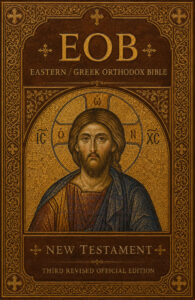
The EOB New Testament was prepared for personal study and liturgical use in English-speaking Orthodox Christian communities. Its format and accessible modern English make both activities rewarding while remaining faithful to the original Greek. The translation is scholarly and strives to be free of the theological biases that have sometimes influenced other English versions. It also includes footnotes that reference key Greek vocabulary to encourage deeper engagement with the biblical languages.
The primary Greek text for the EOB New Testament is the official ecclesiastical text published by the Ecumenical Patriarchate of Constantinople in 1904, commonly called the Patriarchal Text (PT). This text, developed to promote unity among Greek-speaking Orthodox Churches, is very close to the Byzantine/Majority Text tradition and has been the standard used in the Greek Orthodox Churches ever since. While the Patriarchal Text forms the main body of the translation, the EOB also notes significant variants from the Textus Receptus (TR), the Majority Text (MT), and the Critical Text (CT) in its footnotes, giving readers transparency about the textual tradition. The footnotes focus on textual and translation matters rather than extended doctrinal commentary, allowing the inspired text to speak clearly for itself.
The EOB addresses limitations found in earlier popular translations. The King James Version and New King James Version, while long favored in many Orthodox settings for their connection to the Byzantine textual family, use older English and remain under external copyright control. At the same time, many contemporary translations rely on the Critical Text and a more dynamic style that can obscure nuances important to Orthodox theology and worship. The EOB offers a fresh, formal-equivalence rendering that stays within the Orthodox community, remains non-commercial in spirit, and welcomes ongoing input from Orthodox scholars and faithful for future improvements. It is therefore suitable for both devotional reading and liturgical proclamation.
The Old Testament
The Old Testament portion of the EOB follows the Septuagint (LXX) Greek text that has been the canonical Bible of the Orthodox Church from the earliest centuries. Where manuscript variants exist within the Greek tradition, the translation gives priority to the readings of Codex Alexandrinus, one of the most important and complete early witnesses to the Septuagint. This approach ensures continuity with the Greek Old Testament as it was received and used by the Apostles and the early Churches.
The editorial method carefully compares the Septuagint with the Hebrew Masoretic Text (MT) and, when relevant, the Dead Sea Scrolls. Significant differences are handled transparently: major variants from other LXX manuscripts are noted in footnotes only when they substantially affect meaning; differences from the Masoretic Text are indicated in footnotes with concise explanations of the key words or phrases involved (without reprinting the entire MT verse); and any words present in the Masoretic Text but absent in the LXX are added between square brackets [] in the English rendering so that readers can see the textual tradition at a glance. When the Dead Sea Scrolls provide a meaningful variant, it is likewise noted if significant. The result is an English text that remains faithful to the LXX while helping readers appreciate the richness of the broader biblical manuscript tradition.
The translation itself uses clear, accessible English at a high-school to early-college reading level. Sentences are rendered as naturally as possible in contemporary idiom; for example, verses do not automatically begin with “And” when the context allows a smoother transition, while the traditional “Behold” is retained when it fits the opening of a sentence. The goal is to make the meaning immediately understandable while preserving the dignity and theological precision of the sacred text.
Together, the New Testament and Old Testament sections of the EOB present the complete Holy Scriptures in a unified Orthodox edition that is both scholarly and pastoral—ready for personal devotion, study, and the worship life of the Church.