Introduction to the book of Leviticus
The Book of Leviticus receives its English title from the Latin Vulgate, which is derived from the Greek Septuagint (LXX) title Leuitikon (Λευιτικόν), meaning “Levitical” or “pertaining to the Levites.”
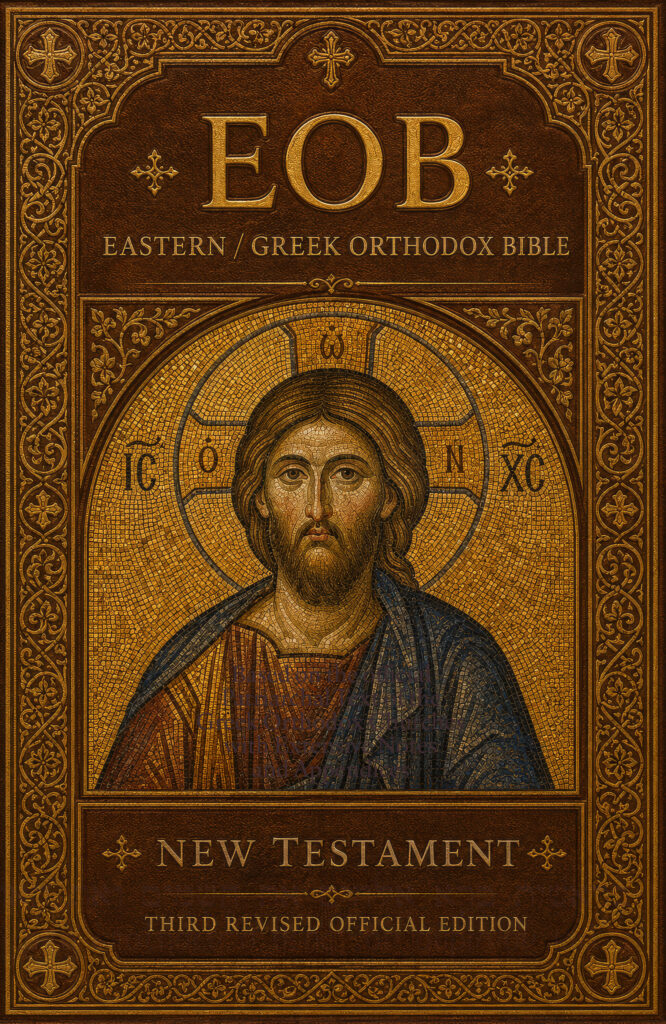
EOB: Official Site of the Eastern / Greek Orthodox Bible (Old and New Testament)
EOB (Eastern / Greek Orthodox Bible):
EOB Footnote:
KJV (King James Version):
WEB (World English Bible):
Benton LXX (Vaticanus):
Douai-Rheims (Vulgate):
Apostoliki Diakonia (LXX):
YLT (Young Literal Translation )(MT):
BBE (Bible in Basic English):
EOB Commentary:
Commentary on Genesis 1:13
The Third Day Completed
The conclusion of the third day marks a significant moment in the creation narrative, as it is the first day on which God pronounces His blessing twice—once upon the gathering of waters and appearance of dry land, and once upon the creation of vegetation. This doubling of divine approval has drawn the attention of the Church Fathers, who see in it a foreshadowing of greater mysteries.
Patristic Interpretation: Saint Basil the Great, in his Hexaemeron, notes that the third day holds particular significance because it witnesses the earth bringing forth life for the first time. The land, previously barren and covered by waters, now becomes fruitful through the divine command. Basil sees this as an image of the soul that, when separated from the chaotic waters of sin and passion, becomes capable of bearing spiritual fruit.
Christological Significance: The Fathers of the Church have long connected the third day with the Resurrection of our Lord Jesus Christ. Just as the earth emerged from the waters on the third day and brought forth life, so Christ emerged from the tomb on the third day, bringing forth the fruit of immortality for all humanity. Saint Augustine and other patristic writers draw this parallel explicitly, seeing in the creation account a prophetic type of the paschal mystery.
The vegetation that springs forth—bearing seed according to its kind—also prefigures the Church, which through the seed of the Gospel brings forth spiritual children in every generation. Christ Himself used the imagery of seeds and growth extensively in His parables, connecting the natural order established on this day with the Kingdom of Heaven.
Liturgical Connections: In Orthodox hymnography, particularly during the Paschal season, we hear echoes of this creation theology. The Church sings of Christ as the one who renews creation, and the imagery of new life springing forth permeates the services of Pascha. The blessing of fruits and vegetables on the Feast of the Transfiguration also connects to this day of creation, acknowledging God as the source of all earthly abundance.
Spiritual Application: For the Orthodox Christian, the third day reminds us that God brings order from chaos and life from barrenness. The earth’s obedience to the divine command serves as a model for the human soul. When we submit to God’s word, we too become capable of bearing fruit—the fruit of the Spirit enumerated by the Apostle Paul. The evening and morning that bracket this day remind us that spiritual growth often emerges from periods of darkness and struggle, culminating in the light of divine grace.
The Book of Leviticus receives its English title from the Latin Vulgate, which is derived from the Greek Septuagint (LXX) title Leuitikon (Λευιτικόν), meaning “Levitical” or “pertaining to the Levites.”

The Book of Exodus receives its English title from the Greek Septuagint (LXX), where it is called Exodos (Ἔξοδος), meaning “departure” or “exit.” This name was chosen because the central

I. Date and Authorship Holy Tradition of the Orthodox Church, affirmed by the Fathers and the liturgical usage of the Church from the earliest centuries, attributes the Book of Genesis

Does Hebrews 11 on the Maccabees Show Stronger Alignment with 4 Maccabees than 2 Maccabees? Hebrews 11 (the famous “Hall of Faith” chapter) does not explicitly mention the Maccabees by