Introduction to the book of Leviticus
The Book of Leviticus receives its English title from the Latin Vulgate, which is derived from the Greek Septuagint (LXX) title Leuitikon (Λευιτικόν), meaning “Levitical” or “pertaining to the Levites.”
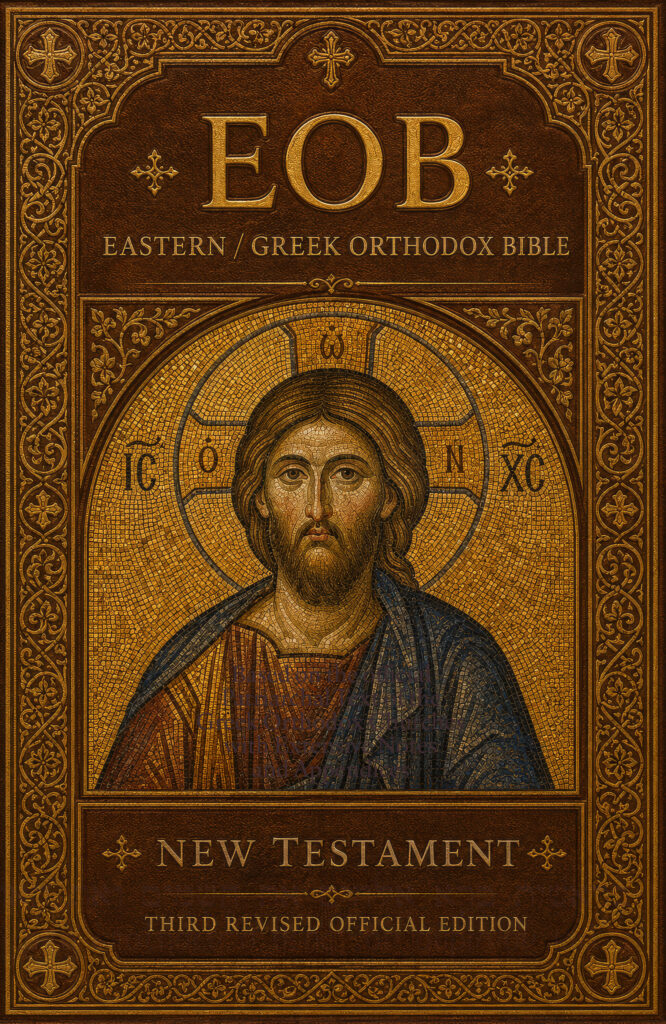
EOB: Official Site of the Eastern / Greek Orthodox Bible (Old and New Testament)
EOB (Eastern / Greek Orthodox Bible):
EOB Footnote:
KJV (King James Version):
WEB (World English Bible):
Benton LXX (Vaticanus):
Douai-Rheims (Vulgate):
Apostoliki Diakonia (LXX):
YLT (Young Literal Translation )(MT):
BBE (Bible in Basic English):
EOB Commentary:
Genesis 1:18 Commentary
The Dominion of Light Over Darkness
This verse completes the account of the fourth day by emphasizing the purpose of the luminaries: to rule over day and night and to separate light from darkness. The Fathers saw in this governance a profound spiritual principle that finds its ultimate fulfillment in Christ.
Christological Significance
The ruling function of the sun and moon over temporal cycles prefigures the eternal reign of Christ, whom the Church confesses as the Sun of Righteousness (Malachi 4:2). Saint Ambrose of Milan notes that just as the sun governs the day by its presence, so Christ governs the Church and illumines the faithful with His divine light. The separation of light from darkness accomplished by these heavenly bodies anticipates the definitive separation Christ brings between the kingdom of light and the dominion of sin.
Saint Basil the Great, in his Hexaemeron, observes that the luminaries exercise their rule not by force but by their very nature—they govern simply by being what they are. This reflects how Christ rules His Church not through coercion but through the radiance of His divine love and truth. The faithful are drawn to Him as creation is ordered by the celestial lights.
Patristic Interpretation
The phrase “God saw that it was good” affirms the inherent goodness of creation’s ordering. Saint John Chrysostom emphasizes that the luminaries serve humanity, demonstrating God’s providential care. Their rule over time itself—marking days, seasons, and years—reveals the Creator’s wisdom in establishing order from the primordial chaos.
Liturgical Connections
The theme of light ruling over darkness permeates Orthodox worship. The evening service of Vespers begins with the chanting of Psalm 103, which praises God who “made the moon to mark the seasons” and whose “sun knows its time for setting.” The hymn “O Gladsome Light” (Phos Hilaron), sung at the lighting of the evening lamps, celebrates Christ as the true light that never sets, transcending the created luminaries that rule only temporarily.
During Pascha, the Church proclaims Christ’s victory over the darkness of death. The Paschal light spreading through the darkened church dramatically enacts the cosmic truth that light has definitively conquered darkness—a truth prefigured in the fourth day of creation.
Spiritual Application
For the Orthodox Christian, this verse reminds us that we are called to live under the governance of divine light. As the luminaries faithfully fulfill their appointed role in separating light from darkness, so believers are called to discern between good and evil, walking as children of light (Ephesians 5:8). The regular cycles of day and night established here also sanctify the rhythm of prayer that marks monastic and parish life, orienting all time toward its Creator.
The Book of Leviticus receives its English title from the Latin Vulgate, which is derived from the Greek Septuagint (LXX) title Leuitikon (Λευιτικόν), meaning “Levitical” or “pertaining to the Levites.”

The Book of Exodus receives its English title from the Greek Septuagint (LXX), where it is called Exodos (Ἔξοδος), meaning “departure” or “exit.” This name was chosen because the central

I. Date and Authorship Holy Tradition of the Orthodox Church, affirmed by the Fathers and the liturgical usage of the Church from the earliest centuries, attributes the Book of Genesis

Does Hebrews 11 on the Maccabees Show Stronger Alignment with 4 Maccabees than 2 Maccabees? Hebrews 11 (the famous “Hall of Faith” chapter) does not explicitly mention the Maccabees by