EOB: Official Site of the Eastern / Greek Orthodox Bible (Old and New Testament)

Genesis 1:20

EOB (Eastern / Greek Orthodox Bible):

God said, “Let the waters bring forth swarms of living creatures, and let birds fly above the earth across the expanse of the heavens.”

EOB Footnote:

The MT includes the phrase “living creatures” (nephesh chayyah) which the LXX renders with a single term for “living souls” (psychas zoon) — the semantic range is equivalent, though the Hebrew construction is more emphatic. The MT specifies “birds that fly” with a verbal construction emphasizing continuous flight, while the LXX uses a participial phrase “winged creatures flying.” The MT phrase “upon the face of the expanse of heaven” is rendered more concisely in the LXX as “across the firmament of heaven.” The Hebrew “swarm” or “teem” (sharats) is rendered in Greek with a term meaning “bring forth” — a meaning-based choice was made to convey the sense of abundant production rather than the more literal “swarm with swarming things.”

Other Translations:

KJV (King James Version):

And God said, Let the waters bring forth abundantly the moving creature that hath life, and fowl that may fly above the earth in the open firmament of heaven.

WEB (World English Bible):

God said, “Let the waters abound with living creatures, and let birds fly above the earth in the open expanse of sky.”

Benton LXX (Vaticanus):

And God said, Let the waters bring forth reptiles having life, and winged creatures flying above the earth in the open firmament of heaven.

Douai-Rheims (Vulgate):

“Let the waters bring forth the creeping creature having life, and the fowl that may fly over the earth under the firmament of heaven.”

Apostoliki Diakonia (LXX):

And God said, “Let the waters bring forth swarms of living creatures, and let birds fly above the earth across the expanse of the heavens.”

YLT (Young Literal Translation )(MT):

And God said, “Let the waters teem with living creatures, and let birds fly above the earth across the expanse of the sky.”

BBE (Bible in Basic English):

Let the waters be full of living things, and let birds be in flight over the earth under the arch of heaven.

EOB COMMENTARY:

EOB Commentary:

THE FIFTH DAY BEGINS: THE WATERS BRING FORTH LIFE

With this verse, we enter the fifth day of creation, marking a profound transition from the ordering of inanimate creation to the emergence of living souls (nephesh chayyah). The command for the waters to bring forth “swarms of living creatures” and for birds to fly across the firmament represents the first appearance of animate life endowed with soul.

Patristic Interpretation: Saint Basil the Great, in his Hexaemeron, marvels at the abundance implied in the Hebrew word for “swarms” (sherets), noting that God’s creative word produces not scarcity but overwhelming abundance. The waters, which had been gathered and bounded on the third day, now become a womb of life at the divine command. Saint Ambrose similarly observes that the waters, having been blessed by the hovering Spirit in verse 2, now bring forth their fruit in obedience to the Creator’s voice.

Christological Significance: The Church Fathers perceived in the waters bringing forth life a prefiguration of baptismal regeneration. Just as the primordial waters produced living creatures at God’s command, so the baptismal waters bring forth new creatures in Christ. Saint Cyril of Jerusalem draws this connection explicitly, teaching that as the waters first received the grace to generate life, so in baptism they receive grace to regenerate souls. The birds flying in the open firmament have been understood as symbols of souls ascending toward heaven, freed from earthly bondage through the waters of rebirth.

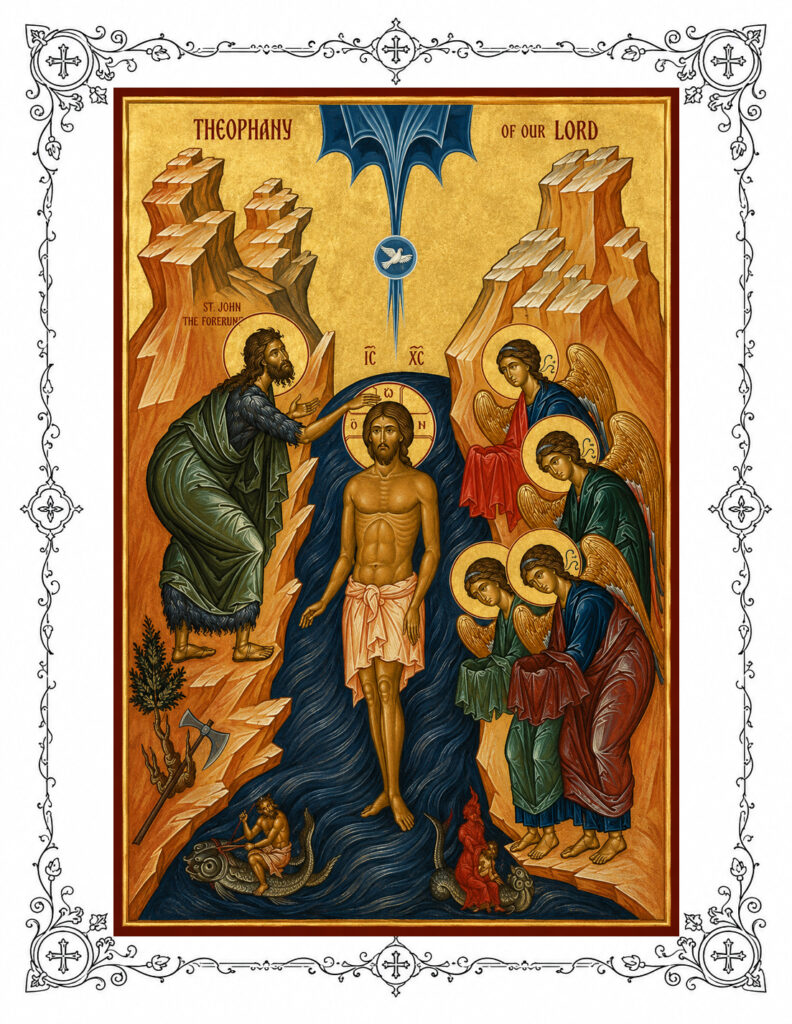
Liturgical Connections: The blessing of waters at Theophany echoes this creative moment. The priest prays that the waters might receive sanctifying grace, recalling their primordial blessing. The troparion of Theophany speaks of the Lord appearing in the Jordan, and the entire cosmos being illumined—a renewal of the original creative blessing upon the waters.

Spiritual Meaning: For Orthodox spirituality, this verse speaks to the soul’s capacity for life when touched by God’s word. As the waters remained barren until commanded to bring forth, so the human heart remains spiritually lifeless until quickened by divine grace. The variety and abundance of creatures emerging from the waters testifies to God’s inexhaustible creativity and generosity—themes central to Orthodox doxology and thanksgiving.

The mention of birds alongside sea creatures unites the depths and the heights in a single creative act, suggesting the cosmic scope of God’s life-giving power, which reaches from the abyss to the heavens. This universal scope finds its fulfillment in Christ, through whom all things were made and in whom all creation finds its true life.

Introduction to the book of Leviticus

The Book of Leviticus receives its English title from the Latin Vulgate, which is derived from the Greek Septuagint (LXX) title Leuitikon (Λευιτικόν), meaning “Levitical” or “pertaining to the Levites.”

Read More »

Introduction to the book of Exodus

The Book of Exodus receives its English title from the Greek Septuagint (LXX), where it is called Exodos (Ἔξοδος), meaning “departure” or “exit.” This name was chosen because the central

Read More »