Introduction to the book of Leviticus
The Book of Leviticus receives its English title from the Latin Vulgate, which is derived from the Greek Septuagint (LXX) title Leuitikon (Λευιτικόν), meaning “Levitical” or “pertaining to the Levites.”
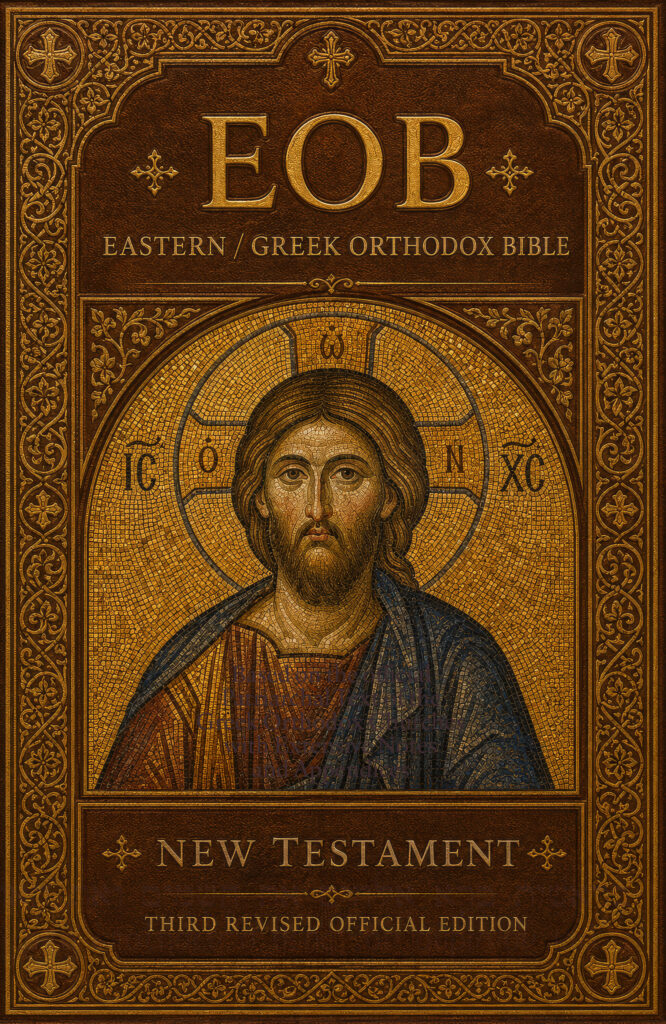
EOB: Official Site of the Eastern / Greek Orthodox Bible (Old and New Testament)
EOB (Eastern / Greek Orthodox Bible):
EOB Footnote:
KJV (King James Version):
WEB (World English Bible):
Benton LXX (Vaticanus):
Douai-Rheims (Vulgate):
Apostoliki Diakonia (LXX):
YLT (Young Literal Translation )(MT):
BBE (Bible in Basic English):
EOB Commentary:
Genesis 2:3 – Commentary
The Sanctification of the Seventh Day
This verse establishes the foundational theology of sacred time within creation. God’s blessing and sanctification of the seventh day reveals that holiness is not merely a moral category but a cosmic reality woven into the very fabric of existence. The Hebrew qadash, rendered as “sanctified” or “made holy,” indicates a setting apart for divine purpose—the same term later applied to the Temple, the priesthood, and the people of Israel.
Christological Significance: The Church Fathers understood this primordial rest as pointing toward the ultimate Sabbath rest accomplished in Christ. Saint Basil the Great teaches that the seventh day prefigures the age to come, the eternal eighth day inaugurated by Christ’s Resurrection. Our Lord’s declaration that “the Son of Man is Lord of the Sabbath” (Matthew 12:8) reveals His divine authority over this sacred institution. Christ’s rest in the tomb on Holy Saturday fulfills the original Sabbath, as God who labored in creation now rests from the labor of redemption.
Patristic Interpretation: Saint Augustine saw in this rest not divine fatigue but the completion of perfect work. Saint Gregory of Nyssa emphasized that God’s rest invites humanity into participation in divine life—theosis itself being the true Sabbath rest. Saint John Chrysostom noted that God blessed this day for our sake, establishing a rhythm of work and worship that orders human life toward its Creator.
Liturgical Connections: The Orthodox Church preserves this theology in her weekly cycle. Saturday (Sabbaton) retains its character as a day commemorating both creation’s completion and Christ’s Sabbath rest in the tomb. The resurrection services move from Saturday evening into Sunday, the eighth day, demonstrating how the old Sabbath finds its fulfillment in Pascha. The Vespers hymns frequently reference God’s rest and the new creation accomplished in Christ.
Spiritual Application: For Orthodox spirituality, this verse grounds the ascetical rhythm of labor and rest, fasting and feasting. The Sabbath principle teaches that human activity finds its meaning not in endless production but in contemplative return to God. Saint Maximus the Confessor developed this into his understanding of the cosmic liturgy—all creation moving through its proper activity toward rest in God.
The cessation from work (shabat) also prefigures the eschatological rest promised to the faithful. The Epistle to the Hebrews (4:9-10) explicitly connects this Genesis rest to the salvation rest awaiting God’s people, urging believers to strive to enter that rest through faith and obedience.
The Book of Leviticus receives its English title from the Latin Vulgate, which is derived from the Greek Septuagint (LXX) title Leuitikon (Λευιτικόν), meaning “Levitical” or “pertaining to the Levites.”

The Book of Exodus receives its English title from the Greek Septuagint (LXX), where it is called Exodos (Ἔξοδος), meaning “departure” or “exit.” This name was chosen because the central

I. Date and Authorship Holy Tradition of the Orthodox Church, affirmed by the Fathers and the liturgical usage of the Church from the earliest centuries, attributes the Book of Genesis

Does Hebrews 11 on the Maccabees Show Stronger Alignment with 4 Maccabees than 2 Maccabees? Hebrews 11 (the famous “Hall of Faith” chapter) does not explicitly mention the Maccabees by