Introduction to the book of Leviticus
The Book of Leviticus receives its English title from the Latin Vulgate, which is derived from the Greek Septuagint (LXX) title Leuitikon (Λευιτικόν), meaning “Levitical” or “pertaining to the Levites.”
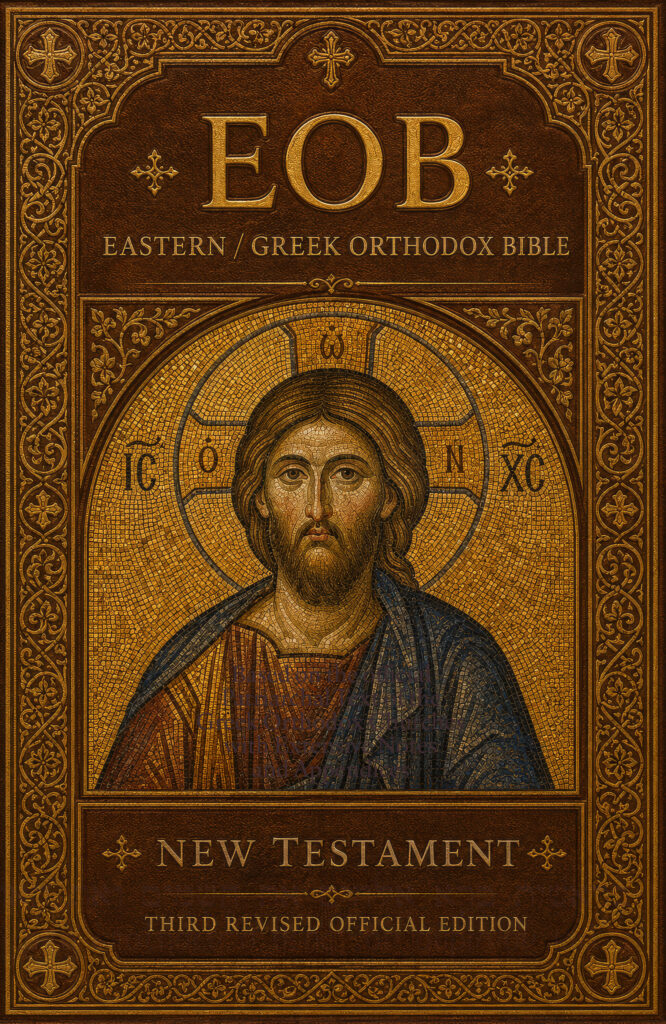
EOB: Official Site of the Eastern / Greek Orthodox Bible (Old and New Testament)
EOB (Eastern / Greek Orthodox Bible):
EOB Footnote:
KJV (King James Version):
WEB (World English Bible):
Benton LXX (Vaticanus):
Douai-Rheims (Vulgate):
Apostoliki Diakonia (LXX):
YLT (Young Literal Translation )(MT):
BBE (Bible in Basic English):
EOB Commentary:
Commentary on Genesis 2:4
This verse serves as a pivotal hinge in the Genesis narrative, transitioning from the cosmic account of creation to the intimate formation of humanity. The phrase “these are the generations” (toledot in Hebrew) introduces a pattern that structures the entire book of Genesis, but here it uniquely applies to heaven and earth themselves, suggesting that creation has a history, a story that unfolds under divine providence.
Patristic Interpretation: The Church Fathers noted with great interest the shift in divine names at this point. Saint John Chrysostom observed that the combination “LORD God” (Kyrios ho Theos) reveals both the transcendent majesty and intimate involvement of the Creator with His creation. This dual naming anticipates the full revelation of God as both wholly other and deeply personal, culminating in the Incarnation.
Saint Ephrem the Syrian understood this verse as marking the beginning of a more detailed account focused on humanity’s special place in creation. The Fathers consistently read this transition as emphasizing that while all creation declares God’s glory, human beings are the crown and purpose of the created order.
Christological Significance: Orthodox theology sees in this verse a preparation for understanding Christ as the New Adam. Just as this passage introduces the detailed account of the first Adam’s formation, it points forward to the “new creation” inaugurated by Christ. The Apostle Paul’s teaching that believers are a “new creation” in Christ (2 Corinthians 5:17) finds its foundation in the original creative work described here. The Lord who formed the first human from the earth is the same Lord who takes on human flesh to restore and elevate that creation.
Liturgical Connections: This passage is read during the Vespers of Great and Holy Saturday, when the Church commemorates Christ’s descent into Hades and the renewal of all creation. The connection between the original creation and the new creation accomplished through Christ’s death and resurrection is thus liturgically affirmed. The faithful hear again of God’s creative work precisely as they await the celebration of the ultimate creative act: the resurrection of the dead.
Spiritual Application: For Orthodox spirituality, this verse reminds us that we exist within a story authored by God. The phrase “in the day that the LORD God made” emphasizes divine initiative and sovereignty. Our lives are not random occurrences but part of the ongoing toledot, the generations of heaven and earth, which find their fulfillment in the Kingdom of God. This awareness cultivates the virtue of wonder and thanksgiving that characterizes authentic Orthodox piety.
The Book of Leviticus receives its English title from the Latin Vulgate, which is derived from the Greek Septuagint (LXX) title Leuitikon (Λευιτικόν), meaning “Levitical” or “pertaining to the Levites.”

The Book of Exodus receives its English title from the Greek Septuagint (LXX), where it is called Exodos (Ἔξοδος), meaning “departure” or “exit.” This name was chosen because the central

I. Date and Authorship Holy Tradition of the Orthodox Church, affirmed by the Fathers and the liturgical usage of the Church from the earliest centuries, attributes the Book of Genesis

Does Hebrews 11 on the Maccabees Show Stronger Alignment with 4 Maccabees than 2 Maccabees? Hebrews 11 (the famous “Hall of Faith” chapter) does not explicitly mention the Maccabees by