EOB: Official Site of the Eastern / Greek Orthodox Bible (Old and New Testament)

Genesis 2:8

EOB (Eastern / Greek Orthodox Bible):

The LORD God planted a garden in Eden, towards the east, and placed the man he had formed there.

EOB Footnote:

The MT reads “garden in Eden, in the east” while the LXX reads “garden in Eden in the east” with essentially the same meaning, though the Hebrew word order places “in the east” (miqqedem) in a position that could also be translated “from the beginning” or “of old.” Some interpreters understand the Hebrew to mean God planted the garden “long ago” rather than “eastward,” but the LXX clearly takes it as a directional reference. The MT includes “the man whom he had formed” at the end, which the LXX also preserves, showing agreement on this point.

Other Translations:

KJV (King James Version):

And the Lord God planted a garden eastward in Eden; and there he put the man whom he had formed.

WEB (World English Bible):

The Lord God planted a garden eastward, in Eden, and there he put the man whom he had formed.

Benton LXX (Vaticanus):

And God planted a garden eastward in Edem, and placed there the man whom he had formed.

Douai-Rheims (Vulgate):

And the Lord God had planted a paradise of pleasure from the beginning: wherein he placed man whom he had formed.

Apostoliki Diakonia (LXX):

The Lord God planted a paradise in Eden, in the east, and there He placed the man whom He had formed.

YLT (Young Literal Translation )(MT):

And Jehovah God planted a garden in Eden, at the east, and He put there the man whom He had formed.

BBE (Bible in Basic English):

And the Lord God made a garden in the east, in Eden; and there he put the man whom he had made.

EOB COMMENTARY:

EOB Commentary:

Genesis 2:8 – Commentary

The Planting of Paradise

This verse marks a pivotal moment in the creation narrative, as God personally plants a garden—paradeisos in the Septuagint—and places the newly formed man within it. The term paradeisos, borrowed from Persian, denotes an enclosed royal garden or park, suggesting both beauty and divine sovereignty. This garden in Eden becomes the primordial sanctuary, the place of communion between God and humanity.

Christological Significance

The Fathers consistently read this passage through the lens of Christ’s redemptive work. Saint Ephrem the Syrian and other patristic writers understood that what was lost in the first paradise would be restored through the Second Adam. When Christ tells the repentant thief, “Today you will be with me in Paradise” (Luke 23:43), He reopens the gates that were closed when Adam was expelled. The garden planted “eastward” anticipates the orientation of Christian worship, as the faithful pray facing east, awaiting the return of Christ who comes as the Sun of Righteousness from the east.

Saint John of Damascus teaches that paradise was both physical and spiritual, a place where Adam could perceive God and commune with Him directly. This understanding shapes Orthodox anthropology—humanity was created for theosis, for participation in divine life, and paradise represents this original calling.

Liturgical Connections

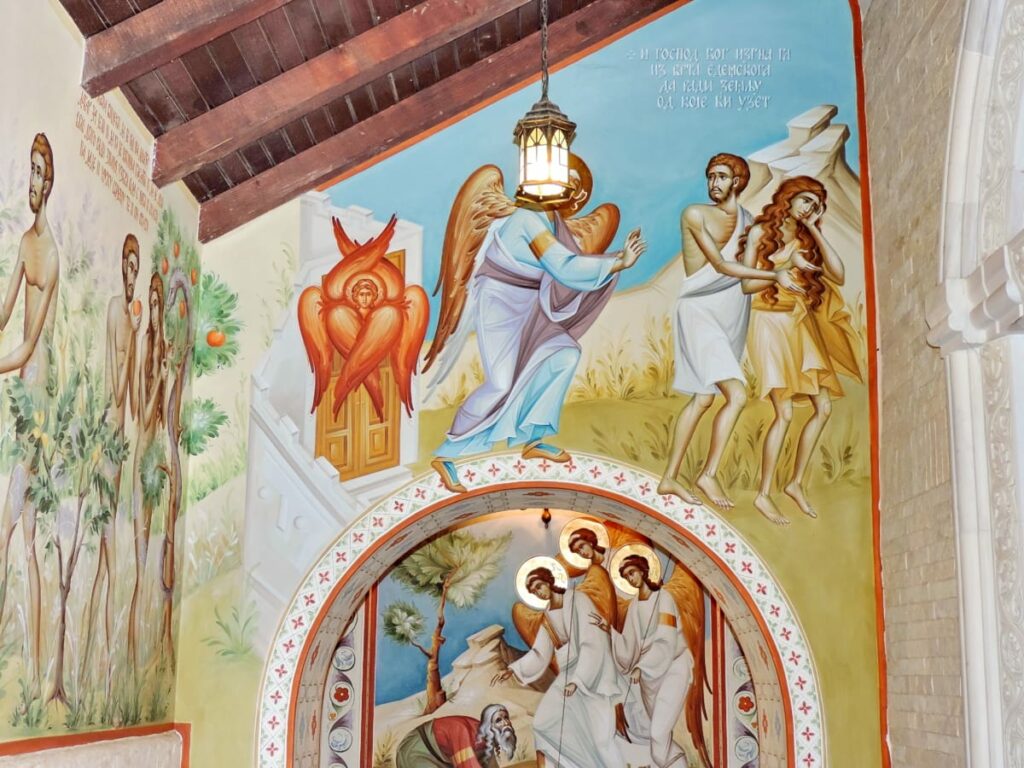
The hymnography of the Orthodox Church frequently invokes the imagery of paradise. During the Sunday of Forgiveness (Cheesefare Sunday), the Church chants of Adam’s lament at being expelled from paradise, making this verse’s significance deeply felt in the liturgical cycle. The entire Lenten journey becomes a return to paradise, culminating in Pascha when Christ descends to Hades and leads Adam and Eve back to their original home.

The placement of man in the garden also prefigures baptism, where the newly illumined Christian is clothed in white garments and enters the Church—the new paradise. Saint Cyril of Jerusalem explicitly connects baptismal regeneration with the restoration of paradise.

Patristic Wisdom

Saint Theophilus of Antioch emphasizes that God Himself planted this garden, indicating its sacred character. Saint Ambrose of Milan sees in the eastward location a symbol of the light of divine wisdom, contrasting with the darkness of sin that would later enter through disobedience.

The verse reminds Orthodox Christians that humanity’s true home is in God’s presence, and that the entire economy of salvation—from Incarnation through the Eucharist to the final restoration—aims at returning us to that blessed communion first established in the garden planted by God’s own hand.

Introduction to the book of Leviticus

The Book of Leviticus receives its English title from the Latin Vulgate, which is derived from the Greek Septuagint (LXX) title Leuitikon (Λευιτικόν), meaning “Levitical” or “pertaining to the Levites.”

Read More »

Introduction to the book of Exodus

The Book of Exodus receives its English title from the Greek Septuagint (LXX), where it is called Exodos (Ἔξοδος), meaning “departure” or “exit.” This name was chosen because the central

Read More »