THE TWO TREES AND THE MYSTERY OF LIFE
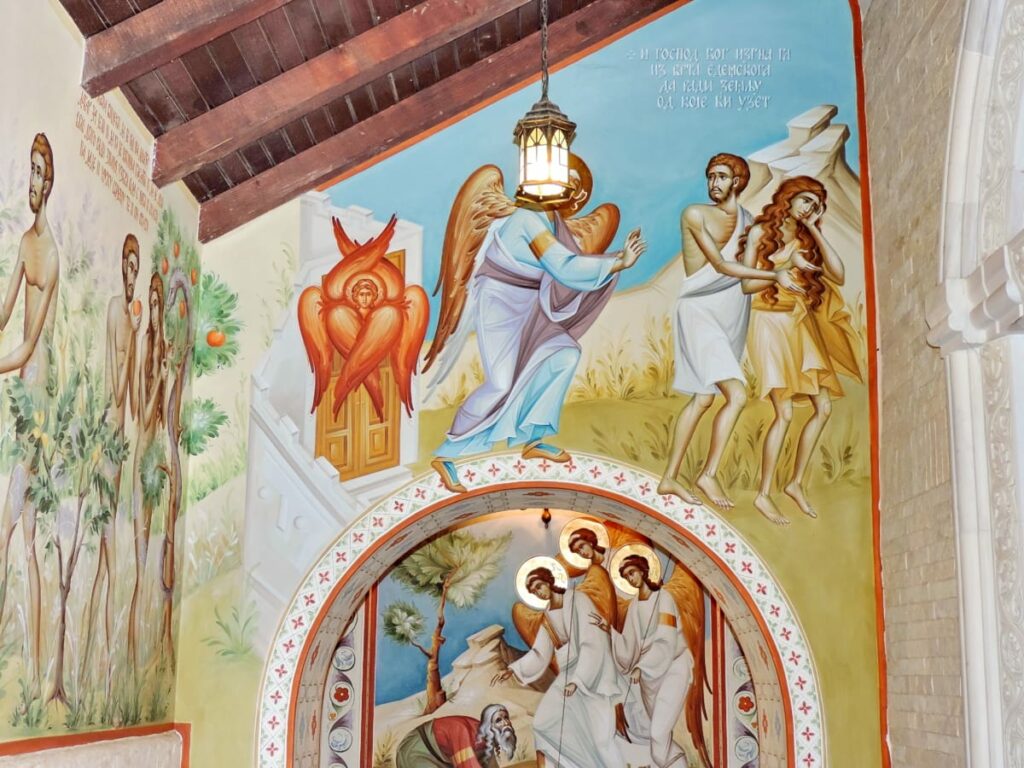
This verse stands as one of the most theologically significant in all of Scripture, introducing the two trees that frame the entire biblical narrative: the Tree of Life and the Tree of the Knowledge of Good and Evil. The Fathers understood these trees not merely as botanical realities but as profound symbols of humanity’s relationship with God.
PATRISTIC INTERPRETATION
St. Ephrem the Syrian teaches that the Tree of Life stood at the center of Paradise as a boundary marker, indicating that Adam was to progress toward it through obedience and spiritual maturation. The tree was not forbidden but was to be attained through the proper path of communion with God. St. John of Damascus similarly understood the Tree of Life as representing theosis itself—the divine life that God intended humanity to share eternally.
St. Gregory the Theologian interprets the Tree of Knowledge as representing contemplation that was premature for humanity’s spiritual infancy. The knowledge itself was not evil, but grasping it before the proper time through disobedience brought death rather than illumination.
CHRISTOLOGICAL FULFILLMENT
The Tree of Life finds its ultimate fulfillment in the Cross of Christ. The liturgical tradition of the Orthodox Church explicitly identifies the Cross as the new Tree of Life. In the hymns of the Exaltation of the Holy Cross, we sing that the wood which brought death in Paradise now becomes the wood that grants life to the world. Christ Himself becomes the fruit of this tree, offering His Body and Blood as true food and true drink.
The Book of Revelation completes this typology, placing the Tree of Life in the heavenly Jerusalem, its leaves for the healing of the nations. What was lost through Adam’s transgression is restored and surpassed through Christ’s redemption.
LITURGICAL CONNECTIONS
During the Vespers of Holy Friday, the Church sings of how Adam was expelled from Paradise through the tree, and through the Tree of the Cross, the thief entered Paradise. This liturgical theology demonstrates how the Church reads Genesis 2:9 through the lens of Pascha.
The Feast of the Exaltation celebrates the Cross as the life-giving tree planted in the midst of the earth, echoing the tree planted in the midst of the garden. Orthodox hymnography consistently draws this parallel, showing that salvation history moves from garden to garden, from tree to tree.
SPIRITUAL APPLICATION
For the Orthodox spiritual life, this verse reminds us that eternal life remains God’s intention for humanity. The path to the Tree of Life, closed by the cherubim’s flaming sword, has been reopened through Baptism and the Eucharist. We who partake of Christ’s Body and Blood truly eat from the Tree of Life, receiving the medicine of immortality, as St. Ignatius of Antioch teaches.