The Land of Havilah and the River Pishon
This verse begins the geographical description of the four rivers flowing from Eden, with Pishon being the first mentioned as encompassing the land of Havilah. While this passage primarily serves as ancient geographical notation, the Fathers found spiritual significance in these details that extends beyond mere cartography.
Patristic Interpretation
St. Ephrem the Syrian understood the rivers of Paradise as representing the spread of divine grace throughout the world. The river that “compasses” or encircles a land suggests the encompassing nature of God’s providential care. St. Ambrose of Milan interpreted the four rivers allegorically as the four cardinal virtues—prudence, temperance, fortitude, and justice—flowing from the single source of wisdom in Paradise. In this reading, Pishon represents prudence, the virtue that guides all others.
St. John of Damascus, following earlier patristic tradition, acknowledged the difficulty in precisely locating these rivers geographically while affirming their real existence. This approach demonstrates the Orthodox hermeneutical principle of holding together both literal and spiritual senses of Scripture.
Typological Significance
The single river dividing into four streams prefigures the one Gospel proclaimed by four Evangelists. Just as the waters of Eden brought life to the whole earth, so the fourfold Gospel brings spiritual life to all nations. The land of Havilah, later associated with gold and precious stones (as the following verses indicate), anticipates the riches of the heavenly Jerusalem described in Revelation, where gold and precious stones adorn the city of God.
Liturgical and Spiritual Connections
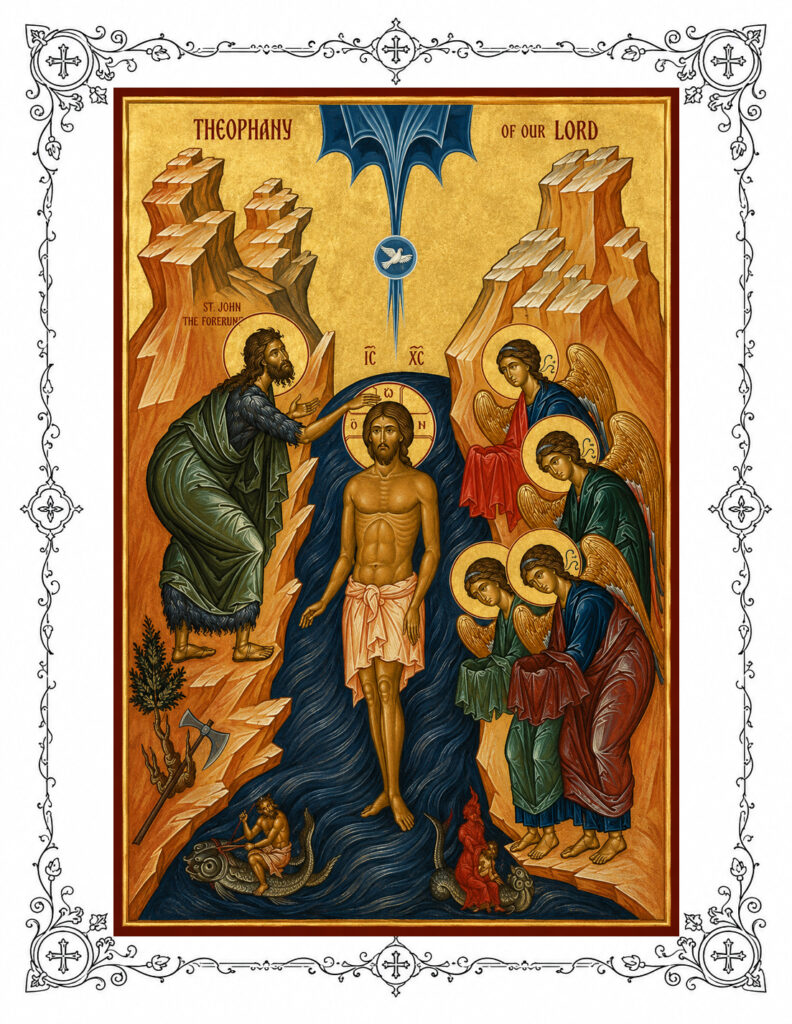
The imagery of life-giving waters flowing from a divine source appears prominently in Orthodox hymnography, particularly during Theophany. The blessing of waters recalls the primordial blessing of creation’s waters and anticipates the eschatological renewal of all things. Christ Himself becomes the true source of living water, as He declared to the Samaritan woman.
The encompassing movement of the river around the land suggests the protective and sanctifying presence of grace. Orthodox spirituality recognizes that divine grace surrounds and permeates creation, a truth liturgically expressed in the blessing of homes, fields, and waters throughout the Church year.
This verse, though seemingly obscure, reminds us that Scripture grounds salvation history in real geography while simultaneously pointing beyond itself to spiritual realities. The Orthodox reading holds these dimensions together, neither reducing the text to mere allegory nor limiting it to ancient geography alone.