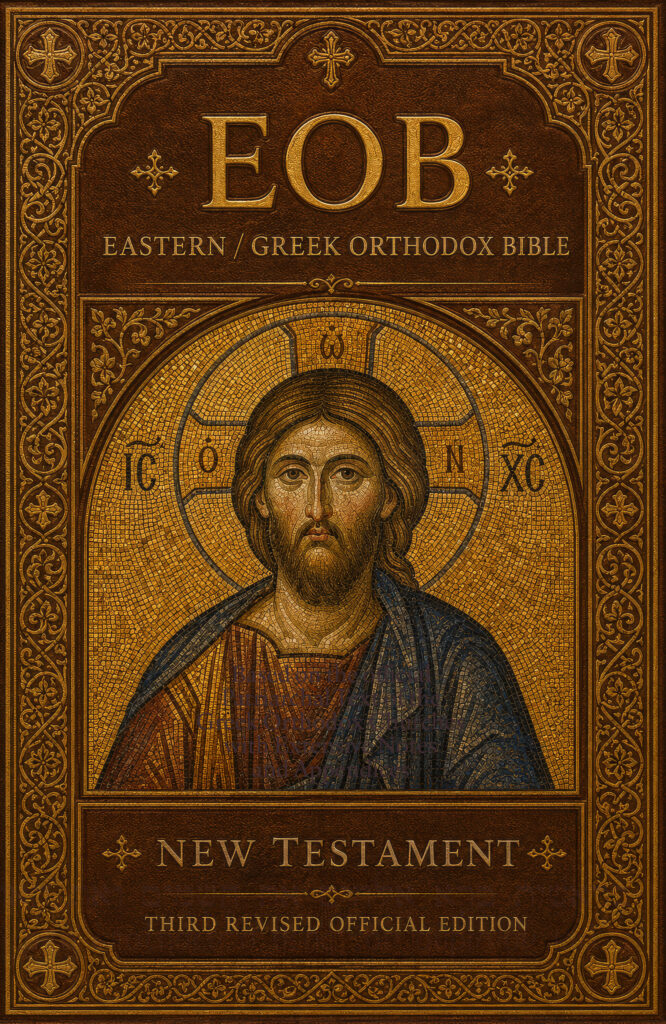
EOB: Official Site of the Eastern / Greek Orthodox Bible (Old and New Testament)

Genesis 2:16

EOB (Eastern / Greek Orthodox Bible):

“The LORD God commanded Adam, ‘You are free to eat from any tree in the garden.'”

EOB Footnote:

The MT includes the emphatic construction “from every tree of the garden you may freely eat,” using an infinitive absolute for emphasis. The LXX renders this with a standard future indicative without the emphatic doubling, though the meaning remains substantially the same.

Other Translations:

KJV (King James Version):

And the Lord God commanded the man, saying, Of every tree of the garden thou mayest freely eat:

WEB (World English Bible):

“Yahweh God commanded the man, saying, ‘You may freely eat of every tree of the garden;’”

Benton LXX (Vaticanus):

And the Lord God gave a charge to Adam, saying, Of every tree which is in the garden thou mayest freely eat.

Douai-Rheims (Vulgate):

And he commanded him, saying: Of every tree of paradise thou shalt eat.

Apostoliki Diakonia (LXX):

The Lord God commanded Adam, saying, “You may freely eat from every tree of the garden.”

YLT (Young Literal Translation )(MT):

“And Jehovah God commands the man, saying, ‘Of every tree of the garden eating thou dost eat;'”

BBE (Bible in Basic English):

And the Lord God gave the man orders, saying, You may freely take of the fruit of every tree of the garden.

EOB COMMENTARY:

EOB Commentary:

THE DIVINE COMMANDMENT AND THE GIFT OF FREEDOM

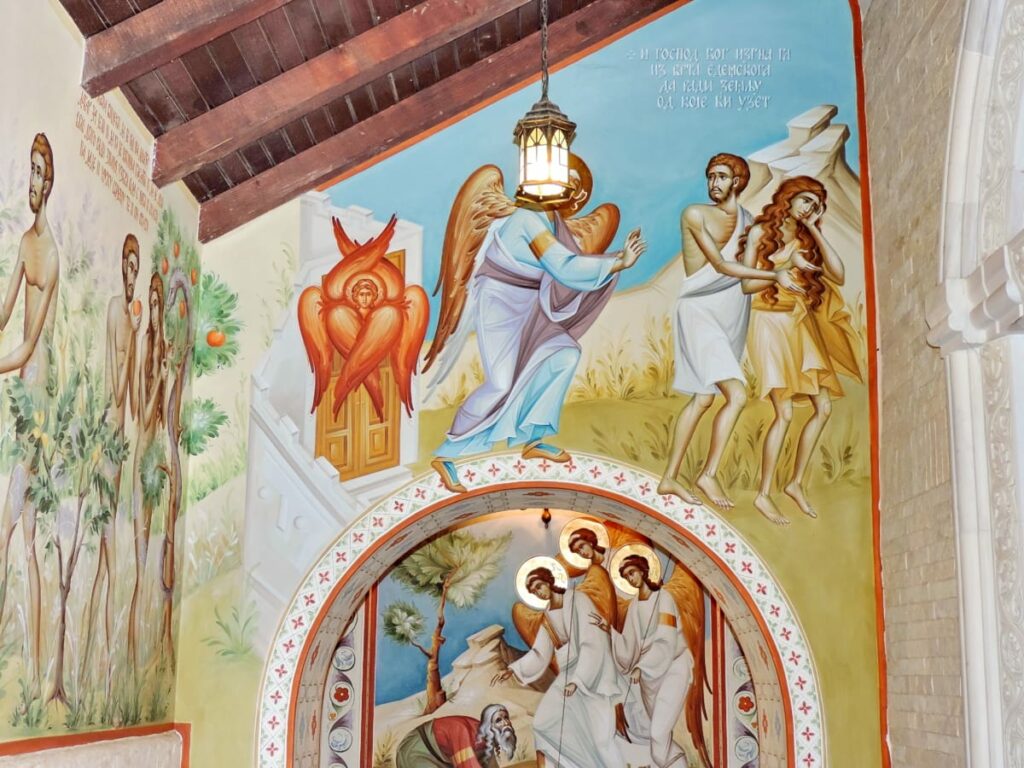
This verse marks the first direct commandment given by God to humanity, establishing the foundational relationship between Creator and creature as one of loving dialogue and moral freedom. The Lord God “commanded” (entellomai) Adam, revealing that human existence from its very inception was oriented toward obedience and communion with the divine will.

Patristic Interpretation: St. John Chrysostom emphasizes that God’s permission to eat freely from every tree demonstrates His abundant generosity and love for mankind. The commandment was not given to restrict human happiness but to provide an opportunity for the exercise of free will in loving response to God. St. Ephrem the Syrian notes that the trees of Paradise represented spiritual realities, and the freedom to eat from them signified humanity’s participation in divine blessings through grateful obedience.

St. Irenaeus of Lyon sees in this commandment the beginning of humanity’s moral education. God treated Adam not as a slave but as a son, giving him genuine freedom while also establishing boundaries that would protect and nurture his spiritual growth. The Fathers consistently teach that true freedom is not autonomy from God but rather the capacity to choose the good in communion with Him.

Christological Significance: The Church Fathers draw a profound parallel between Adam in Paradise and Christ in His earthly ministry. Where Adam received the commandment and would later transgress, Christ the New Adam fulfilled all righteousness through perfect obedience. St. Paul’s teaching that “as by one man’s disobedience many were made sinners, so by one man’s obedience many will be made righteous” (Romans 5:19) finds its foundation in this original commandment.

Liturgical and Spiritual Themes: The hymnography of Great Lent and the Sunday of Forgiveness frequently references Adam’s original state in Paradise and the commandment he received. The Lenten Triodion speaks of Adam’s fall from the “delight of Paradise” precisely because he failed to keep the divine commandment. Orthodox fasting discipline itself echoes this primordial commandment concerning food, teaching believers that salvation involves the sanctification of even our most basic appetites.

The verse also establishes the Orthodox understanding that spiritual life involves both divine gift and human response. God freely gives (“you may freely eat”), yet He also commands. This synergy between grace and human cooperation remains central to Orthodox soteriology. The commandment was given not to burden humanity but to elevate it, offering the possibility of growth in virtue through the exercise of obedient love.

Introduction to the book of Leviticus

The Book of Leviticus receives its English title from the Latin Vulgate, which is derived from the Greek Septuagint (LXX) title Leuitikon (Λευιτικόν), meaning “Levitical” or “pertaining to the Levites.”

Read More »

Introduction to the book of Exodus

The Book of Exodus receives its English title from the Greek Septuagint (LXX), where it is called Exodos (Ἔξοδος), meaning “departure” or “exit.” This name was chosen because the central

Read More »