Genesis 2:24
The Mystery of Union
This verse stands as one of the most theologically significant statements in all of Scripture, establishing the foundational understanding of marriage that reverberates throughout both Testaments and into the heart of Orthodox sacramental theology.
Christological and Ecclesiological Significance
The Apostle Paul directly quotes this passage in Ephesians 5:31-32, declaring it to be a great mysterion—a mystery referring to Christ and the Church. This apostolic interpretation elevates the verse far beyond a mere social institution. The leaving of father and mother, the cleaving to one’s wife, and the becoming of one flesh prophetically images the Incarnation itself, wherein the eternal Son left His Father’s heavenly dwelling to unite Himself inseparably to human nature. Saint John Chrysostom elaborates that just as Eve was taken from Adam’s side, so the Church was born from the side of Christ on the Cross, from the water and blood that flowed forth.
Patristic Interpretation
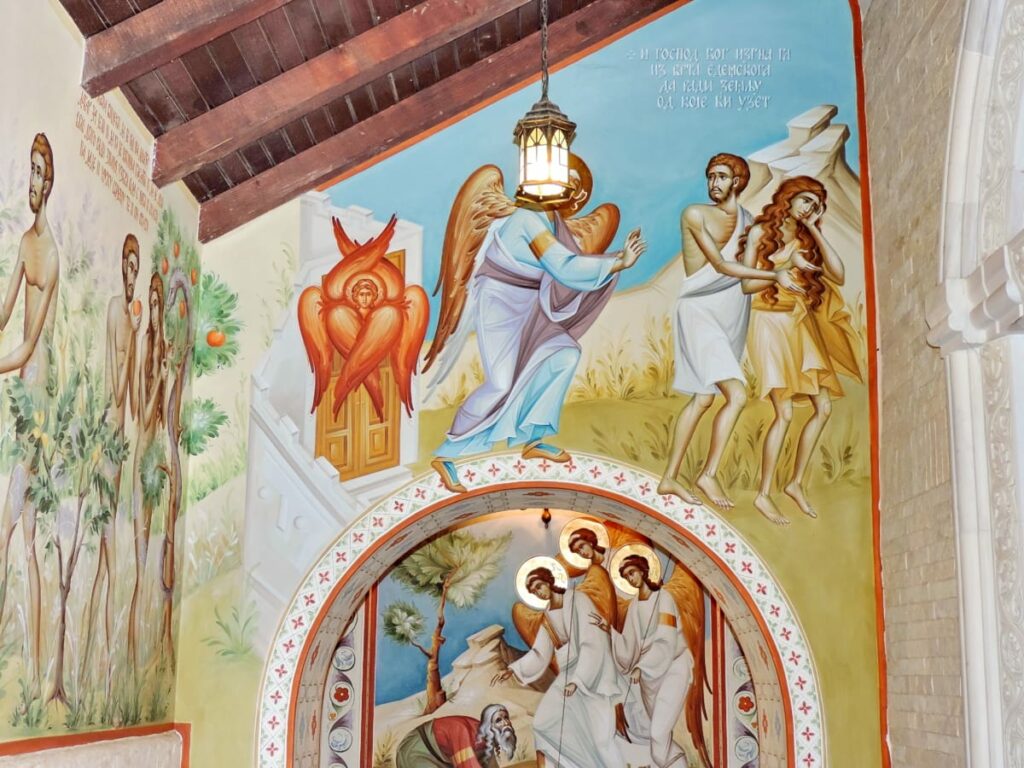
The Fathers consistently read this verse typologically. Saint Methodius of Olympus sees in the deep sleep of Adam a figure of Christ’s death, and in the formation of Eve from his side, the birth of the Church. Saint Augustine emphasizes that the two becoming one flesh points toward the unity that should characterize the Christian community, bound together in Christ.
Liturgical and Sacramental Dimensions
In the Orthodox marriage service, this primordial union is constantly invoked. The prayers recall that God Himself joined the first man and woman, establishing marriage as a divine institution from the beginning of creation. The crowning of the bride and groom signifies their establishment as king and queen of a new domestic church, a little kingdom where the mystery of Christ and the Church is to be lived out daily.
The phrase one flesh carries profound anthropological weight in Orthodox understanding. It speaks not merely of physical union but of a complete interpenetration of lives—spiritual, emotional, and physical. This union, when blessed by God, becomes a path of theosis, wherein husband and wife together ascend toward union with God.
Ascetical Considerations
Even for those called to monasticism, this verse remains significant. The monastic leaves father and mother to cleave to Christ the Bridegroom directly, becoming one spirit with Him. Thus marriage and monasticism are understood as two paths toward the same goal: complete union with God, whether mediated through a spouse or pursued in solitary devotion.
The verse thus contains in seed form the entire Orthodox theology of personhood, communion, and salvation—the movement from isolation to union that characterizes the divine economy from creation to eschaton.