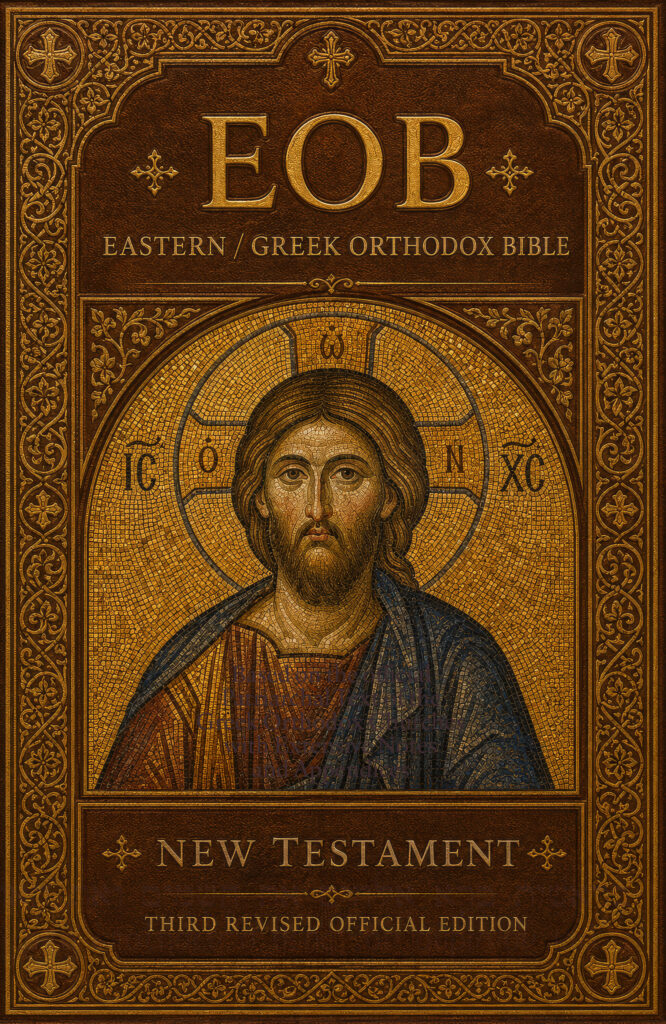
EOB: Official Site of the Eastern / Greek Orthodox Bible (Old and New Testament)

Genesis 3:3

EOB (Eastern / Greek Orthodox Bible):

Genesis 3:3 “But God said, ‘You must not eat the fruit from the tree in the middle of the garden. Do not even touch it, or you will die.'”

EOB Footnote:

The MT includes the phrase “in the middle of the garden” describing the location of the tree, which is absent from the main LXX tradition but appears in some LXX manuscripts. The phrase “lest you die” renders the Greek more literally “lest you should die,” using the subjunctive mood to express potential consequence.

Other Translations:

KJV (King James Version):

But of the fruit of the tree which is in the midst of the garden, God hath said, Ye shall not eat of it, neither shall ye touch it, lest ye die.

WEB (World English Bible):

“But of the fruit of the tree which is in the middle of the garden, God has said, ‘You shall not eat of it. You shall not touch it, lest you die.’”

Benton LXX (Vaticanus):

But of the fruit of the tree which is in the midst of the garden, God said, Ye shall not eat of it, neither shall ye touch it, lest ye die.

Douai-Rheims (Vulgate):

But of the fruit of the tree which is in the midst of paradise, God hath commanded us that we should not eat; and that we should not touch it, lest perhaps we die.

Apostoliki Diakonia (LXX):

but about the fruit of the tree that is in the middle of the garden, God said, ‘You shall not eat from it, nor shall you touch it, lest you die.’

YLT (Young Literal Translation )(MT):

“But of the fruit of the tree that is in the midst of the garden, God has said, ‘You shall not eat it, nor shall you touch it, lest you die.'”

BBE (Bible in Basic English):

But of the fruit of the tree in the middle of the garden, God has said, You are not to take it for food, or put your hand on it, or you will come to your end.

EOB COMMENTARY:

EOB Commentary:

GENESIS 3:3

The Commandment Expanded and the Seeds of Deception

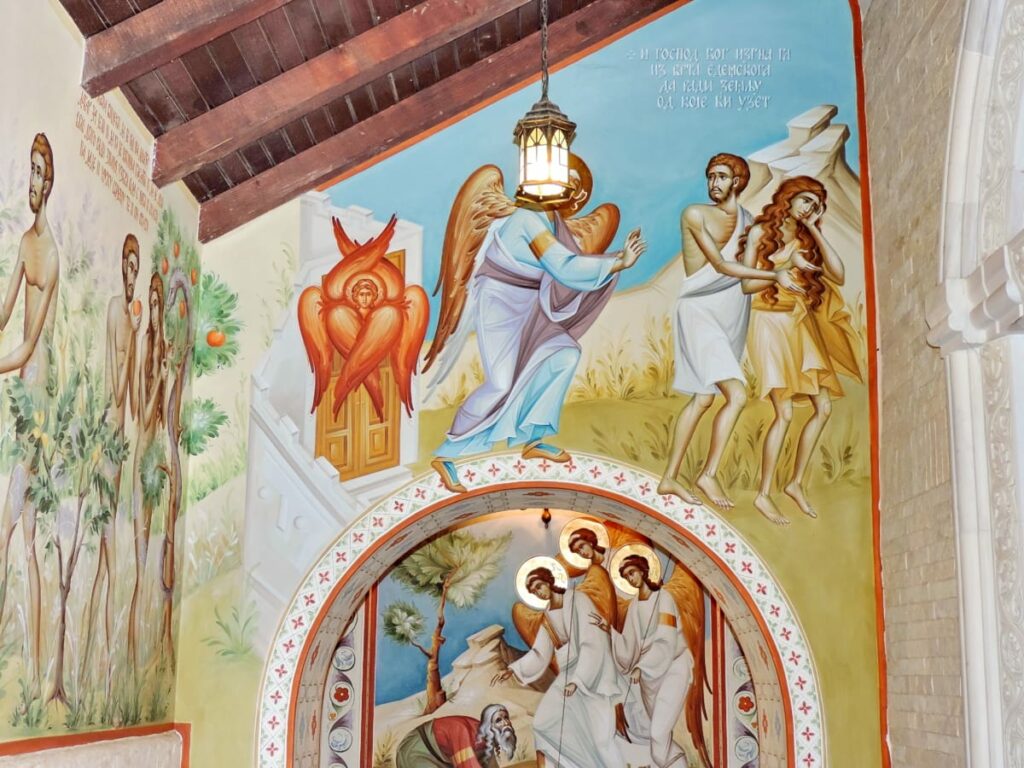
In Eve’s response to the serpent, we observe a subtle yet significant alteration of the divine commandment. God had forbidden eating from the tree of knowledge, but Eve adds “neither shall you touch it.” This expansion of the prohibition reveals the beginning of a dangerous trajectory—either an excessive scrupulosity that burdens the soul beyond what God requires, or perhaps the first stirrings of resentment toward the commandment itself.

Patristic Interpretation: Saint Ephrem the Syrian notes that Eve’s addition to God’s word demonstrates how the enemy works to distort our understanding of divine commands, making them appear more burdensome than they truly are. Saint John Chrysostom similarly observes that this embellishment shows Eve was already entertaining dialogue with the tempter rather than fleeing from him. The Fathers consistently teach that we must neither add to nor subtract from God’s commandments, for both lead to spiritual peril.

Typological Significance: The tree that Eve was forbidden to touch stands in profound contrast to the Tree of the Cross, which brings salvation precisely through contact. Where the first tree brought death through transgression, the second Tree brings life through obedience. Christ, the New Adam, embraces the wood that the first parents were commanded to avoid, transforming the instrument of the curse into the source of blessing.

Liturgical Connections: During the services of Great and Holy Friday, the Church invites the faithful to venerate the Cross with the hymn “Come, let us venerate the life-giving Cross.” This liturgical action directly reverses Eve’s forbidden touch. What was death-dealing in Paradise becomes life-giving through Christ’s sacrifice. The Exaltation of the Holy Cross similarly celebrates this transformation, as the faithful approach and kiss the wood that has become the instrument of salvation.

Spiritual Application: The Orthodox spiritual tradition recognizes in this verse a warning against two extremes: the laxity that dismisses God’s commands and the rigorism that makes them unbearable. The royal path of authentic obedience neither diminishes nor exaggerates what God asks. The Holy Fathers teach that true discernment (diakrisis) enables the believer to understand God’s will accurately, without the distortions that lead to either presumption or despair. Eve’s addition to the commandment, though seemingly pious, opened the door to questioning God’s goodness—a reminder that even apparent strictness can mask spiritual danger when it departs from the simplicity of divine truth.

Introduction to the book of Leviticus

The Book of Leviticus receives its English title from the Latin Vulgate, which is derived from the Greek Septuagint (LXX) title Leuitikon (Λευιτικόν), meaning “Levitical” or “pertaining to the Levites.”

Read More »

Introduction to the book of Exodus

The Book of Exodus receives its English title from the Greek Septuagint (LXX), where it is called Exodos (Ἔξοδος), meaning “departure” or “exit.” This name was chosen because the central

Read More »