Introduction to the book of Leviticus
The Book of Leviticus receives its English title from the Latin Vulgate, which is derived from the Greek Septuagint (LXX) title Leuitikon (Λευιτικόν), meaning “Levitical” or “pertaining to the Levites.”
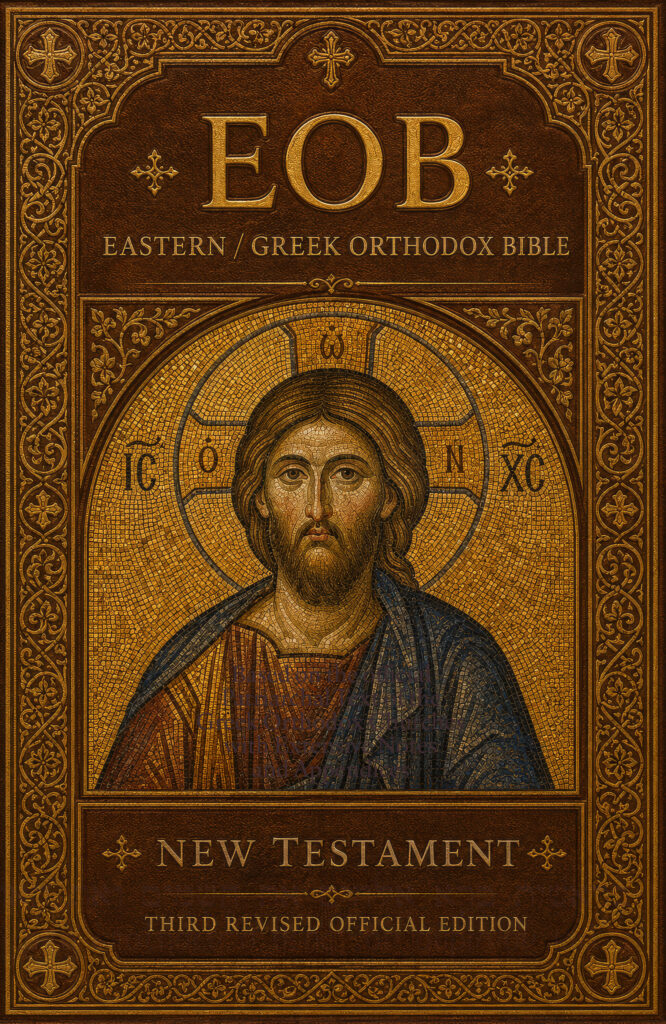
EOB: Official Site of the Eastern / Greek Orthodox Bible (Old and New Testament)
EOB (Eastern / Greek Orthodox Bible):
EOB Footnote:
KJV (King James Version):
WEB (World English Bible):
Benton LXX (Vaticanus):
Douai-Rheims (Vulgate):
Apostoliki Diakonia (LXX):
YLT (Young Literal Translation )(MT):
BBE (Bible in Basic English):
EOB Commentary:
THE FALL AND THE MYSTERY OF HUMAN CHOICE
This verse stands as one of the most consequential in all of Scripture, marking the moment when humanity departed from communion with God. The Eastern Fathers understood this not merely as a historical event but as a revelation of the fundamental dynamics of temptation and sin that continue to operate in every human soul.
THREEFOLD PATTERN OF TEMPTATION: Saint John the Theologian’s teaching in his first epistle concerning the lust of the flesh, the lust of the eyes, and the pride of life finds its archetype here. Eve saw that the tree was good for food (desire of the flesh), pleasing to the eyes (desire of the eyes), and desirable for gaining wisdom (vainglory). This same threefold pattern appears in Christ’s temptation in the wilderness, where the New Adam overcomes precisely where the first Adam and Eve fell.
CHRISTOLOGICAL SIGNIFICANCE: The Fathers consistently read this passage in light of the Incarnation. Where Eve took the forbidden fruit and gave it to her husband unto death, the Theotokos received the Word of God and gave Him to the world unto life. Saint Irenaeus develops this parallel extensively, showing how Mary’s obedience reverses Eve’s disobedience. The tree of transgression finds its antidote in the Tree of the Cross, from which flows not death but eternal life.
PATRISTIC UNDERSTANDING: Saint John Chrysostom emphasizes that Adam was not deceived as Eve was, making his transgression more grievous in one sense, for he sinned with full knowledge out of misguided love for his wife. Saint Ephrem the Syrian notes the tragic irony that in seeking to become like God through disobedience, humanity lost the very likeness of God they already possessed through grace.
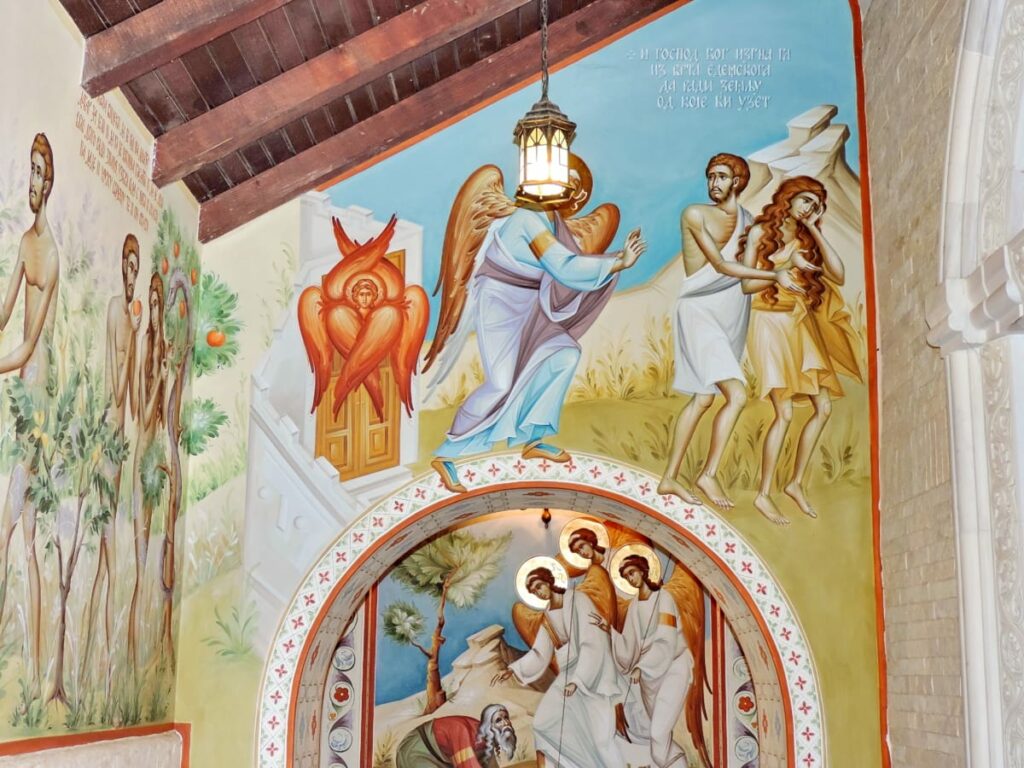
LITURGICAL CONNECTIONS: The Sunday of Forgiveness, which inaugurates Great Lent, features the commemoration of Adam’s expulsion from Paradise. The hymns of this day poignantly depict Adam sitting outside Eden, weeping for what was lost. The entire Lenten journey becomes a return to Paradise, culminating in Pascha when Christ opens the gates that were closed by this primordial transgression.
SPIRITUAL APPLICATION: The Holy Fathers teach that this verse reveals how sin operates through the corruption of natural desires. The fruit was genuinely beautiful and the desire for wisdom genuinely good, yet both were pursued outside of God’s will and timing. Orthodox asceticism does not condemn creation or natural desires but seeks to reorder them according to divine wisdom, healing the distortion introduced in this moment of ancestral transgression.
The Book of Leviticus receives its English title from the Latin Vulgate, which is derived from the Greek Septuagint (LXX) title Leuitikon (Λευιτικόν), meaning “Levitical” or “pertaining to the Levites.”

The Book of Exodus receives its English title from the Greek Septuagint (LXX), where it is called Exodos (Ἔξοδος), meaning “departure” or “exit.” This name was chosen because the central

I. Date and Authorship Holy Tradition of the Orthodox Church, affirmed by the Fathers and the liturgical usage of the Church from the earliest centuries, attributes the Book of Genesis

Does Hebrews 11 on the Maccabees Show Stronger Alignment with 4 Maccabees than 2 Maccabees? Hebrews 11 (the famous “Hall of Faith” chapter) does not explicitly mention the Maccabees by