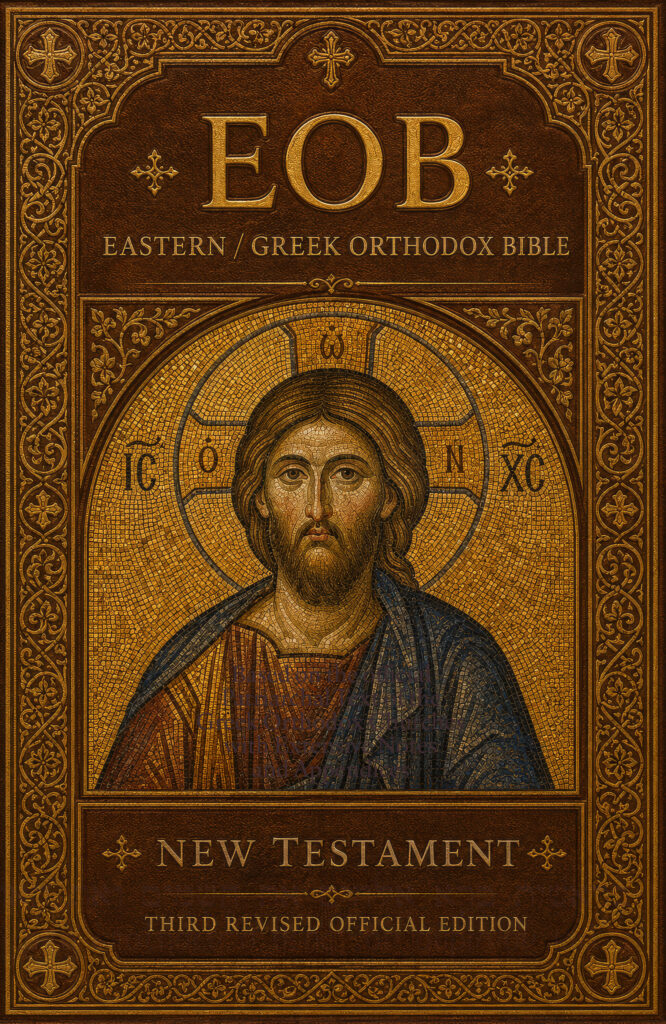

EOB: Official Site of the Eastern / Greek Orthodox Bible (Old and New Testament)

Genesis 3:13

EOB (Eastern / Greek Orthodox Bible):

Then the LORD God asked the woman, “What have you done?” The woman replied, “The serpent tricked me, so I ate.”

EOB Footnote:

The MT includes the divine name YHWH before “God,” reading “the LORD God said” rather than simply “God said” as in the LXX. The MT also uses a more emphatic construction for the woman’s response regarding the serpent’s deception. No DSS manuscript witness exists for this verse. The phrase “the serpent deceived me” renders the Greek verb meaning “to lead astray” or “to deceive thoroughly,” where a more literal translation would be “the serpent utterly deceived me” or “the serpent beguiled me.”

Other Translations:

KJV (King James Version):

And the LORD God said unto the woman, What is this that thou hast done? And the woman said, The serpent beguiled me, and I did eat.

WEB (World English Bible):

“The LORD God said to the woman, ‘What have you done?’ The woman said, ‘The serpent deceived me, and I ate.’”

Benton LXX (Vaticanus):

And the Lord God said to the woman, What is this thou hast done? And the woman said, The serpent deceived me and I ate.

Douai-Rheims (Vulgate):

And the Lord God said to the woman: Why hast thou done this? And she answered: The serpent deceived me, and I did eat.

Apostoliki Diakonia (LXX):

Then the Lord God said to the woman, “What is this you have done?” The woman said, “The serpent deceived me, and I ate.”

YLT (Young Literal Translation )(MT):

And the Lord God said to the woman, “What is this you have done?” And the woman said, “The serpent deceived me, and I ate.”

BBE (Bible in Basic English):

And the Lord God said to the woman, What have you done? And the woman said, The snake gave me food and I took it.

EOB COMMENTARY:

EOB Commentary:

Genesis 3:13 Commentary

The Woman’s Response and the Unfolding of Divine Economy

In this verse, the Lord God questions Eve regarding her transgression, and she responds by attributing her action to the serpent’s deception. This moment of interrogation reveals both the mercy of God, who seeks dialogue even after the fall, and the human tendency toward deflection rather than full repentance. Where Adam pointed to Eve, Eve now points to the serpent, yet her words contain a crucial truth: she was indeed deceived.

Typological Significance for the New Testament: The Apostle Paul directly references this verse in his epistles, particularly in 2 Corinthians 11:3, where he warns that the serpent deceived Eve through his craftiness, and in 1 Timothy 2:14, where he states that Adam was not deceived, but the woman being deceived fell into transgression. This Pauline interpretation establishes Eve’s deception as paradigmatic for understanding spiritual warfare and the vulnerability of humanity to demonic cunning.

Christological and Mariological Dimensions: The Church Fathers consistently read this passage in light of the Annunciation. Just as Eve entered into dialogue with the fallen angel and was led to death, so Mary the Theotokos engaged in conversation with the Archangel Gabriel and became the gateway to life. Saint Irenaeus of Lyon develops this parallel extensively, teaching that the knot of Eve’s disobedience was loosed through Mary’s obedience. Eve’s deception finds its remedy in Mary’s faithful acceptance of the divine word.

Saint John Chrysostom observes that God’s questioning of Eve demonstrates His pedagogical approach, giving opportunity for confession and repentance before pronouncing judgment. The Lord does not immediately condemn but invites self-examination, a pattern reflected in the sacrament of confession where the penitent is called to acknowledge sins before receiving absolution.

Liturgical Connections: The hymnography of the Orthodox Church, particularly during the Annunciation and the Nativity of the Theotokos, frequently contrasts Eve’s deception with Mary’s wisdom. The Akathist Hymn celebrates Mary as the one who “trampled down the deceiver” and reversed the curse brought through Eve’s conversation with the serpent.

Spiritual Application: For Orthodox spirituality, this verse warns against entertaining dialogue with temptation. The neptic fathers teach that Eve’s error began not with eating but with listening and conversing with the enemy. Watchfulness (nepsis) requires cutting off tempting thoughts at their inception, refusing the initial engagement that led to humanity’s fall. The Jesus Prayer and the discipline of guarding the heart find their urgency in this primordial failure of spiritual vigilance.

Introduction to the book of Leviticus

The Book of Leviticus receives its English title from the Latin Vulgate, which is derived from the Greek Septuagint (LXX) title Leuitikon (Λευιτικόν), meaning “Levitical” or “pertaining to the Levites.”

Read More »

Introduction to the book of Exodus

The Book of Exodus receives its English title from the Greek Septuagint (LXX), where it is called Exodos (Ἔξοδος), meaning “departure” or “exit.” This name was chosen because the central

Read More »