Genesis 3:22 Commentary
The Divine Council and Human Divinization
This verse presents one of the most theologically significant statements in Genesis, as God speaks in the plural (“one of us”), echoing the plural of Genesis 1:26. The Fathers consistently interpreted this as a revelation of the Holy Trinity, with the Father addressing the Son and the Holy Spirit. Saint John Chrysostom emphasizes that this plural form indicates the equality and unity of the divine Persons, not a deliberation with angels, as some heterodox interpreters suggested.
The Knowledge of Good and Evil
The phrase “knowing good and evil” requires careful interpretation. The Fathers understood this not as a positive acquisition of wisdom but as an experiential knowledge of evil through transgression. Saint Gregory the Theologian explains that Adam gained knowledge of his own nakedness and vulnerability—a tragic awareness born of disobedience rather than divine gift. This contrasts sharply with the true knowledge that comes through communion with God.
The Tree of Life and Christological Significance
The mention of the Tree of Life carries profound typological meaning for Orthodox theology. The Fathers, including Saint Irenaeus of Lyon, identified this tree as a prefiguration of the Cross of Christ and the Eucharist. When humanity was barred from the original Tree of Life, this was not merely punishment but also mercy—preventing fallen humanity from being eternally fixed in a corrupted state. Christ, the true Tree of Life, would later offer immortality through His death and resurrection.
In the Orthodox liturgical tradition, the hymns of the Exaltation of the Holy Cross explicitly connect the tree in Paradise with the wood of the Cross. The Paschal services proclaim that through the Cross, life has come to the world, reversing the exclusion from the Tree of Life.
Divine Economy and Pastoral Care
Saint Ephrem the Syrian beautifully notes that God’s action in barring access to the tree demonstrates divine pedagogy. Humanity needed purification and transformation before receiving immortality. The incarnation of Christ accomplishes what Adam’s premature grasping could not—true theosis, or divinization, through grace rather than through autonomous human effort.
Liturgical Connections
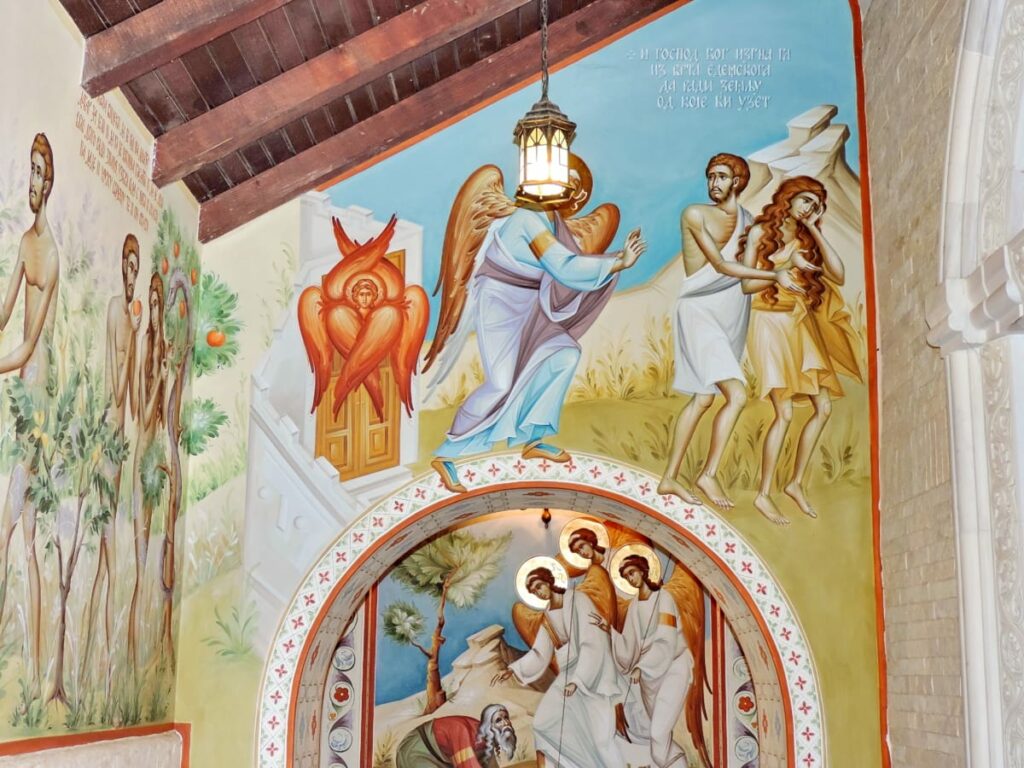
The Forgiveness Vespers of Cheesefare Sunday, commemorating the expulsion from Paradise, draws heavily on this passage. The Church sings of Adam weeping before the gates of Eden, longing for the Paradise he lost. Yet Orthodox hymnography always points forward to Christ, the New Adam, who reopens Paradise to humanity. The good thief’s entry into Paradise on Great Friday demonstrates the fulfillment of what this verse anticipates—restored access to eternal life through Christ.