Introduction to the book of Leviticus
The Book of Leviticus receives its English title from the Latin Vulgate, which is derived from the Greek Septuagint (LXX) title Leuitikon (Λευιτικόν), meaning “Levitical” or “pertaining to the Levites.”
EOB: Official Site of the Eastern / Greek Orthodox Bible (Old and New Testament)
EOB (Eastern / Greek Orthodox Bible):
EOB Footnote:
KJV (King James Version):
WEB (World English Bible):
Benton LXX (Vaticanus):
Douai-Rheims (Vulgate):
Apostoliki Diakonia (LXX):
YLT (Young Literal Translation )(MT):
BBE (Bible in Basic English):
EOB Commentary:
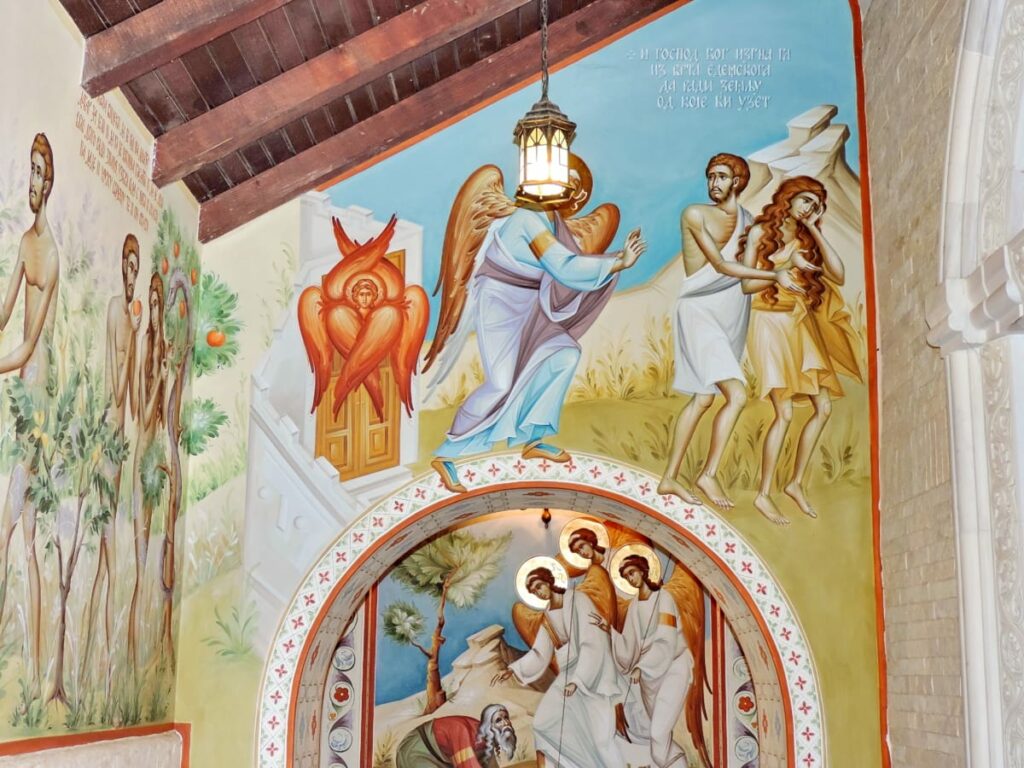
THE EXPULSION FROM PARADISE
This verse marks one of the most consequential moments in salvation history—the formal expulsion of humanity from the Garden of Eden. The Lord God “sent him forth” (exapesteilen in the Septuagint) uses language that carries profound theological weight, for this same verbal root appears throughout Scripture in contexts of divine mission and sending.
Patristic Interpretation: Saint John Chrysostom emphasizes that this expulsion, while appearing as punishment, was simultaneously an act of divine mercy. God removed Adam from proximity to the Tree of Life so that humanity would not live forever in a fallen state, perpetually bound to corruption and sin. The temporary nature of death thus becomes a pathway toward eventual restoration. Saint Ephrem the Syrian similarly notes that God clothed Adam in garments of skin before sending him out, demonstrating that even in judgment, the Creator provides for His creature.
Saint Irenaeus of Lyon sees in this expulsion the beginning of God’s pedagogical plan for humanity. The “ground from which he was taken” reminds Adam of his humble origins and mortality, preparing the human race for the humility necessary to receive salvation.
Christological Significance: The Church Fathers consistently read this passage in light of Christ’s redemptive work. Where Adam was sent out from Paradise, Christ voluntarily descended from heavenly glory. The Second Adam reverses the trajectory of the first—entering into our exile to lead us back to the Father’s house. Saint Gregory the Theologian speaks of Christ as the one who reopens Paradise, and the Orthodox hymnography of Pascha celebrates this restoration with the words “Today Paradise is opened.”
Liturgical Connections: This verse resonates powerfully during the Sunday of Forgiveness (Cheesefare Sunday), when the Church commemorates the expulsion from Eden at the threshold of Great Lent. The evening Vespers features the hymn “Adam sat before Paradise and lamented his nakedness,” calling the faithful to recognize their own exile and begin the Lenten journey of return. The entire season of the Great Fast can be understood as a spiritual pilgrimage back toward Paradise.
The verse also illuminates the theology of Holy Saturday, when Christ descends to Hades and leads Adam and Eve—and all the righteous dead—out of their long exile. Orthodox iconography of the Anastasis depicts Christ grasping Adam’s wrist, reversing the sending forth described in Genesis.
Spiritual Application: For Orthodox spirituality, this verse reminds us that we live east of Eden, in a state of exile that requires constant repentance and return. Yet we do not journey alone—the Church provides the sacramental means by which Paradise is already accessible, most especially in the Divine Liturgy, where heaven and earth unite.
The Book of Leviticus receives its English title from the Latin Vulgate, which is derived from the Greek Septuagint (LXX) title Leuitikon (Λευιτικόν), meaning “Levitical” or “pertaining to the Levites.”

The Book of Exodus receives its English title from the Greek Septuagint (LXX), where it is called Exodos (Ἔξοδος), meaning “departure” or “exit.” This name was chosen because the central

I. Date and Authorship Holy Tradition of the Orthodox Church, affirmed by the Fathers and the liturgical usage of the Church from the earliest centuries, attributes the Book of Genesis

Does Hebrews 11 on the Maccabees Show Stronger Alignment with 4 Maccabees than 2 Maccabees? Hebrews 11 (the famous “Hall of Faith” chapter) does not explicitly mention the Maccabees by