Introduction to the book of Leviticus
The Book of Leviticus receives its English title from the Latin Vulgate, which is derived from the Greek Septuagint (LXX) title Leuitikon (Λευιτικόν), meaning “Levitical” or “pertaining to the Levites.”
EOB: Official Site of the Eastern / Greek Orthodox Bible (Old and New Testament)
EOB (Eastern / Greek Orthodox Bible):
EOB Footnote:
KJV (King James Version):
WEB (World English Bible):
Benton LXX (Vaticanus):
Douai-Rheims (Vulgate):
Apostoliki Diakonia (LXX):
YLT (Young Literal Translation )(MT):
BBE (Bible in Basic English):
EOB Commentary:
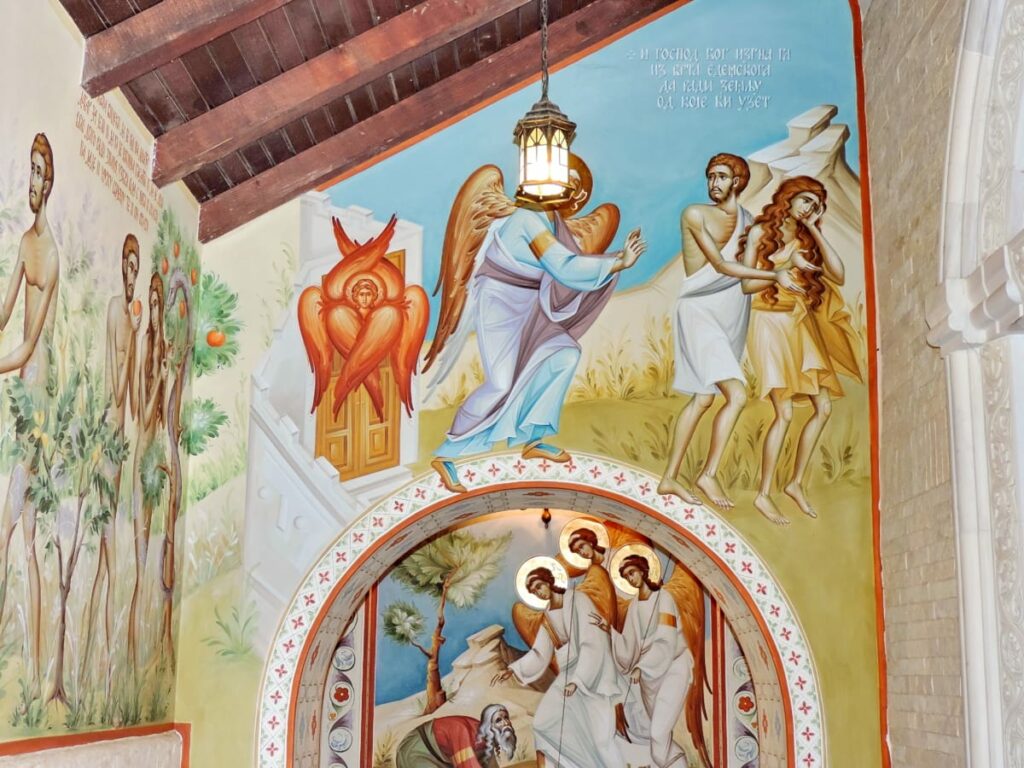
THE EXPULSION AND THE CHERUBIM
The placement of the cherubim with the flaming sword at the entrance to Paradise represents one of the most theologically significant images in all of Scripture, carrying profound implications for the entire economy of salvation.
Patristic Interpretation: The Church Fathers consistently understood this verse as pointing forward to Christ’s redemptive work. Saint John Chrysostom teaches that the cherubim and flaming sword were placed not merely as punishment but as a merciful barrier, preventing humanity from eating of the Tree of Life in a fallen state and thus immortalizing sin. Saint Ephrem the Syrian sees in the flaming sword a prefiguration of baptismal fire that would eventually purify humanity for re-entry into Paradise.
Christological Significance: The Eastern Fathers understood that Christ’s descent into Hades and His Resurrection effectively removed this barrier. Saint Romanos the Melodist beautifully expresses this in his kontakia, proclaiming that Christ, by His Cross, reopened the gates of Paradise. The Good Thief’s entry into Paradise on Great Friday demonstrates this reality: “Today you shall be with me in Paradise” directly reverses the expulsion of Genesis 3:24. Christ Himself becomes the way back to the Tree of Life.
Liturgical Connections: This verse profoundly shapes Orthodox liturgical consciousness. During the Paschal services, the Church celebrates the opening of Paradise’s gates. The Royal Doors of the iconostasis liturgically represent this boundary between heaven and earth, opened during services to signify our access to divine mysteries through Christ. The Cherubic Hymn sung at the Great Entrance invokes these same angelic guardians, now accompanying the faithful as they mystically enter the heavenly sanctuary rather than being barred from it.
The Sunday of Forgiveness, which begins Great Lent, features the hymn lamenting Adam’s expulsion and his weeping before Paradise. This establishes the entire Lenten journey as a return to Eden, culminating in Pascha’s triumphant restoration.
Spiritual Theology: For Orthodox ascetical tradition, the flaming sword represents the purifying trials through which the soul must pass to return to communion with God. The neptic fathers teach that the cherubim symbolize the watchfulness (nepsis) required to guard the heart, while the turning sword represents the discernment needed to cut away passions. Saint Gregory of Nyssa interprets the return to Paradise as the soul’s journey of perpetual ascent into God, the original destiny interrupted by the fall.
The verse thus stands as a hinge point in salvation history, marking both the tragedy of separation and the promise of restoration that finds its fulfillment in the Paschal mystery.
The Book of Leviticus receives its English title from the Latin Vulgate, which is derived from the Greek Septuagint (LXX) title Leuitikon (Λευιτικόν), meaning “Levitical” or “pertaining to the Levites.”

The Book of Exodus receives its English title from the Greek Septuagint (LXX), where it is called Exodos (Ἔξοδος), meaning “departure” or “exit.” This name was chosen because the central

I. Date and Authorship Holy Tradition of the Orthodox Church, affirmed by the Fathers and the liturgical usage of the Church from the earliest centuries, attributes the Book of Genesis

Does Hebrews 11 on the Maccabees Show Stronger Alignment with 4 Maccabees than 2 Maccabees? Hebrews 11 (the famous “Hall of Faith” chapter) does not explicitly mention the Maccabees by