Introduction to the book of Leviticus
The Book of Leviticus receives its English title from the Latin Vulgate, which is derived from the Greek Septuagint (LXX) title Leuitikon (Λευιτικόν), meaning “Levitical” or “pertaining to the Levites.”
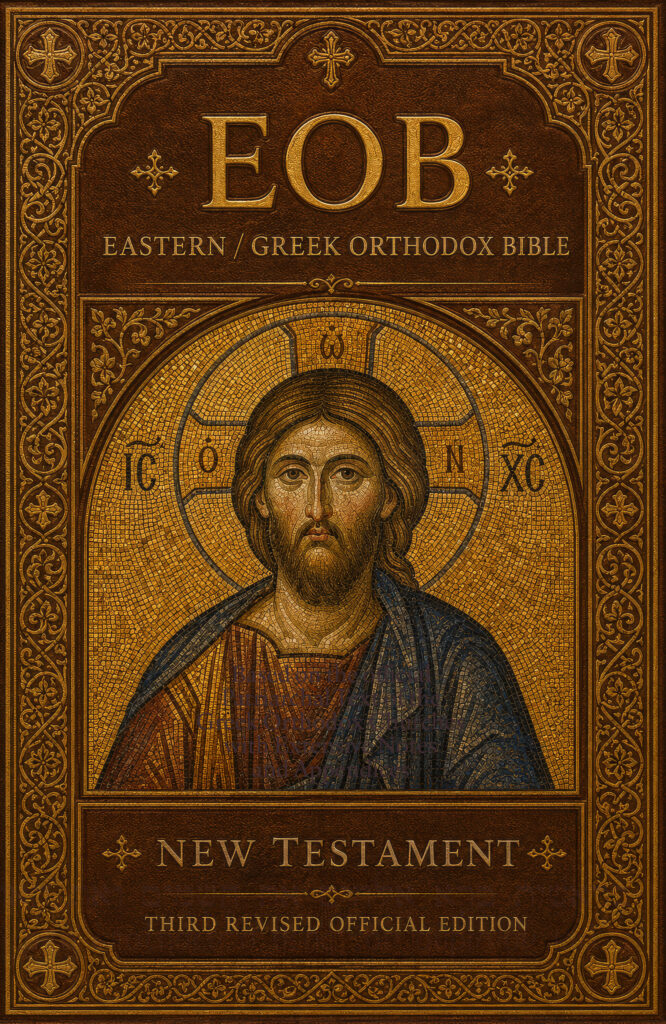
EOB: Official Site of the Eastern / Greek Orthodox Bible (Old and New Testament)
EOB (Eastern / Greek Orthodox Bible):
EOB Footnote:
KJV (King James Version):
WEB (World English Bible):
Benton LXX (Vaticanus):
Douai-Rheims (Vulgate):
Apostoliki Diakonia (LXX):
YLT (Young Literal Translation )(MT):
BBE (Bible in Basic English):
EOB Commentary:
GENESIS 4:24
Lamech’s boast of seventy-sevenfold vengeance stands as one of the most chilling declarations in early Genesis, representing the culmination of Cain’s lineage in unbridled violence and pride. This verse marks the complete corruption of the principle God established when He placed a protective mark upon Cain, promising sevenfold vengeance against anyone who would kill him. Lamech perverts divine mercy into a charter for human brutality, claiming for himself an exponentially greater right to vengeance than God Himself had decreed.
Patristic Interpretation: The Fathers consistently read this passage as illustrating the trajectory of sin when left unchecked by repentance. Saint John Chrysostom observes that while Cain at least showed some fear before God, Lamech boasts openly of murder, demonstrating how sin compounds across generations. The progression from Cain’s fratricide to Lamech’s proud declaration of unlimited retaliation reveals humanity’s descent apart from divine grace.
Christological and New Testament Significance: This verse finds its direct reversal in our Lord’s words to Peter in Matthew 18:22, where Christ commands forgiveness not seven times but seventy times seven. The deliberate echo is unmistakable. Where Lamech claimed the right to unlimited vengeance, Christ establishes the principle of unlimited forgiveness. The New Adam undoes the work of the old humanity. What the line of Cain corrupted, the Son of God restores and transforms. The Church Fathers saw in this contrast the entire gospel in miniature: the way of death through vengeance versus the way of life through mercy.
Saint Ephrem the Syrian notes that Lamech’s sword, by which he boasted of killing, prefigures all human violence that would ultimately be overcome by Christ, who conquered not by the sword but by the Cross. The weapon of pride is answered by the instrument of humility.
Liturgical and Spiritual Application: During Great Lent, the Church calls the faithful to examine their hearts for any trace of Lamech’s spirit. The Lenten Triodion repeatedly emphasizes forgiveness as the prerequisite for approaching Pascha. Forgiveness Vespers, celebrated on the eve of Great Lent, stands as the Church’s direct response to Lamech’s boast. Where he demanded vengeance, the faithful prostrate before one another asking and granting pardon.
Orthodox spiritual tradition teaches that harboring vengeance poisons the soul and separates one from God. The Jesus Prayer itself becomes an antidote to Lamech’s spirit, replacing thoughts of retaliation with constant invocation of mercy. The seventy-sevenfold vengeance is transformed in Christ into seventy-sevenfold healing through perpetual prayer and forgiveness.
The Book of Leviticus receives its English title from the Latin Vulgate, which is derived from the Greek Septuagint (LXX) title Leuitikon (Λευιτικόν), meaning “Levitical” or “pertaining to the Levites.”

The Book of Exodus receives its English title from the Greek Septuagint (LXX), where it is called Exodos (Ἔξοδος), meaning “departure” or “exit.” This name was chosen because the central

I. Date and Authorship Holy Tradition of the Orthodox Church, affirmed by the Fathers and the liturgical usage of the Church from the earliest centuries, attributes the Book of Genesis

Does Hebrews 11 on the Maccabees Show Stronger Alignment with 4 Maccabees than 2 Maccabees? Hebrews 11 (the famous “Hall of Faith” chapter) does not explicitly mention the Maccabees by