Introduction to the book of Leviticus
The Book of Leviticus receives its English title from the Latin Vulgate, which is derived from the Greek Septuagint (LXX) title Leuitikon (Λευιτικόν), meaning “Levitical” or “pertaining to the Levites.”
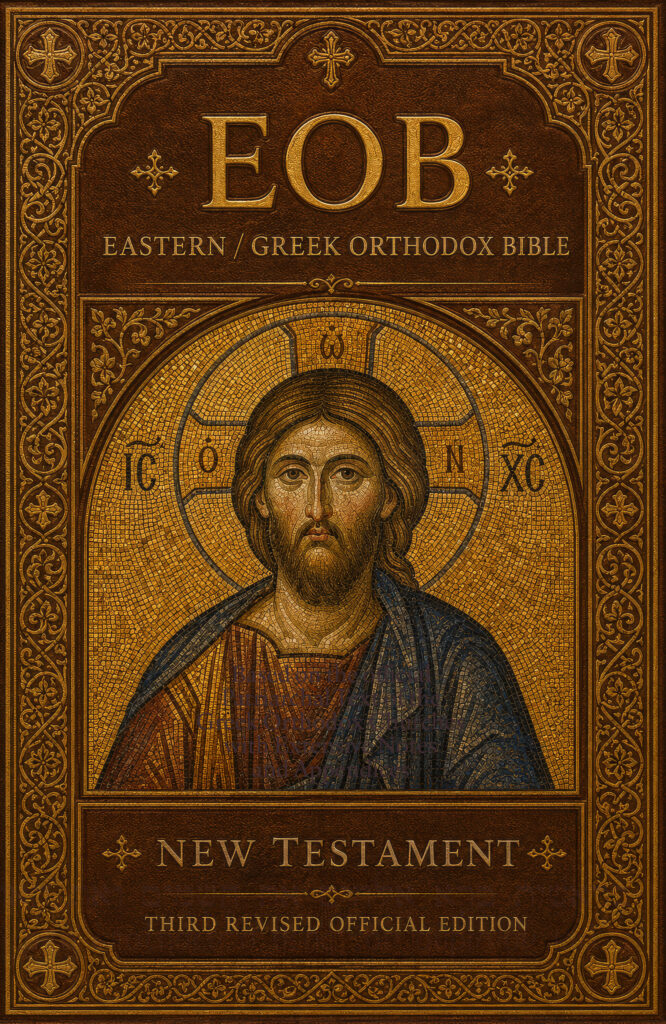
EOB: Official Site of the Eastern / Greek Orthodox Bible (Old and New Testament)
EOB (Eastern / Greek Orthodox Bible):
EOB Footnote:
KJV (King James Version):
WEB (World English Bible):
Benton LXX (Vaticanus):
Douai-Rheims (Vulgate):
Apostoliki Diakonia (LXX):
YLT (Young Literal Translation )(MT):
BBE (Bible in Basic English):
EOB Commentary:
Genesis 5:2 Commentary
Male and Female: The Fullness of Human Nature
This verse reiterates the foundational truth established in Genesis 1:27, emphasizing that God created humanity as male and female, blessed them together, and named them collectively “Adam” (meaning “humanity” or “man”). The repetition within the genealogical framework of Genesis 5 serves to anchor the subsequent lineage in the original divine intention for human nature.
Patristic Interpretation: Saint Gregory of Nyssa, in his work “On the Making of Man,” reflects deeply on the significance of humanity being created male and female while bearing the singular name “Adam.” He sees in this a profound unity of human nature that transcends the distinction of sexes while not abolishing it. The blessing pronounced upon both together indicates that neither sex alone constitutes the fullness of humanity, but rather their complementary union reflects the complete image of God.
Saint John Chrysostom notes that by naming them both “Adam,” Scripture teaches us the fundamental equality of dignity between man and woman before God, even as their roles may differ. This naming also points to the organic unity of the human race, all descending from one source and sharing one nature.
Christological Significance: The Church Fathers saw in this verse a preparation for understanding the New Adam. Christ assumes the fullness of human nature, and through His incarnation, He restores and elevates what was created and blessed in the beginning. Saint Irenaeus teaches that Christ recapitulates all of humanity in Himself, healing the nature that was created male and female and blessed by God.
The blessing mentioned in this verse finds its ultimate fulfillment in Christ, who becomes the source of blessing for all humanity. What was given in creation is restored and perfected in redemption.
Liturgical Connection: In the Orthodox marriage service, the Church invokes the blessing given to the first-created humans. The priest prays that God would bless the couple as He blessed Adam and Eve in Paradise. This liturgical reference connects every Christian marriage to the primordial blessing of Genesis 5:2, understanding matrimony as a participation in God’s original design for human communion and fruitfulness.
Spiritual Reflection: For Orthodox spirituality, this verse reminds us that human nature in its totality—male and female together—is blessed by God and called good. The ascetic tradition, while honoring celibacy, never denigrates the body or the distinction of sexes as evil. Rather, the goal of theosis encompasses the whole human person as God created and blessed humanity from the beginning.
The Book of Leviticus receives its English title from the Latin Vulgate, which is derived from the Greek Septuagint (LXX) title Leuitikon (Λευιτικόν), meaning “Levitical” or “pertaining to the Levites.”

The Book of Exodus receives its English title from the Greek Septuagint (LXX), where it is called Exodos (Ἔξοδος), meaning “departure” or “exit.” This name was chosen because the central

I. Date and Authorship Holy Tradition of the Orthodox Church, affirmed by the Fathers and the liturgical usage of the Church from the earliest centuries, attributes the Book of Genesis

Does Hebrews 11 on the Maccabees Show Stronger Alignment with 4 Maccabees than 2 Maccabees? Hebrews 11 (the famous “Hall of Faith” chapter) does not explicitly mention the Maccabees by