Introduction to the book of Leviticus
The Book of Leviticus receives its English title from the Latin Vulgate, which is derived from the Greek Septuagint (LXX) title Leuitikon (Λευιτικόν), meaning “Levitical” or “pertaining to the Levites.”
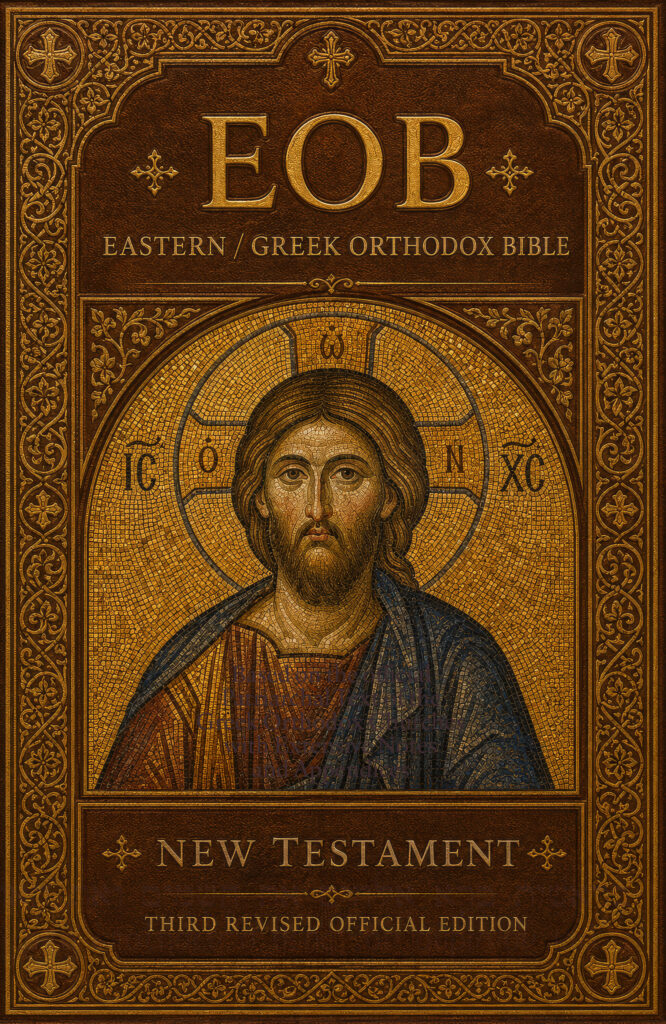
EOB: Official Site of the Eastern / Greek Orthodox Bible (Old and New Testament)
EOB (Eastern / Greek Orthodox Bible):
EOB Footnote:
KJV (King James Version):
WEB (World English Bible):
Benton LXX (Vaticanus):
Douai-Rheims (Vulgate):
Apostoliki Diakonia (LXX):
YLT (Young Literal Translation )(MT):
BBE (Bible in Basic English):
EOB Commentary:
Genesis 5:11 Commentary
And all the days of Enos were nine hundred and five years: and he died.
This verse continues the genealogical record of the antediluvian patriarchs, noting the total lifespan of Enos (Enosh in Hebrew) and his death. While appearing formulaic within the broader genealogy of chapter five, this verse carries theological weight when understood within the Orthodox interpretive tradition.
Christological and Typological Significance:
The genealogy in which Enos appears serves as a direct ancestral line leading to Christ, as confirmed in Luke 3:38, where Enos is explicitly named in the genealogy of our Lord. The Orthodox Church understands these genealogies not merely as historical records but as testimonies to God’s providential preparation for the Incarnation. Each patriarch in this line represents a link in the chain of salvation history, preserving the promise given to Adam and Eve regarding the seed that would crush the serpent’s head.
Patristic Reflection:
The name Enos itself means “mortal man” or “frail humanity,” and the Church Fathers saw significance in this naming. It was during the days of Enos that, according to Genesis 4:26, men began to call upon the name of the Lord. Saint John Chrysostom notes that this represents a renewal of proper worship after the corruption introduced through Cain’s line. The death notice in verse 11, therefore, stands in tension with this spiritual awakening—even those who call upon God’s name remain subject to mortality, awaiting the One who would conquer death itself.
The Refrain of Death:
The repeated phrase “and he died” throughout Genesis 5 functions as a sobering reminder of the wages of sin. Orthodox hymnography, particularly in the funeral services, echoes this reality while simultaneously proclaiming its overcoming in Christ. The Paschal troparion—”Christ is risen from the dead, trampling down death by death”—directly answers the mournful refrain of Genesis 5. What was inevitable for Enos and all the patriarchs has been transformed through the Resurrection.
Liturgical Connection:
During the reading of ancestral genealogies in the Orthodox lectionary, the faithful are reminded that the long ages of the patriarchs, though impressive, still ended in death. Only through Christ, the New Adam, does humanity receive the possibility of true immortality—not merely extended earthly years, but eternal life in communion with God. The contrast between the nine hundred years of Enos ending in death and the eternal life offered through Baptism and the Eucharist forms a central theme of Orthodox soteriology.
The Book of Leviticus receives its English title from the Latin Vulgate, which is derived from the Greek Septuagint (LXX) title Leuitikon (Λευιτικόν), meaning “Levitical” or “pertaining to the Levites.”

The Book of Exodus receives its English title from the Greek Septuagint (LXX), where it is called Exodos (Ἔξοδος), meaning “departure” or “exit.” This name was chosen because the central

I. Date and Authorship Holy Tradition of the Orthodox Church, affirmed by the Fathers and the liturgical usage of the Church from the earliest centuries, attributes the Book of Genesis

Does Hebrews 11 on the Maccabees Show Stronger Alignment with 4 Maccabees than 2 Maccabees? Hebrews 11 (the famous “Hall of Faith” chapter) does not explicitly mention the Maccabees by