Introduction to the book of Leviticus
The Book of Leviticus receives its English title from the Latin Vulgate, which is derived from the Greek Septuagint (LXX) title Leuitikon (Λευιτικόν), meaning “Levitical” or “pertaining to the Levites.”
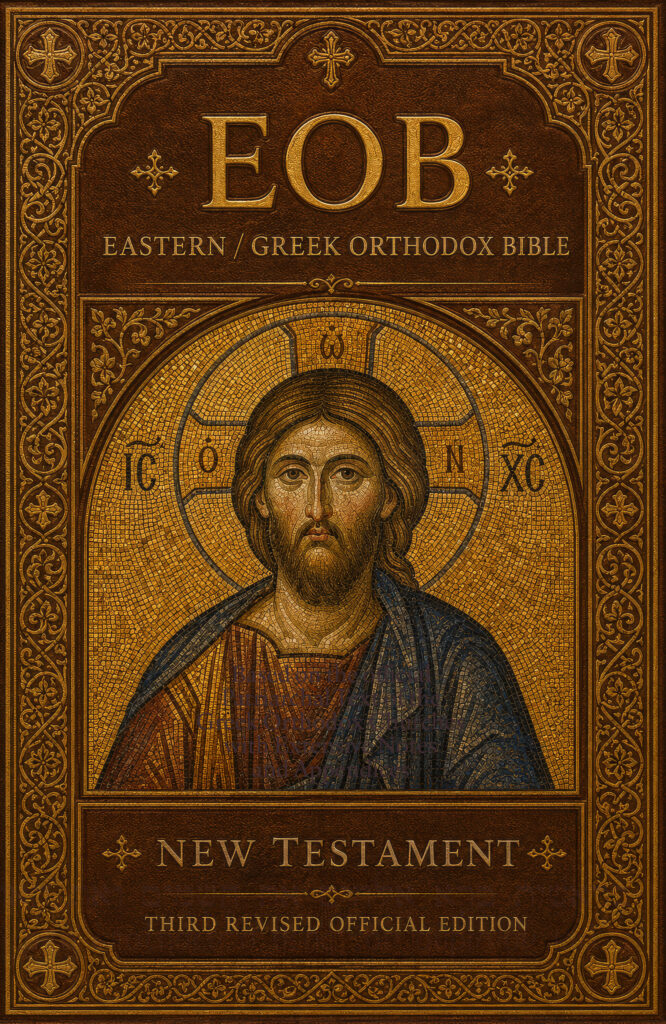
EOB: Official Site of the Eastern / Greek Orthodox Bible (Old and New Testament)
EOB (Eastern / Greek Orthodox Bible):
EOB Footnote:
KJV (King James Version):
WEB (World English Bible):
Benton LXX (Vaticanus):
Douai-Rheims (Vulgate):
Apostoliki Diakonia (LXX):
YLT (Young Literal Translation )(MT):
BBE (Bible in Basic English):
EOB Commentary:
Genesis 5:17
And all the days of Mahalalel were eight hundred and ninety-five years, and he died.
This verse, recording the total lifespan and death of Mahalalel, belongs to the genealogical record connecting Adam to Noah. While appearing formulaic, it carries theological weight within the broader pattern of Genesis 5.
The Name and Its Significance:
Mahalalel’s name means “praise of God” or “one who praises El.” This name stands as a testimony within the pre-flood genealogy, suggesting that even in an age moving toward corruption, there remained those whose very identity was oriented toward divine worship. The Fathers saw in these ancient names prophetic hints of God’s salvific plan.
The Refrain of Death:
The repeated phrase “and he died” throughout Genesis 5 serves as a solemn reminder of the wages of sin introduced in Genesis 3. Despite the extraordinary longevity of the patriarchs, death remained the universal inheritance of Adam’s descendants. St. John Chrysostom emphasizes that these death notices prevent us from imagining that long life somehow exempted these men from mortality’s curse. Each “and he died” points forward to the need for One who would conquer death itself.
Typological Reading:
The genealogy of Genesis 5 finds its fulfillment in the genealogy of Christ recorded in Luke 3, where Mahalalel appears as an ancestor of our Lord according to the flesh. Thus this seemingly mundane verse participates in the great chain of human generations through which the Son of God would enter creation. The “praise of God” embedded in Mahalalel’s name finds its perfect expression in Christ, who offered perfect praise to the Father and taught humanity true worship.
Liturgical Resonance:
The Orthodox funeral service echoes the theology implicit in these genealogical death notices. We acknowledge mortality as the common lot while simultaneously proclaiming the resurrection. The contrast between the ancient patriarchs who “died” and Christ who “trampled down death by death” illuminates the paschal transformation of human destiny.
Spiritual Application:
For Orthodox spirituality, Mahalalel’s 895 years remind us that length of days does not constitute the goal of human existence. Rather, like his name suggests, the purpose of life—whether brief or extended—is the praise of God. The Jesus Prayer and the entire hesychast tradition orient the believer toward making one’s whole life a continuous doxology, fulfilling what Mahalalel’s name proclaimed.
The Book of Leviticus receives its English title from the Latin Vulgate, which is derived from the Greek Septuagint (LXX) title Leuitikon (Λευιτικόν), meaning “Levitical” or “pertaining to the Levites.”

The Book of Exodus receives its English title from the Greek Septuagint (LXX), where it is called Exodos (Ἔξοδος), meaning “departure” or “exit.” This name was chosen because the central

I. Date and Authorship Holy Tradition of the Orthodox Church, affirmed by the Fathers and the liturgical usage of the Church from the earliest centuries, attributes the Book of Genesis

Does Hebrews 11 on the Maccabees Show Stronger Alignment with 4 Maccabees than 2 Maccabees? Hebrews 11 (the famous “Hall of Faith” chapter) does not explicitly mention the Maccabees by