Introduction to the book of Leviticus
The Book of Leviticus receives its English title from the Latin Vulgate, which is derived from the Greek Septuagint (LXX) title Leuitikon (Λευιτικόν), meaning “Levitical” or “pertaining to the Levites.”
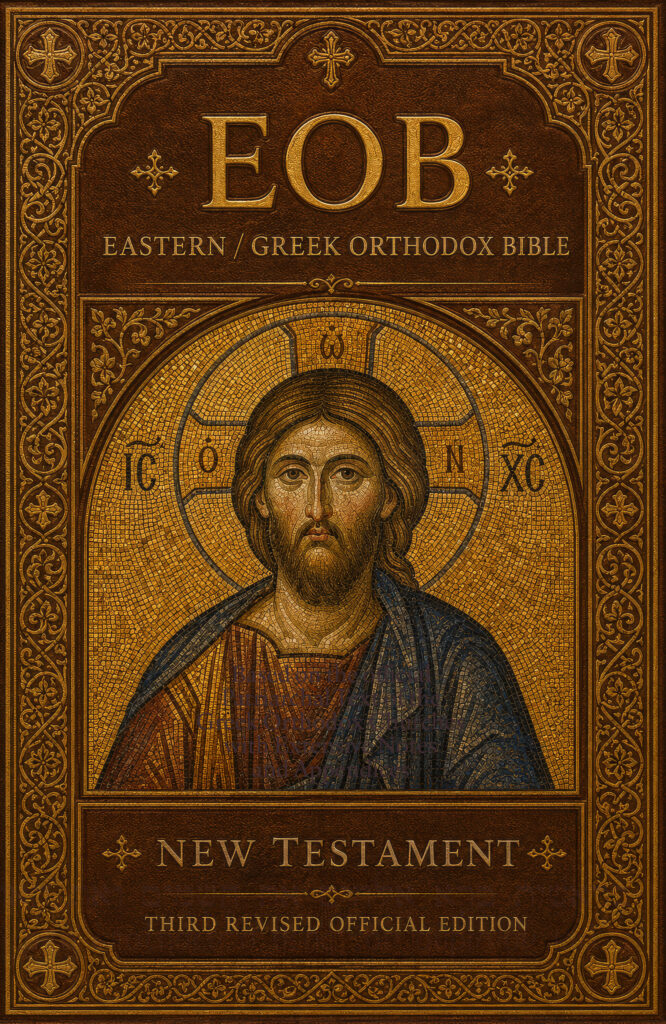
EOB: Official Site of the Eastern / Greek Orthodox Bible (Old and New Testament)
EOB (Eastern / Greek Orthodox Bible):
EOB Footnote:
KJV (King James Version):
WEB (World English Bible):
Benton LXX (Vaticanus):
Douai-Rheims (Vulgate):
Apostoliki Diakonia (LXX):
YLT (Young Literal Translation )(MT):
BBE (Bible in Basic English):
EOB Commentary:
Enoch: The Righteous One Who Walked with God
Genesis 5:21 introduces us to Enoch at the age of sixty-five when he became the father of Methuselah. While this verse appears to be a simple genealogical notation, it marks the beginning of one of the most spiritually significant figures in the antediluvian period and carries profound typological meaning for Orthodox Christian theology.
Christological and Typological Significance
The Orthodox tradition has long recognized Enoch as a type of Christ and a prefigurement of the righteous life that finds its fulfillment in communion with God. The phrase “walked with God” (halak et ha-Elohim), which appears in the subsequent verses describing Enoch’s life, distinguishes him from all others in this genealogy. This walking signifies not mere moral uprightness but intimate fellowship with the Divine—a relationship that anticipates the perfect union of divine and human natures in Christ.
Saint Irenaeus of Lyon saw in Enoch a demonstration that bodily assumption into God’s presence was possible even before the Law, pointing forward to Christ’s Ascension and the general resurrection. Enoch’s translation without experiencing death prefigures the transformation that awaits the faithful at the Second Coming, as Saint Paul teaches in First Thessalonians 4:17.
Patristic Interpretation
The Fathers consistently interpreted Enoch’s righteousness as evidence of natural law written on the heart. Saint John Chrysostom emphasized that Enoch achieved such holiness without the Mosaic Law, prophets, or written Scripture, demonstrating that communion with God is possible through sincere faith and virtuous living. This becomes a powerful argument against those who would excuse their sins by claiming insufficient spiritual resources.
Saint Ephrem the Syrian noted that Enoch’s fathering of Methuselah at sixty-five marked a turning point—suggesting that parenthood itself became an occasion for deeper spiritual awakening and commitment to walking with God.
Liturgical and Spiritual Connections
In Orthodox hymnography, Enoch appears among the righteous ancestors commemorated on the Sunday of the Holy Forefathers before the Nativity of Christ. He stands as a witness that even in the earliest generations, humanity could attain remarkable holiness through faith.
For Orthodox spirituality, Enoch represents the hesychastic ideal of continuous communion with God—theoria in its purest form. His life demonstrates that the goal of the Christian life, theosis or deification, has always been God’s intention for humanity. Walking with God is not passive but active participation in divine life, a theme central to Orthodox ascetical theology and the Jesus Prayer tradition.
The Book of Leviticus receives its English title from the Latin Vulgate, which is derived from the Greek Septuagint (LXX) title Leuitikon (Λευιτικόν), meaning “Levitical” or “pertaining to the Levites.”

The Book of Exodus receives its English title from the Greek Septuagint (LXX), where it is called Exodos (Ἔξοδος), meaning “departure” or “exit.” This name was chosen because the central

I. Date and Authorship Holy Tradition of the Orthodox Church, affirmed by the Fathers and the liturgical usage of the Church from the earliest centuries, attributes the Book of Genesis

Does Hebrews 11 on the Maccabees Show Stronger Alignment with 4 Maccabees than 2 Maccabees? Hebrews 11 (the famous “Hall of Faith” chapter) does not explicitly mention the Maccabees by