Introduction to the book of Leviticus
The Book of Leviticus receives its English title from the Latin Vulgate, which is derived from the Greek Septuagint (LXX) title Leuitikon (Λευιτικόν), meaning “Levitical” or “pertaining to the Levites.”
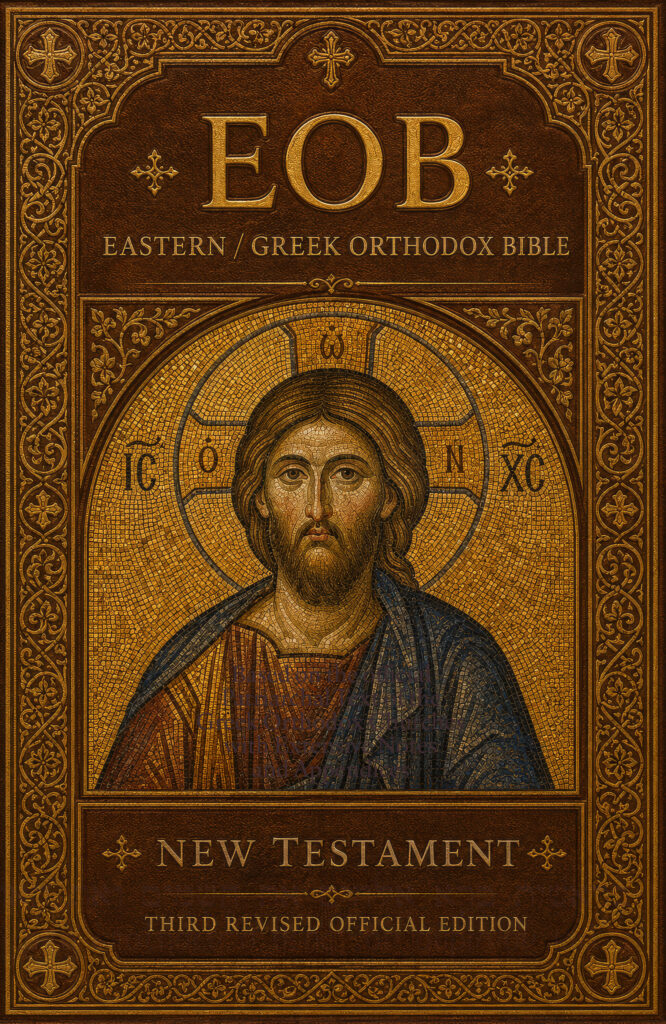
EOB: Official Site of the Eastern / Greek Orthodox Bible (Old and New Testament)
EOB (Eastern / Greek Orthodox Bible):
EOB Footnote:
KJV (King James Version):
WEB (World English Bible):
Benton LXX (Vaticanus):
Douai-Rheims (Vulgate):
Apostoliki Diakonia (LXX):
YLT (Young Literal Translation )(MT):
BBE (Bible in Basic English):
EOB Commentary:
Lamech and the Naming of Noah: A Prophetic Anticipation of Rest
Genesis 5:28 introduces us to Lamech, the father of Noah, at a pivotal moment in the genealogy from Adam to the flood. While this verse simply records that Lamech lived 182 years and begot a son, it sets the stage for the profound prophetic declaration that follows in verse 29, where Lamech names his son Noah, meaning “rest” or “comfort.”
Typological Significance for Christ
The Orthodox tradition sees in Noah a clear type of Christ. Just as Lamech prophesied that Noah would bring comfort and rest from the curse upon the ground, so Christ brings ultimate rest to humanity burdened by sin and death. The Fathers consistently interpreted Noah’s name as pointing forward to the true Rest-giver. Saint John Chrysostom notes that while Noah brought temporary relief through the preservation of humanity, Christ brings eternal rest through His redemptive work. The connection between Noah and Christ is reinforced in the New Testament, where Saint Peter explicitly draws parallels between the waters of the flood and baptism (1 Peter 3:20-21).
Patristic Interpretation
Saint Ephrem the Syrian observes that Lamech, though living in a time of increasing wickedness before the flood, possessed prophetic insight regarding his son’s significance. The Fathers saw this as evidence of the Holy Spirit’s work even in the antediluvian period, preparing humanity for salvation. Saint Cyril of Alexandria interprets the “toil of our hands” mentioned in the subsequent verse as referring to the laborious struggle against sin that would find its resolution ultimately in Christ.
Liturgical Connections
In the Orthodox liturgical tradition, Noah appears prominently in the hymnography of Great Lent, particularly in the canon readings during the first weeks. The Church sees the ark as a type of the Church herself, the vessel of salvation amid the flood of sin. The theme of rest (anapausis) that Noah’s name embodies resonates throughout Orthodox worship, particularly in memorial services where we pray that the departed may find rest in a place of light, a place of green pasture, a place of rest.
Spiritual Significance
For Orthodox spirituality, this passage reminds us that God works through generations, preparing salvation history through faithful individuals. Lamech’s faith in naming his son with prophetic hope demonstrates that even in times of great darkness, the righteous maintain their trust in God’s promises. This patience across generations mirrors the spiritual discipline of the Orthodox faithful who await the fullness of the Kingdom while laboring in this present age, finding their true rest only in Christ, the fulfillment of all prophetic types.
The Book of Leviticus receives its English title from the Latin Vulgate, which is derived from the Greek Septuagint (LXX) title Leuitikon (Λευιτικόν), meaning “Levitical” or “pertaining to the Levites.”

The Book of Exodus receives its English title from the Greek Septuagint (LXX), where it is called Exodos (Ἔξοδος), meaning “departure” or “exit.” This name was chosen because the central

I. Date and Authorship Holy Tradition of the Orthodox Church, affirmed by the Fathers and the liturgical usage of the Church from the earliest centuries, attributes the Book of Genesis

Does Hebrews 11 on the Maccabees Show Stronger Alignment with 4 Maccabees than 2 Maccabees? Hebrews 11 (the famous “Hall of Faith” chapter) does not explicitly mention the Maccabees by