Commentary on Genesis 6:17
The Divine Announcement of the Flood
In this verse, God speaks directly to Noah, announcing His intention to bring the flood of waters upon the earth. The phrase “I, behold, I” (Hebrew: ani hineni) emphasizes the personal involvement of God in this act of judgment, while simultaneously revealing His sovereign authority over creation. The waters that once brought forth life at God’s command in Genesis 1 now become instruments of purification and judgment.
Typological Significance for Christ and Baptism
The Fathers of the Church consistently interpreted the flood as a prefiguration of baptism. Saint Peter himself establishes this connection explicitly in his first epistle, where he writes that baptism, which corresponds to the flood, now saves us through the resurrection of Jesus Christ (1 Peter 3:20-21). The waters of the flood thus become a type of the baptismal waters, destroying the old sinful humanity while preserving the righteous through wood—the ark prefiguring the Cross of Christ.
Saint John Chrysostom observes that just as the flood destroyed corruption while saving Noah and his family, so baptism destroys sin while granting new life to the believer. The ark floating upon the waters becomes an image of the Church, outside of which there is no salvation, carrying the faithful through the waters of death into new life.
Patristic Interpretation
Saint Ephrem the Syrian notes that God’s announcement to Noah demonstrates both divine justice and mercy operating together. The judgment upon flesh that had corrupted its way is tempered by the preservation of the righteous remnant. Saint Cyril of Jerusalem, in his Catechetical Lectures, uses this passage to instruct catechumens about the purifying nature of water when joined to divine command.
Liturgical Connections
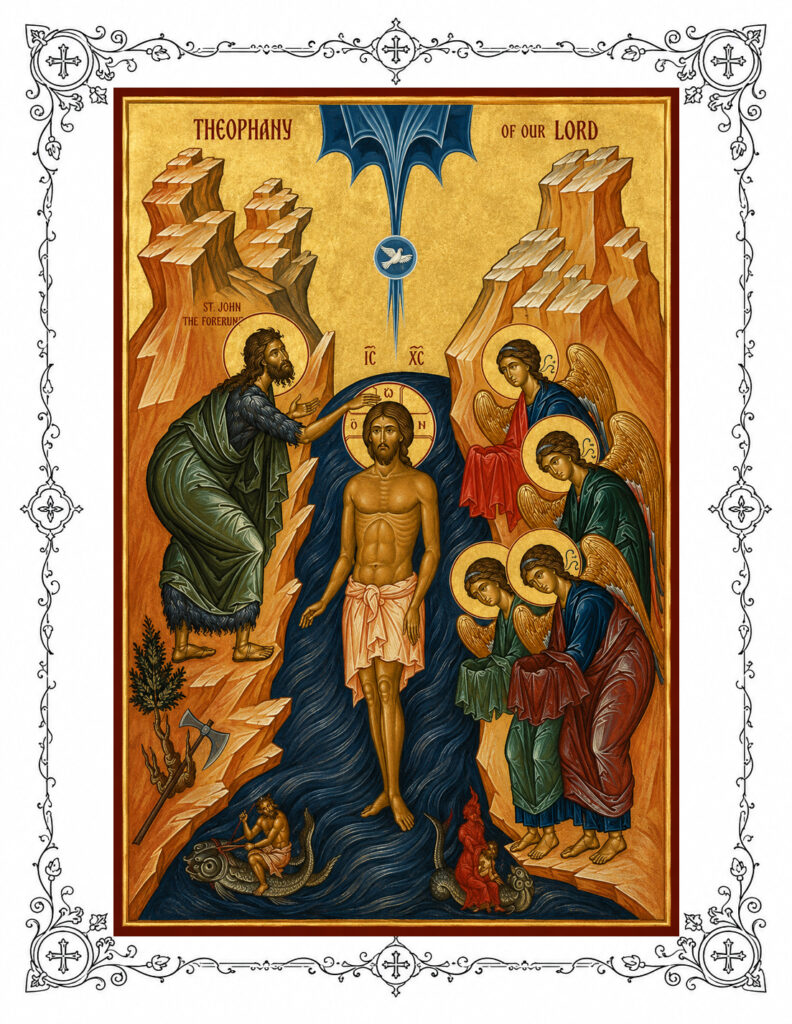
The Orthodox Church commemorates this passage during the Great Blessing of Waters at Theophany, where the prayers recall how God used water both for judgment and for sanctification throughout salvation history. The flood waters are mentioned alongside the waters of the Jordan, showing the continuity of God’s salvific work through water.
In the baptismal rite itself, the priest prays over the waters, invoking the same God who brought the flood and who sanctified the Jordan. The candidate, like Noah, passes through waters of death to emerge into new life, preserved in the ark of the Church.
Spiritual Application
For Orthodox spirituality, this verse reminds us that God’s judgment and mercy are not opposed but work together for human salvation. The destruction of corruption makes way for renewal. Every Christian, having passed through baptismal waters, is called to live as Noah did—righteous and blameless in their generation, walking with God amid a corrupt world.