Introduction to the book of Leviticus
The Book of Leviticus receives its English title from the Latin Vulgate, which is derived from the Greek Septuagint (LXX) title Leuitikon (Λευιτικόν), meaning “Levitical” or “pertaining to the Levites.”
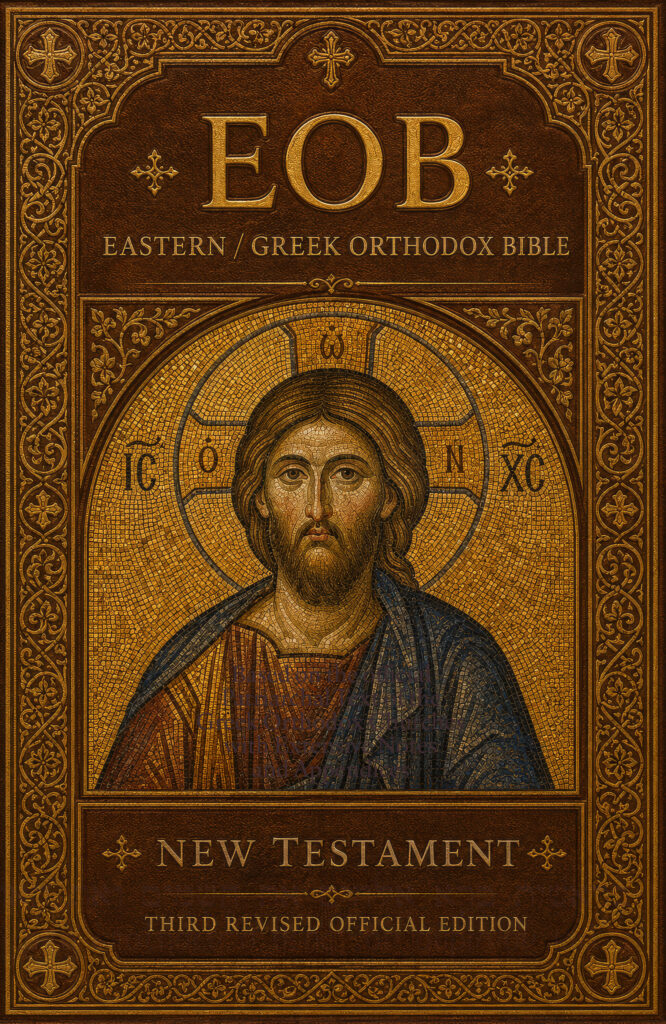
EOB: Official Site of the Eastern / Greek Orthodox Bible (Old and New Testament)
EOB (Eastern / Greek Orthodox Bible):
EOB Footnote:
KJV (King James Version):
WEB (World English Bible):
Benton LXX (Vaticanus):
Douai-Rheims (Vulgate):
Apostoliki Diakonia (LXX):
YLT (Young Literal Translation )(MT):
BBE (Bible in Basic English):
EOB Commentary:
Commentary on Genesis 7:2
The Divine Distinction Between Clean and Unclean
This verse presents a striking detail in the flood narrative: God commands Noah to take seven pairs of clean animals but only one pair of unclean animals into the ark. This distinction, appearing long before the Mosaic Law, reveals that the categories of clean and unclean have their origin not in later legislation but in primordial divine wisdom.
Patristic Interpretation: Saint John Chrysostom observes that the greater number of clean animals was preserved for sacrifice, anticipating Noah’s offering upon leaving the ark. The sevenfold number points to completeness and sanctification, while the clean animals represent those things set apart for sacred use. Saint Ephrem the Syrian similarly notes that God’s providence ensured sufficient animals for both the continuation of species and for worship.
Typological Significance: The Fathers consistently read the ark as a type of the Church, and within this framework, the distinction between clean and unclean animals takes on ecclesiological meaning. The Church gathers all humanity, yet there remains a distinction between those prepared for sacred service and those still in need of purification. Saint Ambrose of Milan sees in the clean animals a figure of the faithful who offer themselves as living sacrifices, while the unclean represent those who enter the Church but have not yet been fully transformed.
Christological Dimension: The number seven, appearing here in connection with the clean animals, carries profound significance throughout Scripture, culminating in Christ who is the true Sabbath rest and the source of all holiness. He is the one who makes clean what was formerly unclean, as demonstrated in His healing of lepers and His declaration that all foods are clean. The abundance of clean animals preserved through the flood prefigures the abundance of grace that flows from Christ to sanctify all creation.
Liturgical Connections: The Orthodox Church’s blessing of animals and its careful attention to fasting disciplines echo this ancient distinction between clean and unclean. While the New Covenant has transformed our understanding—for nothing God has made is to be rejected when received with thanksgiving—the Church maintains a liturgical rhythm that honors the principle of setting apart certain things for sacred purposes.
Spiritual Application: For the Orthodox Christian, this verse invites reflection on our own preparation for entering the ark of salvation. Are we among those who offer ourselves wholly to God, multiplied in virtue like the seven pairs? The spiritual life calls us to move from the state of the unclean—preserved by mercy but minimal in number—to the abundance of the clean, sanctified and ready for divine service. Through repentance, fasting, and participation in the mysteries, we are transformed from unclean to clean, from merely surviving the flood of this world to thriving as offerings acceptable to God.
The Book of Leviticus receives its English title from the Latin Vulgate, which is derived from the Greek Septuagint (LXX) title Leuitikon (Λευιτικόν), meaning “Levitical” or “pertaining to the Levites.”

The Book of Exodus receives its English title from the Greek Septuagint (LXX), where it is called Exodos (Ἔξοδος), meaning “departure” or “exit.” This name was chosen because the central

I. Date and Authorship Holy Tradition of the Orthodox Church, affirmed by the Fathers and the liturgical usage of the Church from the earliest centuries, attributes the Book of Genesis

Does Hebrews 11 on the Maccabees Show Stronger Alignment with 4 Maccabees than 2 Maccabees? Hebrews 11 (the famous “Hall of Faith” chapter) does not explicitly mention the Maccabees by