Introduction to the book of Leviticus
The Book of Leviticus receives its English title from the Latin Vulgate, which is derived from the Greek Septuagint (LXX) title Leuitikon (Λευιτικόν), meaning “Levitical” or “pertaining to the Levites.”
EOB: Official Site of the Eastern / Greek Orthodox Bible (Old and New Testament)
EOB (Eastern / Greek Orthodox Bible):
EOB Footnote:
KJV (King James Version):
WEB (World English Bible):
Benton LXX (Vaticanus):
Douai-Rheims (Vulgate):
Apostoliki Diakonia (LXX):
YLT (Young Literal Translation )(MT):
BBE (Bible in Basic English):
EOB Commentary:
Genesis 7:16 Commentary
The Divine Seal of Salvation
This verse presents a profound theological image: God Himself closes the door of the ark behind Noah and his family. The phrase “and the Lord shut him in” reveals that salvation is ultimately God’s work, not merely human effort. Noah built the ark in obedience, but it was the Lord who sealed the vessel of deliverance.
Typological Significance for Christ and the Church
The Fathers consistently read this passage as prefiguring baptism and the Church. Saint John Chrysostom notes that just as the ark preserved eight souls through water, so the Church preserves the faithful through the waters of baptism. The number eight itself carries resurrection significance, pointing to the eighth day—the day of Christ’s rising and the inauguration of the new creation.
The closing of the door by God’s own hand prefigures Christ as the true Door (John 10:9). He who enters through Christ enters into salvation. Saint Ephrem the Syrian observes that the ark had one door, just as there is one way to the Father through the Son. The sealing of the ark also anticipates the sealing of Christ’s tomb, from which new life would emerge.
Liturgical Connections
The Orthodox baptismal rite explicitly invokes the typology of Noah’s ark. The prayer over the baptismal waters recalls how God saved Noah and his household through wood and water, connecting this ancient deliverance to the wood of the Cross and the waters of regeneration. The closing of the ark’s door by God parallels the anointing with chrism that seals the newly baptized, marking them as God’s own possession.
In the Paschal liturgy, we sing of Christ descending into Hades and breaking its gates. The image of God sealing Noah within the ark of life stands in contrast to the gates of death that could not hold the Author of Life.
Spiritual Application
This verse teaches the Orthodox Christian about divine providence and protection. Once we enter the ark of the Church through baptism, God Himself becomes our guardian. The closing of the door signifies both protection from the judgment outside and commitment to the journey within. There is no turning back from the baptismal covenant.
Saint Cyril of Jerusalem reminds catechumens that entering the baptismal waters is like entering the ark—a passage through death to life. The door that God closes behind us is the door to our former life of sin. We emerge, like Noah after the flood, into a world made new by grace.
The intimacy of God’s action here—personally closing the door—reveals His tender care for those who trust in Him. Noah did not seal his own fate; God sealed him in mercy.
The Book of Leviticus receives its English title from the Latin Vulgate, which is derived from the Greek Septuagint (LXX) title Leuitikon (Λευιτικόν), meaning “Levitical” or “pertaining to the Levites.”

The Book of Exodus receives its English title from the Greek Septuagint (LXX), where it is called Exodos (Ἔξοδος), meaning “departure” or “exit.” This name was chosen because the central
I. Date and Authorship Holy Tradition of the Orthodox Church, affirmed by the Fathers and the liturgical usage of the Church from the earliest centuries, attributes the Book of Genesis
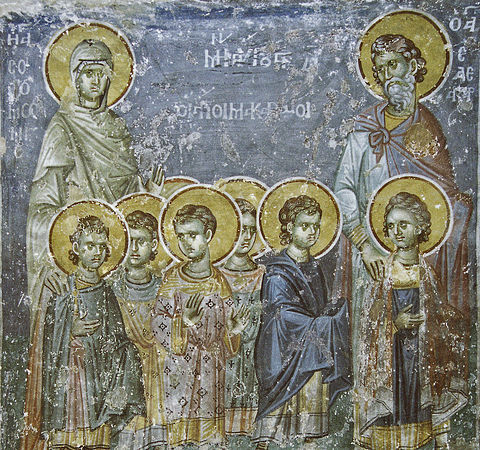
Does Hebrews 11 on the Maccabees Show Stronger Alignment with 4 Maccabees than 2 Maccabees? Hebrews 11 (the famous “Hall of Faith” chapter) does not explicitly mention the Maccabees by