Introduction to the book of Leviticus
The Book of Leviticus receives its English title from the Latin Vulgate, which is derived from the Greek Septuagint (LXX) title Leuitikon (Λευιτικόν), meaning “Levitical” or “pertaining to the Levites.”
EOB: Official Site of the Eastern / Greek Orthodox Bible (Old and New Testament)
EOB (Eastern / Greek Orthodox Bible):
EOB Footnote:
KJV (King James Version):
WEB (World English Bible):
Benton LXX (Vaticanus):
Douai-Rheims (Vulgate):
Apostoliki Diakonia (LXX):
YLT (Young Literal Translation )(MT):
BBE (Bible in Basic English):
EOB Commentary:
The Waters Decrease and the Mountaintops Appear
This verse marks a pivotal moment in the flood narrative, recording the gradual recession of the waters and the emergence of the mountaintops on the first day of the tenth month. The Fathers of the Church discerned in this detail profound typological significance pointing toward the mystery of salvation.
Patristic Interpretation: Saint Ephrem the Syrian observes that the appearance of the mountaintops represents the first visible signs of the renewed creation emerging from the waters of judgment. Just as the earth was initially covered and formless under the primordial waters in Genesis 1, so too the flood returned creation to a state of watery chaos, from which God would bring forth new life. The mountaintops breaking through the surface prefigure the resurrection, where Christ emerges victorious from the waters of death.
Saint Ambrose of Milan connects this gradual revelation to the progressive nature of divine pedagogy. God does not restore creation instantaneously but allows Noah to witness the slow unfolding of redemption, teaching patience and trust in divine providence. This mirrors the gradual revelation of salvation history, culminating in the Incarnation.
Christological Significance: The Orthodox tradition sees the ark resting and the mountains appearing as types of Christ and His Church. As the mountaintops emerge as the first stable ground in a world of chaos, so Christ is the Rock upon which the Church is founded, the first solid ground of salvation appearing above the floods of sin and death. The tenth month, coming after the prolonged period of waiting, suggests the fullness of time when God’s saving work becomes manifest.
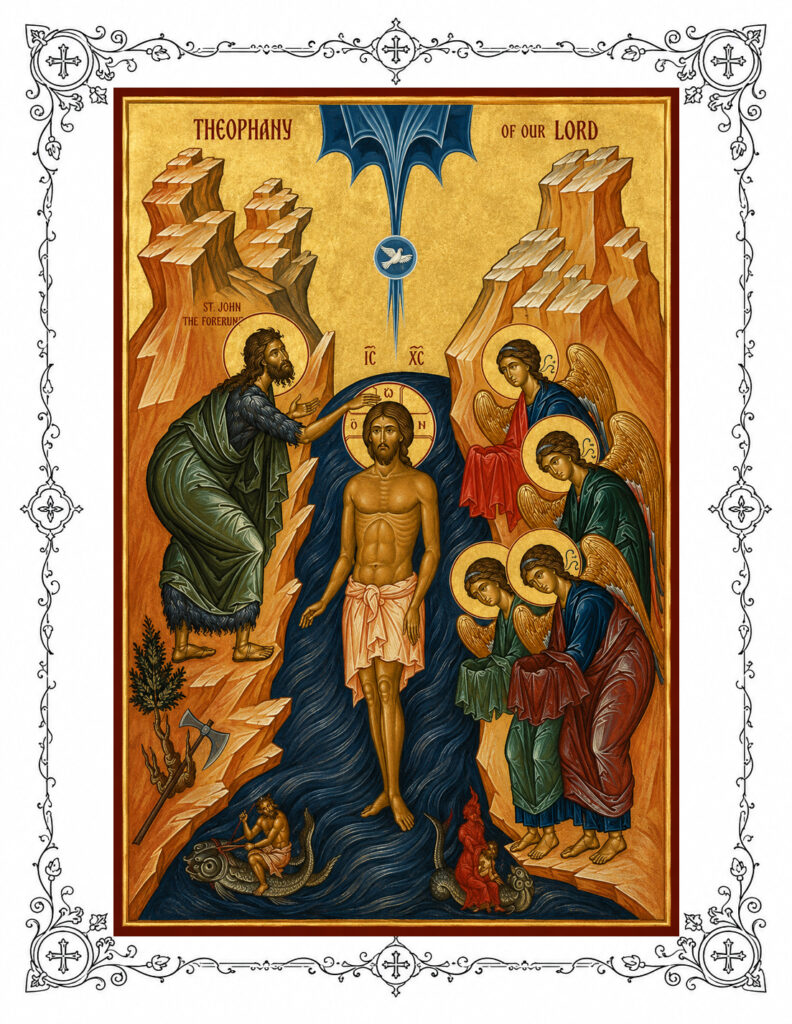
Liturgical Connections: The Great Blessing of Waters at Theophany draws upon flood imagery, blessing the waters that once brought judgment but now, through Christ’s baptism, become sources of sanctification. The emergence from the flood waters parallels the emergence of the newly baptized from the font, rising to new life as the earth rose renewed from the deluge.
Spiritual Application: For the Orthodox Christian, this verse speaks to the spiritual life’s rhythm of patience amid trial. The waters decreased gradually, not suddenly. Similarly, the passions that flood the soul are subdued progressively through ascetic struggle and divine grace. The mountaintops appearing offer hope that perseverance in the spiritual ark of the Church will yield visible fruits of transformation. As the Fathers teach, we must remain in the ark of salvation, trusting that God will reveal solid ground beneath our feet in His appointed time.
The Book of Leviticus receives its English title from the Latin Vulgate, which is derived from the Greek Septuagint (LXX) title Leuitikon (Λευιτικόν), meaning “Levitical” or “pertaining to the Levites.”

The Book of Exodus receives its English title from the Greek Septuagint (LXX), where it is called Exodos (Ἔξοδος), meaning “departure” or “exit.” This name was chosen because the central

I. Date and Authorship Holy Tradition of the Orthodox Church, affirmed by the Fathers and the liturgical usage of the Church from the earliest centuries, attributes the Book of Genesis

Does Hebrews 11 on the Maccabees Show Stronger Alignment with 4 Maccabees than 2 Maccabees? Hebrews 11 (the famous “Hall of Faith” chapter) does not explicitly mention the Maccabees by