Introduction to the book of Leviticus
The Book of Leviticus receives its English title from the Latin Vulgate, which is derived from the Greek Septuagint (LXX) title Leuitikon (Λευιτικόν), meaning “Levitical” or “pertaining to the Levites.”
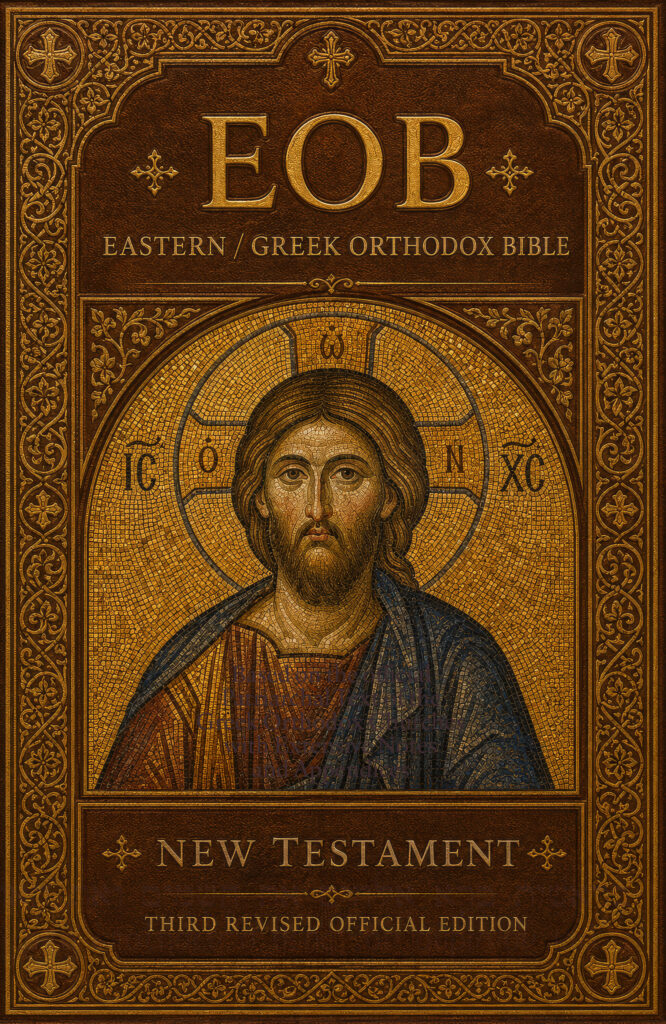
EOB: Official Site of the Eastern / Greek Orthodox Bible (Old and New Testament)
EOB (Eastern / Greek Orthodox Bible):
EOB Footnote:
KJV (King James Version):
WEB (World English Bible):
Benton LXX (Vaticanus):
Douai-Rheims (Vulgate):
Apostoliki Diakonia (LXX):
YLT (Young Literal Translation )(MT):
BBE (Bible in Basic English):
EOB Commentary:
Genesis 8:5 – Commentary
The Gradual Revelation of New Creation
This verse marks a pivotal moment in the flood narrative, as the waters continue their steady recession and the tops of the mountains become visible on the first day of the tenth month. The Fathers see in this gradual emergence of dry land a profound image of spiritual restoration and the dawning of salvation.
Patristic Interpretation: Saint Ephrem the Syrian notes that the appearance of the mountaintops signals God’s faithfulness in preserving creation and points toward the ultimate restoration of all things. The mountains emerging from the waters recall the third day of creation when dry land first appeared from the primordial deep, suggesting that the flood narrative recapitulates and renews the original creative act.
Christological Significance: The Orthodox tradition reads this gradual unveiling as typologically connected to the progressive revelation of Christ in salvation history. Just as the mountains slowly became visible as the waters receded, so too did the mystery of the Incarnation gradually become clearer through the prophets until the fullness of time. The mountaintops appearing can also be understood as an image of the saints and righteous ones who stand firm above the waters of sin and death, their heads lifted toward heaven.
Liturgical Connections: In the hymnography of Great Lent and the Paschal season, water imagery features prominently. The flood waters represent both judgment and purification, and their recession anticipates the baptismal waters through which believers pass from death to life. The emergence of solid ground from beneath the waters finds its fulfillment in Christ’s emergence from the tomb and from the waters of the Jordan.
Spiritual Application: For the Orthodox Christian, this verse offers consolation during periods of spiritual trial. Just as Noah waited patiently while the waters slowly receded, believers are called to patient endurance, trusting that God’s saving work proceeds according to divine timing. The appearance of the mountaintops after months of seeing nothing but water would have brought immense hope to those in the ark. Similarly, even small signs of spiritual progress or answered prayer should encourage the faithful to persevere.
The specific mention of the tenth month carries numerical significance in patristic thought, as ten often represents completion and the fullness of the Law. The mountains becoming visible in this month suggests that true vision and understanding come through patient obedience to God’s commands.
The Book of Leviticus receives its English title from the Latin Vulgate, which is derived from the Greek Septuagint (LXX) title Leuitikon (Λευιτικόν), meaning “Levitical” or “pertaining to the Levites.”

The Book of Exodus receives its English title from the Greek Septuagint (LXX), where it is called Exodos (Ἔξοδος), meaning “departure” or “exit.” This name was chosen because the central

I. Date and Authorship Holy Tradition of the Orthodox Church, affirmed by the Fathers and the liturgical usage of the Church from the earliest centuries, attributes the Book of Genesis

Does Hebrews 11 on the Maccabees Show Stronger Alignment with 4 Maccabees than 2 Maccabees? Hebrews 11 (the famous “Hall of Faith” chapter) does not explicitly mention the Maccabees by