Commentary on Genesis 9:14
The Divine Remembrance and the Sign of Covenant
This verse reveals a profound theological truth about God’s relationship with creation through the mechanism of divine remembrance. When God speaks of bringing clouds over the earth and the bow appearing, He establishes a perpetual visual sign that connects heaven and earth. The cloud itself becomes a bearer of sacred meaning, transforming what might appear as a harbinger of destruction into a canvas for covenantal promise.
Typological Significance for Christ and the Church
The Fathers of the Church perceived in this passage a foreshadowing of the Incarnation and the sacramental life. Saint John Chrysostom notes that just as the rainbow appears within the cloud yet transforms its threatening aspect into beauty, so the Son of God took upon Himself human nature—entering into the very condition that had been subject to judgment—and transformed it into a vehicle of salvation. The cloud represents humanity in its fallen state, while the bow represents the divine glory shining through created matter.
The rainbow’s appearance specifically in connection with clouds bearing rain finds liturgical resonance in the Orthodox understanding of baptism. The waters that once destroyed now become the waters of regeneration. Saint Cyril of Jerusalem draws this connection explicitly, teaching that what was once an instrument of death becomes, through God’s covenant faithfulness, an instrument of life.
Liturgical and Spiritual Dimensions
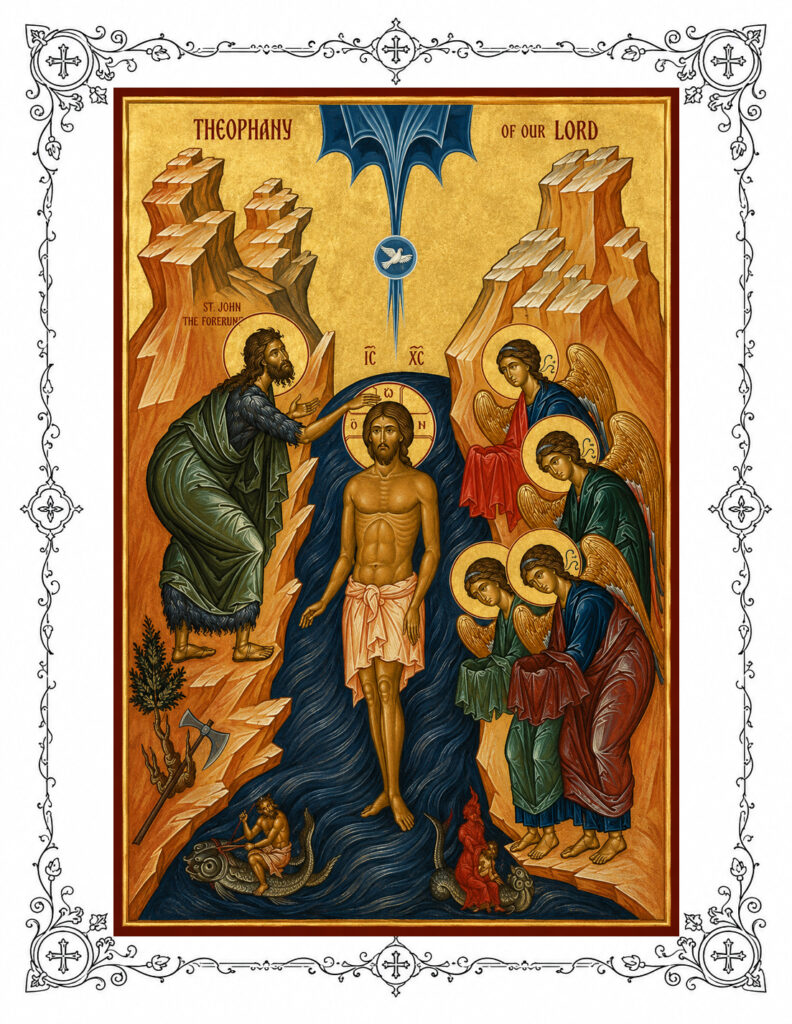
In Orthodox hymnography, particularly during the feast of Theophany, we encounter themes that echo this passage. The blessing of waters recalls God’s transformation of the threatening element into a source of blessing. The priest’s prayers invoke God’s power to sanctify the waters, remembering that He who once judged through water now saves through water.
The phrase “the bow shall be seen in the cloud” also carries eschatological weight. In the Apocalypse of Saint John, the rainbow appears around the throne of God, connecting this Noahic covenant to the final restoration of all things. Orthodox iconography sometimes depicts Christ enthroned within a mandorla containing rainbow colors, visually linking the Genesis covenant to its ultimate fulfillment.
For Orthodox spirituality, this verse teaches that God’s remembrance is not mere recollection but active, salvific engagement with His creation. When God sees the bow, He remembers—and His remembrance is itself the guarantee of preservation. This understanding shapes the Orthodox approach to prayer, particularly the commemoration of the living and the dead in the Divine Liturgy, where we ask God to remember His servants, trusting that His remembrance brings blessing and life.