Introduction to the book of Leviticus
The Book of Leviticus receives its English title from the Latin Vulgate, which is derived from the Greek Septuagint (LXX) title Leuitikon (Λευιτικόν), meaning “Levitical” or “pertaining to the Levites.”
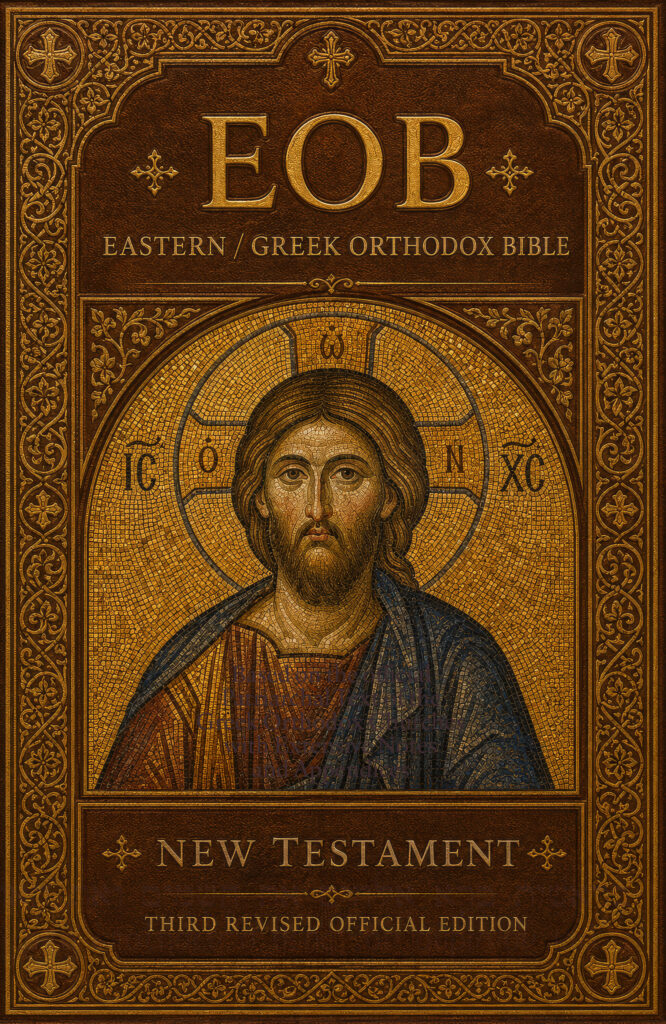
EOB: Official Site of the Eastern / Greek Orthodox Bible (Old and New Testament)
EOB (Eastern / Greek Orthodox Bible):
EOB Footnote:
KJV (King James Version):
WEB (World English Bible):
Benton LXX (Vaticanus):
Douai-Rheims (Vulgate):
Apostoliki Diakonia (LXX):
YLT (Young Literal Translation )(MT):
BBE (Bible in Basic English):
EOB Commentary:
GENESIS 10:9 – NIMROD THE MIGHTY HUNTER
Typological Significance
This verse describing Nimrod as a “mighty hunter before the Lord” has received considerable attention in patristic interpretation, often being read in a negative light despite the surface meaning. The phrase “before the Lord” (enanti Kyriou in the Septuagint) was understood by many Fathers not as divine approval but rather as a boastful opposition to God. Nimrod becomes a type of the proud ruler who sets himself against the divine order, foreshadowing all tyrannical powers that oppose the Kingdom of God.
Patristic Interpretation
Saint Augustine in the City of God interprets Nimrod’s hunting not primarily of animals but of men—he was a hunter of souls, a deceiver and oppressor of peoples. The connection to Babel in the following verses reinforces this reading, as Nimrod becomes associated with the confusion of tongues and humanity’s prideful attempt to storm heaven. Saint John Chrysostom similarly notes that Nimrod’s might was exercised in opposition to God’s purposes, representing the first emergence of tyranny after the Flood.
The phrase becoming proverbial—”like Nimrod, a mighty hunter before the Lord”—indicates that his reputation spread widely, yet this fame was not necessarily commendable. The Fathers saw in such earthly glory a warning against vainglory and the pursuit of worldly power.
Christological Contrast
Orthodox theology sees in Nimrod an antitype to Christ. Where Nimrod hunted and dominated men through force, Christ the Good Shepherd seeks the lost sheep to save them. Where Nimrod built Babel in pride, Christ humbled Himself and at Pentecost reversed Babel’s confusion through the gift of tongues. The contrast between the earthly hunter-king and the Heavenly King who allows Himself to be hunted and slain for humanity’s salvation presents a profound meditation on the nature of true authority.
Spiritual Application
For Orthodox spirituality, Nimrod represents the passionate soul that seeks to dominate rather than serve, to hunt rather than nurture. The ascetical tradition warns against the “Nimrod spirit” within each person—the desire for power, recognition, and control that sets itself “before the Lord” in competition rather than submission. The Jesus Prayer and the cultivation of humility serve as antidotes to this ancient temptation that emerged so soon after humanity’s fresh start following the Flood.
The verse reminds the faithful that renown among men means nothing if it represents opposition to God’s purposes, and that true greatness in the Kingdom is measured by service and self-emptying love.
The Book of Leviticus receives its English title from the Latin Vulgate, which is derived from the Greek Septuagint (LXX) title Leuitikon (Λευιτικόν), meaning “Levitical” or “pertaining to the Levites.”

The Book of Exodus receives its English title from the Greek Septuagint (LXX), where it is called Exodos (Ἔξοδος), meaning “departure” or “exit.” This name was chosen because the central

I. Date and Authorship Holy Tradition of the Orthodox Church, affirmed by the Fathers and the liturgical usage of the Church from the earliest centuries, attributes the Book of Genesis

Does Hebrews 11 on the Maccabees Show Stronger Alignment with 4 Maccabees than 2 Maccabees? Hebrews 11 (the famous “Hall of Faith” chapter) does not explicitly mention the Maccabees by