Introduction to the book of Leviticus
The Book of Leviticus receives its English title from the Latin Vulgate, which is derived from the Greek Septuagint (LXX) title Leuitikon (Λευιτικόν), meaning “Levitical” or “pertaining to the Levites.”
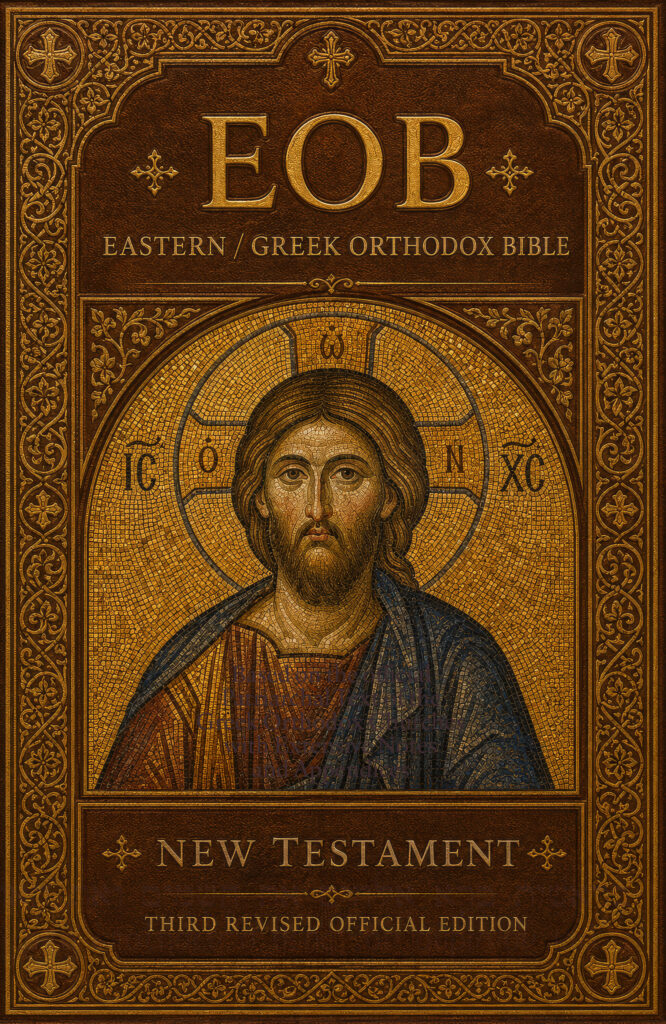
EOB: Official Site of the Eastern / Greek Orthodox Bible (Old and New Testament)
EOB (Eastern / Greek Orthodox Bible):
EOB Footnote:
KJV (King James Version):
WEB (World English Bible):
Benton LXX (Vaticanus):
Douai-Rheims (Vulgate):
Apostoliki Diakonia (LXX):
YLT (Young Literal Translation )(MT):
BBE (Bible in Basic English):
EOB Commentary:
Genesis 10:13 Commentary
And Mizraim begot Ludim, and Anamim, and Lehabim, and Naphtuhim.
This verse continues the genealogical record of the descendants of Ham through his son Mizraim, the progenitor of Egypt. While this passage may appear to be a simple ethnographic catalogue, the Fathers of the Church understood such genealogies as bearing theological significance within the broader narrative of salvation history.
Patristic Understanding: The Church Fathers recognized that the Table of Nations in Genesis 10 demonstrates the unity of the human race descended from Noah, and thus from Adam. Saint Augustine in his City of God notes that these genealogies establish the historical framework through which God’s providence operates, preparing the way for the eventual calling of all nations to salvation. The multiplication of peoples after the Flood prefigures the universal scope of the Gospel, which would be preached to every nation, tribe, and tongue.
Typological Significance: Egypt, represented by Mizraim and his descendants, holds a complex place in Orthodox biblical interpretation. Egypt serves throughout Scripture as both a place of refuge and a symbol of bondage to sin. The descendants of Mizraim would later enslave Israel, making the Exodus a central type of salvation and baptism. Yet Egypt also sheltered the Holy Family when they fled from Herod, fulfilling the prophecy “Out of Egypt I called My Son” (Hosea 11:1, Matthew 2:15). Thus even in this genealogical notation, we see the seeds of nations that would play crucial roles in the drama of redemption.
Liturgical Connection: In the Orthodox baptismal service, the prayers of exorcism and the blessing of the waters recall the crossing of the Red Sea, where the descendants of Mizraim were overcome. The catechumen passes through the waters as Israel passed through the sea, leaving behind the Egypt of sin and entering into the promised inheritance of the Kingdom. The genealogy of Genesis 10 thus provides the historical background for understanding the typological depth of our sacramental life.
Spiritual Application: The Fathers also saw in the dispersion of nations a reminder that human diversity, while real, does not negate our common origin and common calling. Saint John Chrysostom emphasized that the Gospel breaks down the barriers between peoples, gathering all the scattered children of Adam into the one Body of Christ, the Church. What was divided at Babel is reunited at Pentecost, when people of every nation heard the apostles speaking in their own tongues.
The Book of Leviticus receives its English title from the Latin Vulgate, which is derived from the Greek Septuagint (LXX) title Leuitikon (Λευιτικόν), meaning “Levitical” or “pertaining to the Levites.”

The Book of Exodus receives its English title from the Greek Septuagint (LXX), where it is called Exodos (Ἔξοδος), meaning “departure” or “exit.” This name was chosen because the central

I. Date and Authorship Holy Tradition of the Orthodox Church, affirmed by the Fathers and the liturgical usage of the Church from the earliest centuries, attributes the Book of Genesis

Does Hebrews 11 on the Maccabees Show Stronger Alignment with 4 Maccabees than 2 Maccabees? Hebrews 11 (the famous “Hall of Faith” chapter) does not explicitly mention the Maccabees by