Introduction to the book of Leviticus
The Book of Leviticus receives its English title from the Latin Vulgate, which is derived from the Greek Septuagint (LXX) title Leuitikon (Λευιτικόν), meaning “Levitical” or “pertaining to the Levites.”
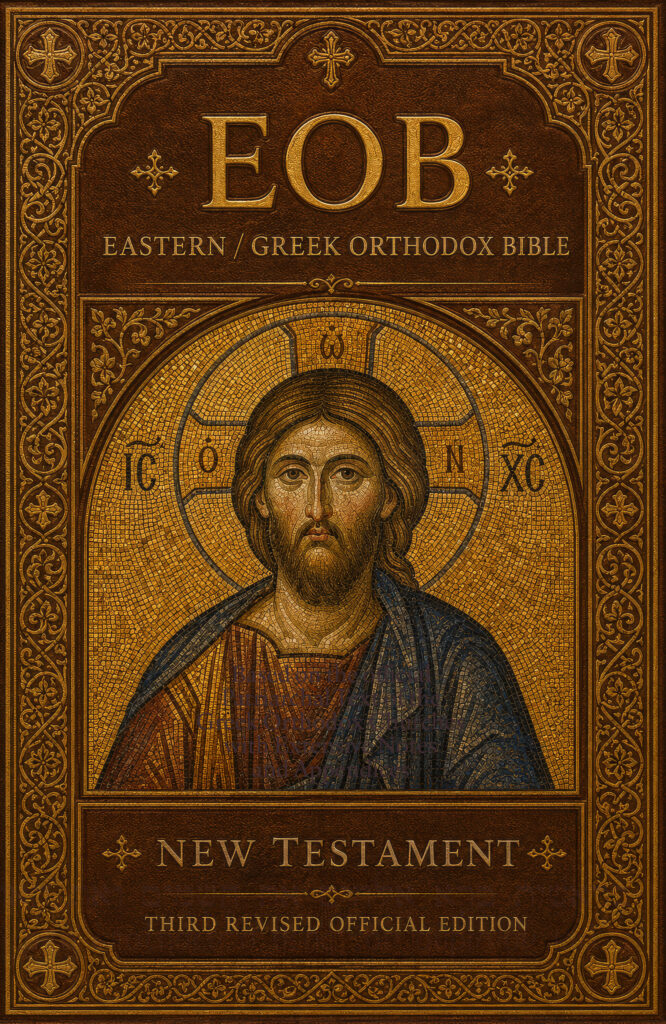
EOB: Official Site of the Eastern / Greek Orthodox Bible (Old and New Testament)
EOB (Eastern / Greek Orthodox Bible):
EOB Footnote:
KJV (King James Version):
WEB (World English Bible):
Benton LXX (Vaticanus):
Douai-Rheims (Vulgate):
Apostoliki Diakonia (LXX):
YLT (Young Literal Translation )(MT):
BBE (Bible in Basic English):
EOB Commentary:
Commentary on Genesis 10:18
The Dispersion of the Canaanite Clans
This verse concludes the enumeration of the descendants of Canaan, noting that afterward the families of the Canaanites spread abroad. While this may appear to be merely genealogical data, the Orthodox interpretive tradition finds deeper significance in understanding the spread of nations and their relationship to salvation history.
Typological Significance:
The Canaanites, whose territorial expansion is noted here, become throughout Scripture a type of the fallen condition of humanity apart from divine grace. The lands they inhabited would later become the Promised Land given to Israel, prefiguring the heavenly inheritance promised to the faithful in Christ. Saint Ephrem the Syrian notes that the dispersion of peoples after the flood established the conditions by which God would later call Abraham out from among the nations, setting apart a people through whom the Messiah would come.
Christological Reading:
The Church Fathers understood that the spreading abroad of nations, including the Canaanites, was part of divine providence preparing for the universal mission of Christ. Where the Canaanites spread in rebellion and idolatry, Christ would send His apostles to gather all nations into the one Body of the Church. The geographic specificity of these genealogies reminds us that the Incarnation occurred in real history, in lands whose boundaries were established in these ancient times.
Liturgical Connection:
In the Orthodox liturgical tradition, the reading of Genesis during Great Lent includes these genealogical passages, reminding the faithful that God’s plan of salvation unfolds through concrete human history. The spreading of the Canaanite clans stands in contrast to the gathering of all peoples at Pentecost, when the Holy Spirit reversed the confusion of Babel and united diverse nations in the one faith.
Patristic Wisdom:
Saint John Chrysostom, in his Homilies on Genesis, encourages believers not to pass over such verses hastily, for even the recording of names and territories demonstrates God’s providential ordering of human affairs. The boundaries of nations, as Saint Paul would later teach in Athens, were established so that people might seek God and find Him.
Spiritual Application:
For Orthodox Christians, this verse serves as a reminder that no corner of creation lies outside God’s redemptive purpose. The very lands where Canaanite clans once spread in darkness would become places where the light of Christ shone forth, where martyrs witnessed, and where the Divine Liturgy continues to be celebrated to this day.
The Book of Leviticus receives its English title from the Latin Vulgate, which is derived from the Greek Septuagint (LXX) title Leuitikon (Λευιτικόν), meaning “Levitical” or “pertaining to the Levites.”

The Book of Exodus receives its English title from the Greek Septuagint (LXX), where it is called Exodos (Ἔξοδος), meaning “departure” or “exit.” This name was chosen because the central

I. Date and Authorship Holy Tradition of the Orthodox Church, affirmed by the Fathers and the liturgical usage of the Church from the earliest centuries, attributes the Book of Genesis

Does Hebrews 11 on the Maccabees Show Stronger Alignment with 4 Maccabees than 2 Maccabees? Hebrews 11 (the famous “Hall of Faith” chapter) does not explicitly mention the Maccabees by