Introduction to the book of Leviticus
The Book of Leviticus receives its English title from the Latin Vulgate, which is derived from the Greek Septuagint (LXX) title Leuitikon (Λευιτικόν), meaning “Levitical” or “pertaining to the Levites.”
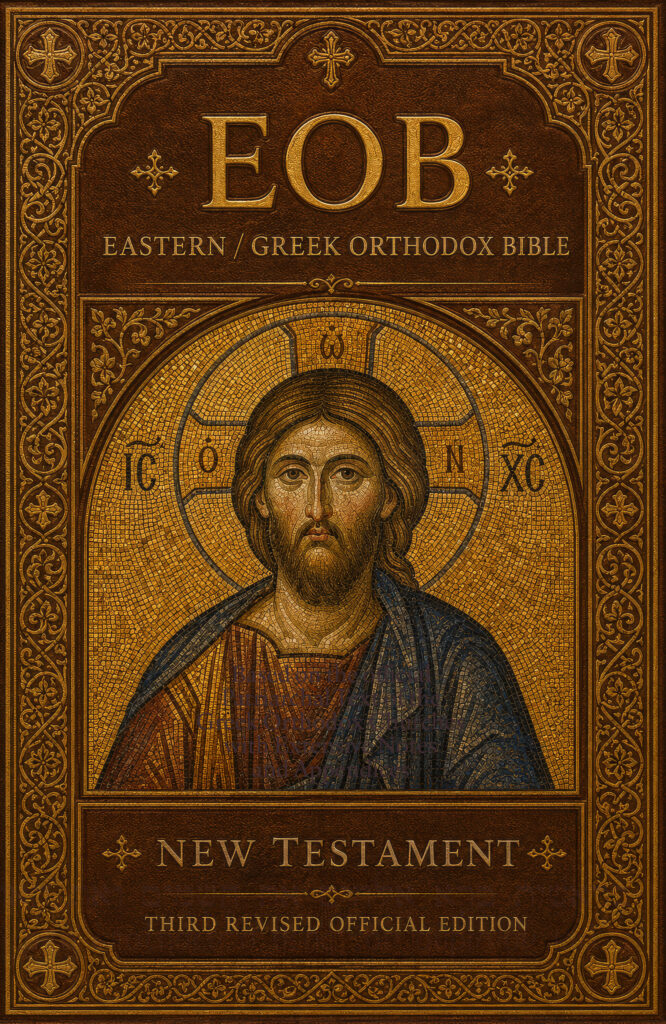
EOB: Official Site of the Eastern / Greek Orthodox Bible (Old and New Testament)
EOB (Eastern / Greek Orthodox Bible):
EOB Footnote:
KJV (King James Version):
WEB (World English Bible):
Benton LXX (Vaticanus):
Douai-Rheims (Vulgate):
Apostoliki Diakonia (LXX):
YLT (Young Literal Translation )(MT):
BBE (Bible in Basic English):
EOB Commentary:
The Table of Nations: Foundation for Universal Salvation
This concluding verse of the Table of Nations carries profound theological significance that reverberates throughout Scripture and into the heart of Orthodox Christian understanding of salvation history.
Ecclesiological Significance: The enumeration of seventy nations (according to the Septuagint tradition, seventy-two in some reckonings) establishes a foundational typology that Christ Himself fulfills. When our Lord appoints seventy (or seventy-two) disciples in Luke 10, the Fathers consistently interpret this as a deliberate echo of Genesis 10. Saint Cyril of Alexandria and other patristic commentators understood this appointment as signifying that the Gospel would reach all the nations descended from Noah’s sons. The mission of the seventy thus becomes the reversal and healing of Babel’s division.
Christological Dimension: The phrase “after the flood” reminds us that humanity’s post-diluvian expansion occurs under the sign of God’s covenant mercy. The Orthodox Church sees in Noah a type of Christ, and in the ark a type of the Church. Just as all nations descend from those preserved in the ark, so all peoples find their true unity and preservation in Christ and His Church. The scattering of nations becomes, in God’s providence, preparation for the gathering of all peoples into one Body.
Liturgical Connections: This passage finds resonance in the Pentecost celebration, where the miracle of tongues explicitly reverses Babel’s confusion. The kontakion of Pentecost proclaims that when the Most High confused the tongues, He divided the nations, but when He distributed the tongues of fire, He called all to unity. The Table of Nations thus stands as the historical backdrop against which the Holy Spirit’s unifying work at Pentecost must be understood.
Patristic Interpretation: Saint Augustine in the City of God extensively treats this genealogy, noting that it establishes the organic unity of humanity while acknowledging legitimate diversity. The Fathers consistently emphasized that ethnic and linguistic diversity, while resulting from judgment at Babel, becomes in God’s economy a means of manifesting the catholicity of the Church. Saint John Chrysostom observes that Scripture carefully preserves these genealogies to demonstrate that all humanity shares common ancestry and common need for redemption.
Spiritual Application: For Orthodox spirituality, this verse reminds us that no nation or people stands outside God’s providential care. The universality of human descent from Noah’s family establishes the universality of the Gospel’s call. Every Divine Liturgy, celebrated in countless languages across the nations, fulfills the promise implicit in this ancient genealogy—that from every family and tongue, God would gather a people for His Name.
The Book of Leviticus receives its English title from the Latin Vulgate, which is derived from the Greek Septuagint (LXX) title Leuitikon (Λευιτικόν), meaning “Levitical” or “pertaining to the Levites.”

The Book of Exodus receives its English title from the Greek Septuagint (LXX), where it is called Exodos (Ἔξοδος), meaning “departure” or “exit.” This name was chosen because the central

I. Date and Authorship Holy Tradition of the Orthodox Church, affirmed by the Fathers and the liturgical usage of the Church from the earliest centuries, attributes the Book of Genesis

Does Hebrews 11 on the Maccabees Show Stronger Alignment with 4 Maccabees than 2 Maccabees? Hebrews 11 (the famous “Hall of Faith” chapter) does not explicitly mention the Maccabees by