Introduction to the book of Leviticus
The Book of Leviticus receives its English title from the Latin Vulgate, which is derived from the Greek Septuagint (LXX) title Leuitikon (Λευιτικόν), meaning “Levitical” or “pertaining to the Levites.”
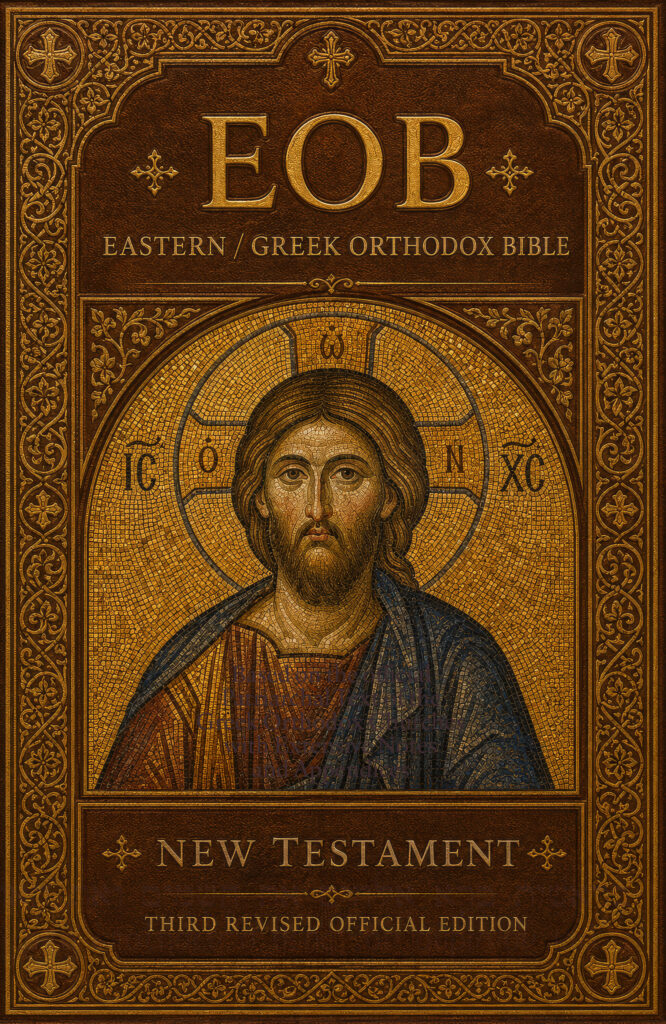
EOB: Official Site of the Eastern / Greek Orthodox Bible (Old and New Testament)
EOB (Eastern / Greek Orthodox Bible):
EOB Footnote:
KJV (King James Version):
WEB (World English Bible):
Benton LXX (Vaticanus):
Douai-Rheims (Vulgate):
Apostoliki Diakonia (LXX):
YLT (Young Literal Translation )(MT):
BBE (Bible in Basic English):
EOB Commentary:
Genesis 11:3 – Commentary
The Brick and the Stone
This verse marks a significant moment in the narrative of Babel, where humanity substitutes natural stone with manufactured brick and natural morite (bitumen or slime) for mortar. The Fathers see in this substitution a profound spiritual meaning that resonates throughout Scripture and into the life of the Church.
Patristic Interpretation: Saint Ephrem the Syrian notes that the builders of Babel rejected what God had provided naturally in favor of their own human constructions. This represents the fundamental error of pride—the belief that human ingenuity can improve upon or replace divine provision. The brick, formed by human hands and fired in kilns, symbolizes the works of man apart from God, while natural stone throughout Scripture represents divine foundation and stability.
Christological Significance: The contrast between brick and stone finds its ultimate resolution in Christ, whom Saint Peter identifies as the “living stone” (1 Peter 2:4) and the “chief cornerstone” (1 Peter 2:6). Where Babel’s builders rejected God’s stone for their own bricks, the Church is built upon the true Stone rejected by the builders. Christ Himself declares that upon the rock (petra) of Peter’s confession, He will build His Church (Matthew 16:18). The artificial unity sought at Babel through human manufacture stands in stark contrast to the organic unity of the Body of Christ.
Liturgical Connections: In the Orthodox consecration of a church, natural stones are placed in the foundation, and the antimension contains relics—connecting the worship space to the apostolic foundation built upon Christ the Cornerstone. The Pentecost services explicitly contrast Babel’s confusion with the unity restored through the Holy Spirit, where the scattered languages are reunited not through human effort but through divine grace.
Spiritual Application: The substitution of brick for stone speaks to the perennial temptation in spiritual life to replace authentic divine gifts with human substitutes—to construct our own righteousness rather than receive Christ’s, to build religious systems rather than enter into living relationship with God. Saint John Chrysostom observes that all human constructions apart from God, no matter how impressive, are destined for confusion and dissolution.
The slime or bitumen used as mortar was the same substance that waterproofed Noah’s ark. What preserved the righteous through judgment here becomes the binding agent of rebellion—a reminder that material things in themselves are neutral, taking their moral character from the purposes to which they are directed.
The Book of Leviticus receives its English title from the Latin Vulgate, which is derived from the Greek Septuagint (LXX) title Leuitikon (Λευιτικόν), meaning “Levitical” or “pertaining to the Levites.”

The Book of Exodus receives its English title from the Greek Septuagint (LXX), where it is called Exodos (Ἔξοδος), meaning “departure” or “exit.” This name was chosen because the central

I. Date and Authorship Holy Tradition of the Orthodox Church, affirmed by the Fathers and the liturgical usage of the Church from the earliest centuries, attributes the Book of Genesis

Does Hebrews 11 on the Maccabees Show Stronger Alignment with 4 Maccabees than 2 Maccabees? Hebrews 11 (the famous “Hall of Faith” chapter) does not explicitly mention the Maccabees by