Introduction to the book of Leviticus
The Book of Leviticus receives its English title from the Latin Vulgate, which is derived from the Greek Septuagint (LXX) title Leuitikon (Λευιτικόν), meaning “Levitical” or “pertaining to the Levites.”
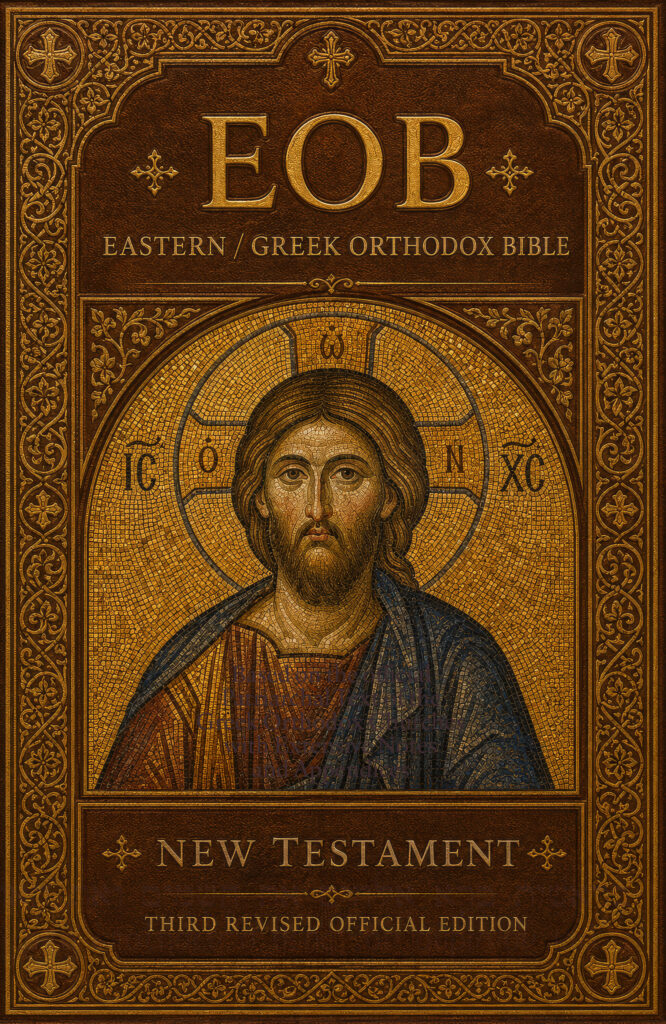
EOB: Official Site of the Eastern / Greek Orthodox Bible (Old and New Testament)
EOB (Eastern / Greek Orthodox Bible):
EOB Footnote:
KJV (King James Version):
WEB (World English Bible):
Benton LXX (Vaticanus):
Douai-Rheims (Vulgate):
Apostoliki Diakonia (LXX):
YLT (Young Literal Translation )(MT):
BBE (Bible in Basic English):
EOB Commentary:
Commentary on Genesis 11:10
The Genealogy of Shem and the Line of Promise
This verse initiates the toledot (generations) of Shem, marking a pivotal transition in the Genesis narrative from the universal history of humanity to the particular lineage through which salvation would come. Following the dispersion at Babel, the sacred text narrows its focus to trace the ancestry that will culminate in Abraham and ultimately in Christ Himself.
Christological Significance:
The genealogy beginning here finds its fulfillment in the Gospel of Luke, where the evangelist traces the lineage of our Lord Jesus Christ back through Shem to Adam and to God Himself (Luke 3:36). This connection establishes that the Incarnate Word entered human history not arbitrarily but through a divinely prepared lineage. The Church Fathers understood these genealogies as demonstrating God’s providential ordering of history toward the coming of the Messiah. Saint Irenaeus of Lyon emphasized that such genealogical records prove Christ’s true humanity and His genuine participation in our nature through real ancestral descent.
Patristic Interpretation:
Saint John Chrysostom, in his Homilies on Genesis, notes that Scripture preserves these genealogies with precision to demonstrate God’s faithfulness across generations. The mention that Shem begat Arphaxad “two years after the flood” anchors sacred history in concrete temporal reality, showing that God works within time to accomplish His eternal purposes. The Fathers saw in Shem’s blessing by Noah (Genesis 9:26) a prophetic indication that through his line the blessing would flow to all nations.
Liturgical and Spiritual Dimensions:
The Orthodox Church reads portions of these genealogies during the Royal Hours of the Nativity, connecting the birth of Christ to the long preparation of His ancestors. This practice reflects the theological conviction that every generation in this lineage participated, knowingly or unknowingly, in the divine economy of salvation.
The careful recording of ages and generations also speaks to Orthodox spirituality regarding the communion of saints across time. Each name represents a person who lived, died, and awaited the fulfillment of God’s promises. The faithful who hear these names in liturgical context are reminded that they too stand within a great cloud of witnesses stretching from Shem to the present day.
The genealogy thus serves as a bridge connecting the primordial history of Genesis 1-11 with the patriarchal narratives that follow, demonstrating that God’s plan of redemption unfolds through particular people in particular times, yet always moves toward the universal salvation accomplished in Christ.
The Book of Leviticus receives its English title from the Latin Vulgate, which is derived from the Greek Septuagint (LXX) title Leuitikon (Λευιτικόν), meaning “Levitical” or “pertaining to the Levites.”

The Book of Exodus receives its English title from the Greek Septuagint (LXX), where it is called Exodos (Ἔξοδος), meaning “departure” or “exit.” This name was chosen because the central

I. Date and Authorship Holy Tradition of the Orthodox Church, affirmed by the Fathers and the liturgical usage of the Church from the earliest centuries, attributes the Book of Genesis

Does Hebrews 11 on the Maccabees Show Stronger Alignment with 4 Maccabees than 2 Maccabees? Hebrews 11 (the famous “Hall of Faith” chapter) does not explicitly mention the Maccabees by