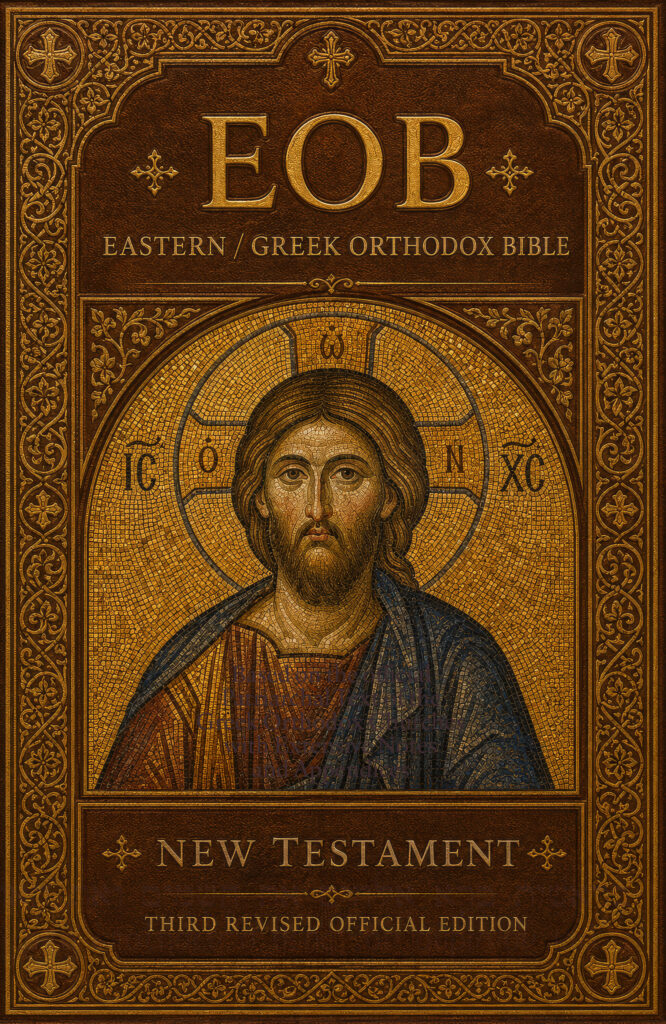
EOB: Official Site of the Eastern / Greek Orthodox Bible (Old and New Testament)

Genesis 11:27

EOB (Eastern / Greek Orthodox Bible):

This is the account of Terah’s family: Terah was the father of Abram, Nahor, and Haran. And Haran was the father of Lot.

EOB Footnote:

The MT includes the phrase “Haran fathered Lot” which is also present in the LXX, establishing Lot’s lineage within the genealogical record. The MT spelling “Sarai” corresponds to the LXX “Sara” for Abram’s wife. No DSS manuscript witness exists for this verse.

Other Translations:

KJV (King James Version):

Now these are the generations of Terah: Terah begat Abram, Nahor, and Haran; and Haran begat Lot.

WEB (World English Bible):

Now this is the history of the generations of Terah. Terah became the father of Abram, Nahor, and Haran. Haran became the father of Lot.

Benton LXX (Vaticanus):

This verse is not available in the Brenton translation of the Septuagint.

Douai-Rheims (Vulgate):

These are the generations of Thare: Thare begot Abram, Nachor, and Aran.

Apostoliki Diakonia (LXX):

These are the generations of Terah: Terah became the father of Abram, Nahor, and Haran; and Haran became the father of Lot.

YLT (Young Literal Translation )(MT):

And these are the generations of Terah: Terah begot Abram, Nahor, and Haran; and Haran begot Lot.

BBE (Bible in Basic English):

This is the story of Terah’s family. Terah became the father of Abram, Nahor, and Haran; and Haran became the father of Lot.

EOB COMMENTARY:

EOB Commentary:

Commentary on Genesis 11:27

The Generations of Terah and the Preparation for Salvation

This verse marks a pivotal transition in the book of Genesis, moving from the universal history of humanity to the particular history of the chosen lineage through which the Messiah would come. The phrase “these are the generations of Terah” (toledot Terah) introduces the genealogical line that will culminate in Abraham, the father of faith and the ancestor of Christ according to the flesh.

Christological Significance:
The mention of Abram (later Abraham) in this genealogy is of supreme importance for Orthodox Christology. Saint Matthew begins his Gospel with “The book of the generation of Jesus Christ, the son of David, the son of Abraham,” directly connecting our Lord to this very lineage introduced here. The Church Fathers understood that God’s plan of salvation, which would reach its fullness in the Incarnation, began to take concrete historical form with the calling of Abraham’s family out of Ur of the Chaldees.

Patristic Interpretation:
Saint John Chrysostom observes that Scripture here begins to narrow its focus, leaving aside the broader nations to concentrate on the line of promise. He notes that even before Abraham received his calling, God’s providence was already at work in his family circumstances. The barrenness of Sarai, mentioned shortly after this verse, becomes a recurring theme that the Fathers interpret typologically as pointing to the miraculous nature of salvation, which comes not through natural human effort but through divine grace.

Saint Ephrem the Syrian comments on how Terah’s family dwelling in Ur among idolaters demonstrates that God’s election is not based on human merit but on divine mercy. Abraham was called out of paganism, prefiguring how Christ would call all nations out of the darkness of idol worship into the light of true worship.

Liturgical Connections:
This genealogical passage is read during the Vespers of certain Old Testament commemorations and during Great Lent, when the Church reads through Genesis. The liturgical context reminds the faithful that our salvation has deep historical roots and that God works through generations to accomplish His purposes.

Spiritual Themes:
For Orthodox spirituality, this verse reminds us that each person exists within a web of relationships and generations. Just as Terah’s family became the vessel for God’s saving work, so too are Orthodox Christians called to understand themselves as part of the ongoing story of salvation, connected to those who came before and responsible for those who will follow. The journey from Ur to the Promised Land prefigures our own spiritual journey from the land of bondage to the heavenly Jerusalem.

Introduction to the book of Leviticus

The Book of Leviticus receives its English title from the Latin Vulgate, which is derived from the Greek Septuagint (LXX) title Leuitikon (Λευιτικόν), meaning “Levitical” or “pertaining to the Levites.”

Read More »

Introduction to the book of Exodus

The Book of Exodus receives its English title from the Greek Septuagint (LXX), where it is called Exodos (Ἔξοδος), meaning “departure” or “exit.” This name was chosen because the central

Read More »