Introduction to the book of Leviticus
The Book of Leviticus receives its English title from the Latin Vulgate, which is derived from the Greek Septuagint (LXX) title Leuitikon (Λευιτικόν), meaning “Levitical” or “pertaining to the Levites.”
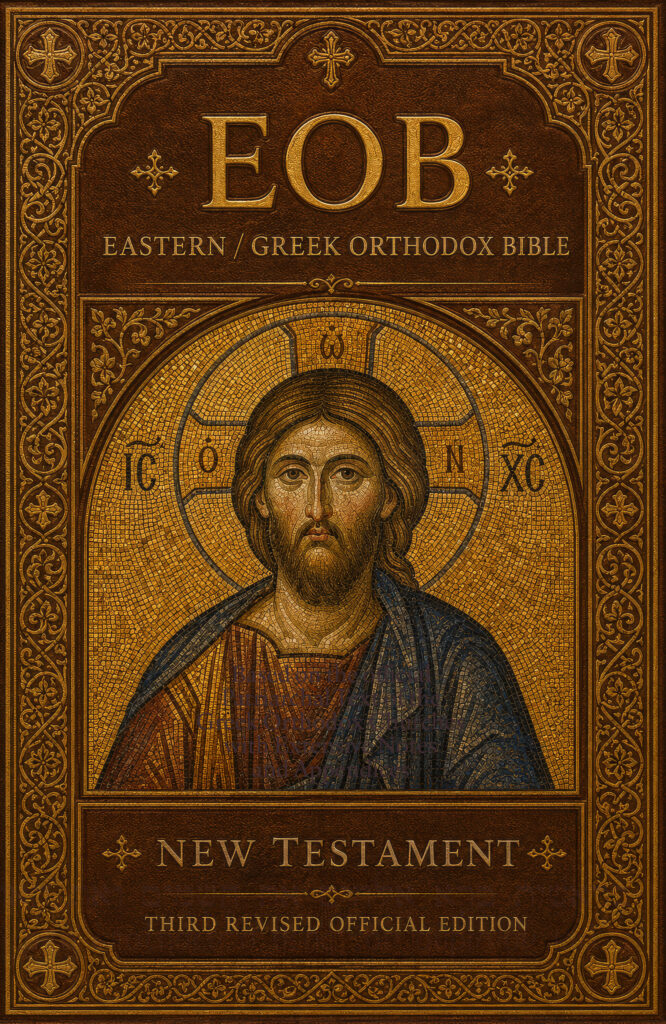
EOB: Official Site of the Eastern / Greek Orthodox Bible (Old and New Testament)
EOB (Eastern / Greek Orthodox Bible):
EOB Footnote:
KJV (King James Version):
WEB (World English Bible):
Benton LXX (Vaticanus):
Douai-Rheims (Vulgate):
Apostoliki Diakonia (LXX):
YLT (Young Literal Translation )(MT):
BBE (Bible in Basic English):
EOB Commentary:
Genesis 1:12 Commentary
The Fruitfulness of Creation and Its Spiritual Significance
This verse presents the earth’s obedient response to the divine command, bringing forth vegetation “according to its kind” (kata genos). The threefold description of grass, herbs yielding seed, and fruit trees establishes a pattern of ordered abundance that the Fathers understood as revealing God’s providential wisdom. Saint Basil the Great, in his Hexaemeron, emphasizes that the phrase “according to its kind” demonstrates the stability and permanence God embedded within creation, ensuring that each species reproduces faithfully without confusion or disorder.
Christological and Ecclesial Dimensions
The Fathers perceived in the fruitfulness of the earth a type of the Virgin Mary, who would bring forth the Fruit of Life without human seed. Just as the earth in this primordial moment produced vegetation by divine command alone, so too would the Theotokos conceive by the Holy Spirit. Saint Ephrem the Syrian draws this parallel explicitly, seeing in the virgin earth a prefiguration of the Virgin Birth.
The seed-bearing nature of plants also prefigures the Gospel teaching on spiritual fruitfulness. Christ’s parables of the sower and the mustard seed find their cosmic foundation here. The principle that seed produces after its kind illuminates the Lord’s teaching that good trees bear good fruit, establishing a moral and spiritual law rooted in the very structure of creation.
Liturgical Connections
The blessing of fruits on the Feast of the Transfiguration reflects the Church’s understanding that creation’s fruitfulness participates in divine blessing. The prayers offered over first fruits acknowledge that the earth’s productivity originates in God’s creative word spoken at the beginning. The Paschal blessing of foods similarly connects the abundance of the table to the primordial blessing pronounced over vegetation.
In the hymnography for Great and Holy Saturday, the Church sings of Christ as the “grain of wheat” that falls into the earth and brings forth much fruit, connecting the agricultural imagery of Genesis to the mystery of death and resurrection.
Spiritual Application
The Fathers understood this verse as teaching that creation contains within itself the seeds of its own perpetuation through God’s sustaining word. For the spiritual life, this suggests that divine grace, once planted in the soul through baptism, contains the principle of growth and multiplication. Saint Gregory of Nyssa saw in the progressive unfolding of vegetation a model for the soul’s journey toward theosis, moving from simple beginnings toward the bearing of mature spiritual fruit.
The Book of Leviticus receives its English title from the Latin Vulgate, which is derived from the Greek Septuagint (LXX) title Leuitikon (Λευιτικόν), meaning “Levitical” or “pertaining to the Levites.”

The Book of Exodus receives its English title from the Greek Septuagint (LXX), where it is called Exodos (Ἔξοδος), meaning “departure” or “exit.” This name was chosen because the central

I. Date and Authorship Holy Tradition of the Orthodox Church, affirmed by the Fathers and the liturgical usage of the Church from the earliest centuries, attributes the Book of Genesis

Does Hebrews 11 on the Maccabees Show Stronger Alignment with 4 Maccabees than 2 Maccabees? Hebrews 11 (the famous “Hall of Faith” chapter) does not explicitly mention the Maccabees by