Introduction to the book of Leviticus
The Book of Leviticus receives its English title from the Latin Vulgate, which is derived from the Greek Septuagint (LXX) title Leuitikon (Λευιτικόν), meaning “Levitical” or “pertaining to the Levites.”
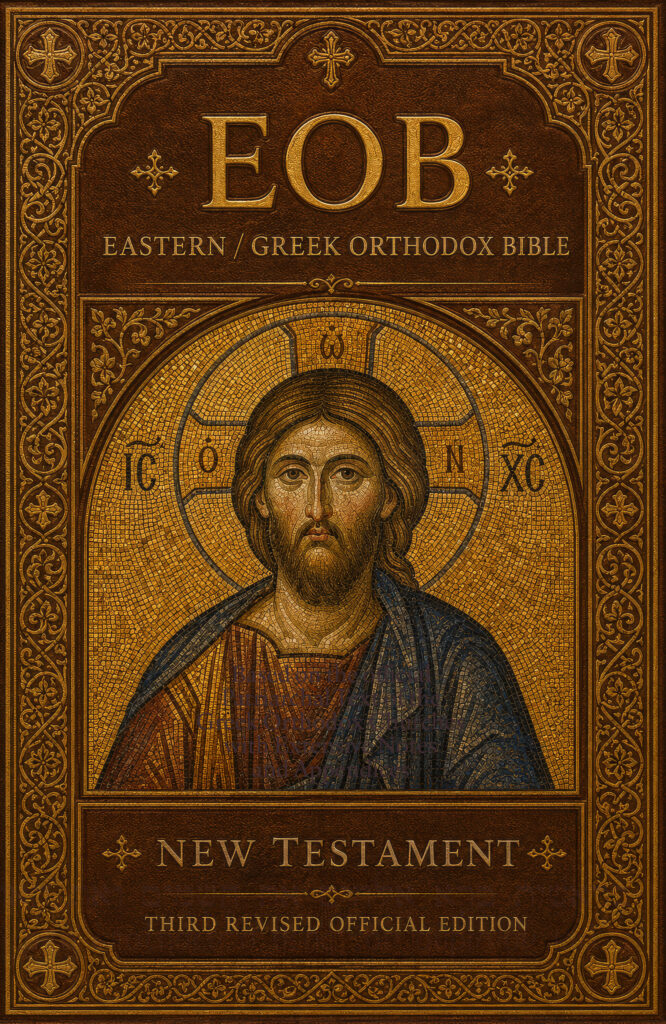
EOB: Official Site of the Eastern / Greek Orthodox Bible (Old and New Testament)
EOB (Eastern / Greek Orthodox Bible):
EOB Footnote:
KJV (King James Version):
WEB (World English Bible):
Benton LXX (Vaticanus):
Douai-Rheims (Vulgate):
Apostoliki Diakonia (LXX):
YLT (Young Literal Translation )(MT):
BBE (Bible in Basic English):
EOB Commentary:
Genesis 1:24
The Land Bringing Forth Living Creatures
This verse marks the beginning of the sixth day’s creative work, wherein God commands the earth itself to bring forth living souls (nephesh chayyah) according to their kinds—cattle, creeping things, and beasts of the earth. The Fathers note that while the waters were commanded to bring forth fish and birds, here the dry land participates in the creative act, demonstrating that all creation serves as an instrument of the divine will.
Patristic Interpretation: Saint Basil the Great, in his Hexaemeron, observes that God’s command to the earth reveals the ongoing fruitfulness embedded within creation. The earth does not create of itself but responds obediently to the Creator’s word, bringing forth what was not previously visible. Saint John Chrysostom emphasizes that the variety of animals manifests the boundless wisdom and artistry of God, each creature designed with particular purpose and beauty.
Christological Significance: The Church Fathers perceived in the creation of land animals a preparation for the greater work to follow—the creation of man in God’s image. Just as the earth brought forth living creatures at God’s command, so too would the Virgin Mary, the pure earth untouched by the curse, bring forth the incarnate Word. Saint Ephrem the Syrian draws connections between the obedient earth and the Theotokos, both responding to the divine word with fruitful submission.
Liturgical Connections: The blessing of animals in Orthodox practice, particularly on the feasts of Saints Florus and Laurus (patrons of horses) and other occasions, reflects the Church’s understanding that animals remain under God’s providential care. The prayers acknowledge that these creatures were fashioned by divine command and entrusted to human stewardship.
Spiritual Application: The phrase “according to their kinds” (le-minah) teaches the Orthodox faithful about the ordered nature of creation. God establishes boundaries and distinctions that reflect His wisdom. This ordering prefigures the spiritual life, where each person is called to fulfill their unique vocation within the Body of Christ while maintaining the harmony of the whole.
The earth’s obedience to God’s creative word serves as a model for human response to divine grace. As the land brought forth abundantly when commanded, so the human heart, when receptive to God’s word, produces the fruits of the Spirit. The Fathers consistently remind us that what was accomplished physically in creation must be accomplished spiritually in the soul through cooperation with divine grace.
The Book of Leviticus receives its English title from the Latin Vulgate, which is derived from the Greek Septuagint (LXX) title Leuitikon (Λευιτικόν), meaning “Levitical” or “pertaining to the Levites.”

The Book of Exodus receives its English title from the Greek Septuagint (LXX), where it is called Exodos (Ἔξοδος), meaning “departure” or “exit.” This name was chosen because the central

I. Date and Authorship Holy Tradition of the Orthodox Church, affirmed by the Fathers and the liturgical usage of the Church from the earliest centuries, attributes the Book of Genesis

Does Hebrews 11 on the Maccabees Show Stronger Alignment with 4 Maccabees than 2 Maccabees? Hebrews 11 (the famous “Hall of Faith” chapter) does not explicitly mention the Maccabees by