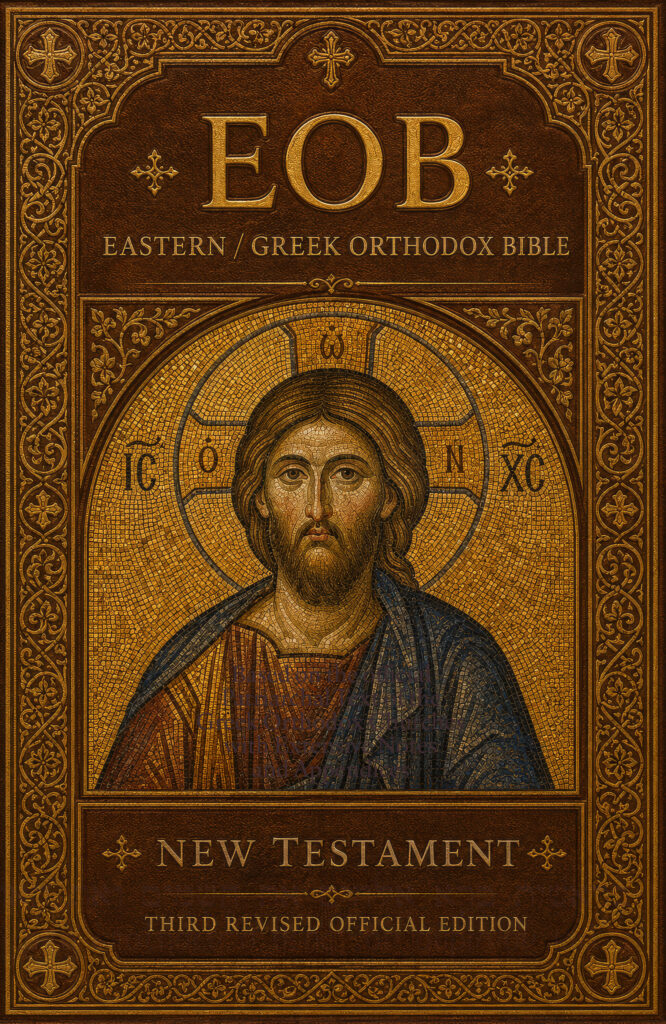
EOB: Official Site of the Eastern / Greek Orthodox Bible (Old and New Testament)

Genesis 1:26

EOB (Eastern / Greek Orthodox Bible):

Then God said, “Let us make humankind according to our image and according to our likeness, [and let them have dominion over the fish of the sea, over the birds of the sky, over the livestock, over all the earth, and over every creeping thing that creeps upon the earth].”

EOB Footnote:

The MT includes “and over all the earth” in the list of what humanity will rule, which appears in some LXX manuscripts but is absent or varies in others. Some LXX witnesses read “over all the earth” while others have “over all the wild animals of the earth” or similar variations. Codex Alexandrinus includes the phrase about ruling over the earth. The Hebrew word translated “image” and the word translated “likeness” are distinct terms in the MT, with the first suggesting a representative figure and the second suggesting resemblance or similarity. The LXX renders these with corresponding but not identical Greek terms. The phrase “Let us make” uses a plural verb and pronoun in both MT and LXX, which has been understood in various ways throughout interpretive history.

Other Translations:

KJV (King James Version):

And God said, Let us make man in our image, after our likeness: and let them have dominion over the fish of the sea, and over the fowl of the air, and over the cattle, and over all the earth, and over every creeping thing that creepeth upon the earth.

WEB (World English Bible):

“Let us make man in our image, after our likeness. Let them have dominion over the fish of the sea, over the birds of the sky, over the livestock, over all the earth, and over every creeping thing that creeps on the earth.”

Benton LXX (Vaticanus):

And God said, Let us make man according to our image and likeness: and let them have dominion over the fish of the sea, and over the flying creatures of heaven, and over the cattle, and all the earth, and all the reptiles that creep on the earth.

Douai-Rheims (Vulgate):

And he said: Let us make man to our image and likeness: and let him have dominion over the fishes of the sea, and the fowls of the air, and the beasts, and the whole earth, and every creeping creature that moveth upon the earth.

Apostoliki Diakonia (LXX):

Then God said, “Let us make man in our image, according to our likeness, and let them have authority over the fish of the sea and over the birds of the sky and over the cattle and over all the earth and over every creeping thing that creeps on the earth.”

YLT (Young Literal Translation )(MT):

And God said, “Let us make man in our image, according to our likeness, and let them rule over the fish of the sea, and over the birds of the heavens, and over the livestock, and over all the earth, and over every creeping thing that creeps on the earth.”

BBE (Bible in Basic English):

And God said, Let us make man in our image, like us: and let them have rule over the fish of the sea and over the birds of the air and over the cattle and over all the earth and over every living thing which goes flat on the earth.

EOB COMMENTARY:

EOB Commentary:

Genesis 1:26 Commentary

The Divine Council and the Holy Trinity

This verse stands as one of the most theologically significant passages in all of Scripture, for here God speaks in the plural: “Let Us make man in Our image, according to Our likeness.” The Fathers of the Church consistently understood this plural address as a revelation of the Holy Trinity, a divine dialogue within the Godhead before the creation of humanity. Saint Basil the Great teaches that the Father speaks to the Son and the Holy Spirit, revealing that the creation of man was a deliberate act of the entire Trinity, distinguishing humanity from all other creatures which were brought forth by simple divine command.

The Image and Likeness

The distinction between “image” (tselem in Hebrew, eikon in Greek) and “likeness” (demut, homoiosis) has occupied Orthodox theological reflection extensively. Many Fathers, following Saint Irenaeus of Lyon, understood the image as that which humanity possesses by nature—rationality, free will, and the capacity for communion with God—while the likeness represents the goal of human existence, the dynamic process of theosis or deification. Saint John of Damascus summarizes this teaching by explaining that we are created with the potential for divine likeness, which is actualized through virtue and participation in the divine life.

Christological Significance

The New Testament reveals that Christ is the true Image of the invisible God (Colossians 1:15) and the exact imprint of the Father’s nature (Hebrews 1:3). Orthodox theology thus understands that humanity was created according to the pattern of the incarnate Logos. The eternal Son, who would become man, is the archetype after which Adam was fashioned. Saint Athanasius the Great emphasizes that the Word became flesh so that we might become god, restoring and perfecting the image that was damaged through the fall.

Liturgical and Spiritual Dimensions

In the Orthodox funeral service, we chant “I am the image of Thine ineffable glory, even though I bear the wounds of sin,” reflecting the Church’s understanding that despite the fall, the divine image remains in humanity, though wounded and in need of healing. The Great Canon of Saint Andrew of Crete during Lent repeatedly calls the faithful to recognize their dignity as bearers of God’s image while lamenting how sin has obscured this likeness.

The Anthropological Foundation

This verse establishes the fundamental dignity of every human person, grounding Orthodox Christian ethics and the Church’s unwavering defense of human life from conception to natural death. Because each person bears the divine image, every human being possesses inherent sacred worth that no sin or circumstance can eradicate. This theological anthropology shapes Orthodox understanding of salvation not as mere legal transaction but as the restoration and perfection of the divine image through union with Christ, the perfect Image, in the communion of the Holy Spirit.
Introduction to the book of Leviticus

The Book of Leviticus receives its English title from the Latin Vulgate, which is derived from the Greek Septuagint (LXX) title Leuitikon (Λευιτικόν), meaning “Levitical” or “pertaining to the Levites.”

Read More »

Introduction to the book of Exodus

The Book of Exodus receives its English title from the Greek Septuagint (LXX), where it is called Exodos (Ἔξοδος), meaning “departure” or “exit.” This name was chosen because the central

Read More »