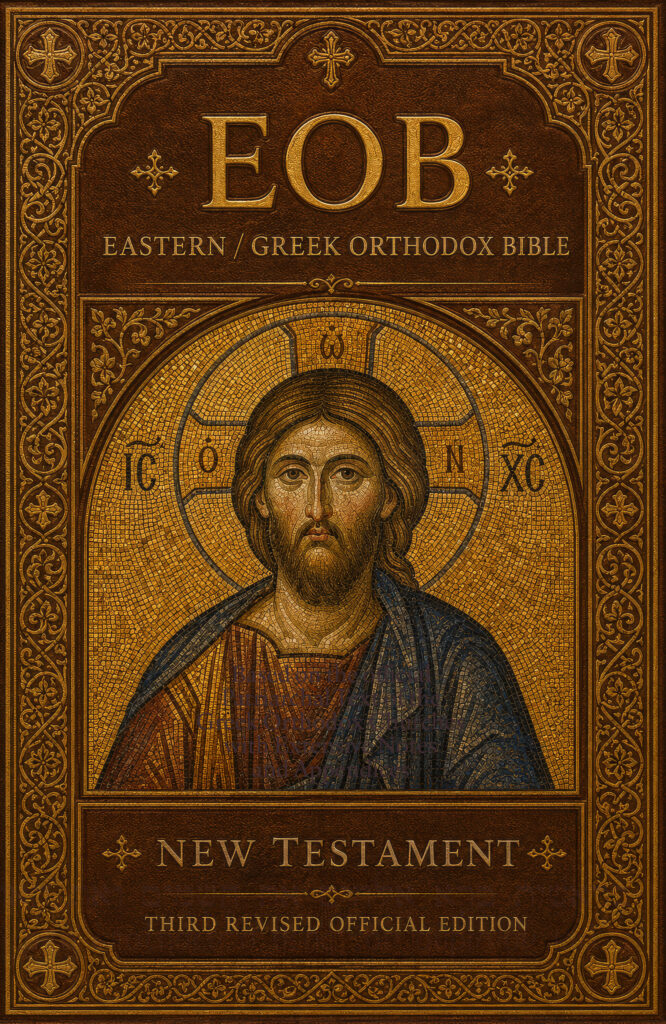
EOB: Official Site of the Eastern / Greek Orthodox Bible (Old and New Testament)

Genesis 1:28

EOB (Eastern / Greek Orthodox Bible):

God blessed them, saying, “Be fruitful, multiply, fill the earth and subdue it. Rule over the fish of the sea, the birds of the sky, [and over every living thing that moves on the earth].”

EOB Footnote:

The MT includes “and subdue it” (referring to the earth) after “fill the earth,” which is present in the LXX but rendered with a verb meaning “have dominion over” or “rule.” The MT uses a distinct verb for “subdue” (kavash) separate from the verb for “have dominion” (radah), while the LXX uses forms that may blur this distinction slightly. The phrase “over every living thing that moves upon the earth” in the MT is rendered similarly in the LXX, though the LXX specifies “all the cattle and all the earth” in addition to creatures, expanding the scope of dominion slightly. DSS: 4Q7 (4QGen-g) preserves a fragmentary witness to this verse but shows no significant variation from the MT.

Other Translations:

KJV (King James Version):

And God blessed them, and God said unto them, Be fruitful, and multiply, and replenish the earth, and subdue it: and have dominion over the fish of the sea, and over the fowl of the air, and over every living thing that moveth upon the earth.

WEB (World English Bible):

God blessed them. God said to them, “Be fruitful, multiply, fill the earth, and subdue it. Have dominion over the fish of the sea, over the birds of the sky, and over every living thing that moves on the earth.”

Benton LXX (Vaticanus):

And God blessed them, saying, Increase and multiply, and fill the earth and subdue it, and have dominion over the fish of the sea and the birds of the sky, and all the cattle and all the earth, and all the reptiles that creep on the earth.

Douai-Rheims (Vulgate):

And God blessed them, saying: Increase and multiply, and fill the earth, and subdue it, and rule over the fishes of the sea, and the fowls of the air, and all living creatures that move upon the earth.

Apostoliki Diakonia (LXX):

God blessed them and said to them, “Be fruitful and multiply, fill the earth and subdue it, and have dominion over the fish of the sea, the birds of the sky, and every living creature that moves on the earth.”

YLT (Young Literal Translation )(MT):

“Be fruitful, and multiply, and fill the earth, and subdue it, and rule over the fish of the sea, and over the bird of the sky, and over every living thing that moves upon the earth.”

BBE (Bible in Basic English):

“Have offspring and become many and fill the earth and be masters of it; be rulers over the fish of the sea and over the birds of the air and over every living thing moving on the earth.”

EOB COMMENTARY:

EOB Commentary:

Genesis 1:28

The Divine Mandate and Its Fulfillment in Christ

This verse establishes humanity’s royal vocation as God’s appointed stewards over creation. The blessing and command to “be fruitful and multiply, and fill the earth and subdue it” represents not merely biological reproduction but the calling to extend the divine order throughout the cosmos. The Fathers understood this dominion not as tyrannical exploitation but as priestly mediation, with Adam serving as the link between the material and spiritual realms.

Patristic Interpretation: St. Gregory of Nyssa interprets the command to “have dominion” as reflecting humanity’s creation in the divine image, since God Himself is the ultimate ruler of all. This dominion was to be exercised through virtue and wisdom, not through force. St. John Chrysostom emphasizes that this authority was given before the Fall, indicating that proper stewardship flows from communion with God rather than from fallen self-assertion. The multiplication commanded here was understood by some Fathers, including St. Maximus the Confessor, as potentially referring to spiritual multiplication through the cultivation of virtues, though the literal sense remained primary.

Christological Fulfillment: The New Adam, Jesus Christ, perfectly fulfills this mandate. Where the first Adam failed in his stewardship, Christ exercises true dominion over creation through His miracles—calming storms, multiplying loaves, and commanding demons. His authority extends even over death itself. The Great Commission in Matthew 28:19-20 echoes this original blessing, transforming biological fruitfulness into spiritual multiplication through baptism and discipleship. Christ’s followers are called to fill the earth not merely with human offspring but with children of God born through water and the Spirit.

Liturgical Connections: The Orthodox wedding service draws upon this blessing, as the priest invokes God’s original command upon the newly married couple. The crowning of the bride and groom symbolizes their royal dignity as stewards of a new household, a domestic church called to be fruitful in both children and virtues. The Church also sees this verse reflected in monastic life, where spiritual fatherhood and motherhood generate countless children in the faith, fulfilling the command to multiply in a transfigured manner.

Ascetical Theology: Orthodox spirituality recognizes that fallen humanity exercises dominion poorly, often becoming enslaved to the very creation we were meant to govern. The passions represent a reversal of the proper order. Through ascesis and theosis, the Christian recovers authentic dominion—first over oneself, then extending outward. The saints demonstrate this restored authority, as seen in accounts of desert fathers befriending wild beasts, recapitulating the Edenic harmony that this verse originally established.

Introduction to the book of Leviticus

The Book of Leviticus receives its English title from the Latin Vulgate, which is derived from the Greek Septuagint (LXX) title Leuitikon (Λευιτικόν), meaning “Levitical” or “pertaining to the Levites.”

Read More »

Introduction to the book of Exodus

The Book of Exodus receives its English title from the Greek Septuagint (LXX), where it is called Exodos (Ἔξοδος), meaning “departure” or “exit.” This name was chosen because the central

Read More »