Introduction to the book of Leviticus
The Book of Leviticus receives its English title from the Latin Vulgate, which is derived from the Greek Septuagint (LXX) title Leuitikon (Λευιτικόν), meaning “Levitical” or “pertaining to the Levites.”
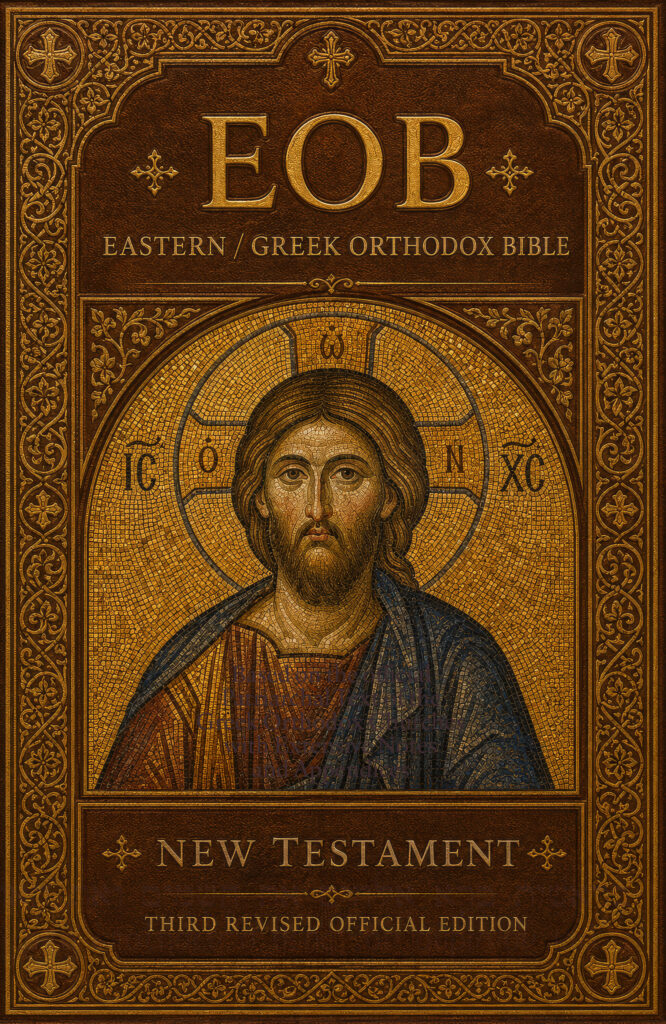
EOB: Official Site of the Eastern / Greek Orthodox Bible (Old and New Testament)
EOB (Eastern / Greek Orthodox Bible):
EOB Footnote:
KJV (King James Version):
WEB (World English Bible):
Benton LXX (Vaticanus):
Douai-Rheims (Vulgate):
Apostoliki Diakonia (LXX):
YLT (Young Literal Translation )(MT):
BBE (Bible in Basic English):
EOB Commentary:
Commentary on Genesis 1:30
The Divine Provision for All Creatures
This verse completes the picture of God’s original economy of creation, revealing that in the primordial state, all living creatures—beasts, birds, and creeping things—were given green plants for food. The Fathers understood this to indicate a peaceable kingdom before the Fall, where violence and death through predation were absent from God’s original design.
Patristic Interpretation: St. Basil the Great, in his Hexaemeron, reflects on the harmony of the original creation, noting that the ferocity we now observe in certain animals was not part of their original nature but a consequence of the cosmic disruption introduced by human sin. St. John Chrysostom similarly emphasizes that the entire created order was affected by Adam’s transgression, and what we witness now in nature—predator and prey—represents a fallen condition rather than the Creator’s primordial intention.
Eschatological and Christological Significance: This verse finds its prophetic fulfillment in Isaiah’s vision of the messianic age, where “the wolf shall dwell with the lamb” and “the lion shall eat straw like the ox” (Isaiah 11:6-7). The Orthodox Church understands this not merely as poetic imagery but as a genuine restoration of the original created order through Christ. The Second Adam reverses what the first Adam corrupted. In the age to come, when Christ makes all things new (Revelation 21:5), creation itself will be liberated from its bondage to corruption (Romans 8:21).
Liturgical Connections: During the blessing of animals on certain feast days, and particularly in prayers for the protection of livestock and fields, the Church implicitly acknowledges God’s providential care for all creatures as established in this foundational text. The Paschal proclamation that Christ has “trampled down death by death” extends hope not only to humanity but to the entire groaning creation awaiting redemption.
Spiritual Application: For the Orthodox Christian, this verse serves as a reminder that violence, death, and suffering—even in the animal kingdom—are not normative but represent the tragic consequences of sin’s entrance into the world. This understanding cultivates a spirit of compassion toward all creatures and ecological responsibility as stewards of God’s creation. The ascetic tradition, with its stories of saints living peacefully among wild beasts—such as St. Seraphim of Sarov with his bear or St. Gerasimos with his lion—offers glimpses of Paradise restored through holiness, anticipating the final transfiguration of all creation in Christ.
The Book of Leviticus receives its English title from the Latin Vulgate, which is derived from the Greek Septuagint (LXX) title Leuitikon (Λευιτικόν), meaning “Levitical” or “pertaining to the Levites.”

The Book of Exodus receives its English title from the Greek Septuagint (LXX), where it is called Exodos (Ἔξοδος), meaning “departure” or “exit.” This name was chosen because the central

I. Date and Authorship Holy Tradition of the Orthodox Church, affirmed by the Fathers and the liturgical usage of the Church from the earliest centuries, attributes the Book of Genesis

Does Hebrews 11 on the Maccabees Show Stronger Alignment with 4 Maccabees than 2 Maccabees? Hebrews 11 (the famous “Hall of Faith” chapter) does not explicitly mention the Maccabees by