Introduction to the book of Leviticus
The Book of Leviticus receives its English title from the Latin Vulgate, which is derived from the Greek Septuagint (LXX) title Leuitikon (Λευιτικόν), meaning “Levitical” or “pertaining to the Levites.”
EOB: Official Site of the Eastern / Greek Orthodox Bible (Old and New Testament)
EOB (Eastern / Greek Orthodox Bible):
EOB Footnote:
KJV (King James Version):
WEB (World English Bible):
Benton LXX (Vaticanus):
Douai-Rheims (Vulgate):
Apostoliki Diakonia (LXX):
YLT (Young Literal Translation )(MT):
BBE (Bible in Basic English):
EOB Commentary:
Genesis 1:7 Commentary
The Division of the Waters
This verse describes God’s creation of the firmament (raqia in Hebrew, stereoma in the Septuagint), which separates the waters above from the waters below. The Fathers understood this not merely as a cosmological statement but as revealing the ordering wisdom of God who brings structure out of chaos and distinction out of confusion.
Patristic Interpretation: St. Basil the Great in his Hexaemeron extensively discusses this passage, noting that the waters above the firmament serve divine purposes beyond our full comprehension. He suggests these upper waters may serve to temper the heat of the celestial bodies. St. John of Damascus similarly affirms the reality of waters above the heavens, trusting the scriptural account even where natural philosophy might question it. The Fathers consistently emphasize that God’s creative word accomplishes what it declares, demonstrating the performative power of divine speech.
Christological Significance: The firmament as a boundary and structure within creation prefigures Christ who is Himself the true boundary between heaven and earth, the one who unites what was divided. St. Maximus the Confessor would see in such cosmic divisions the pattern that Christ overcomes in His person, reconciling all things in Himself. The Logos through whom all things were made establishes order and distinction, yet in the Incarnation bridges every divide.
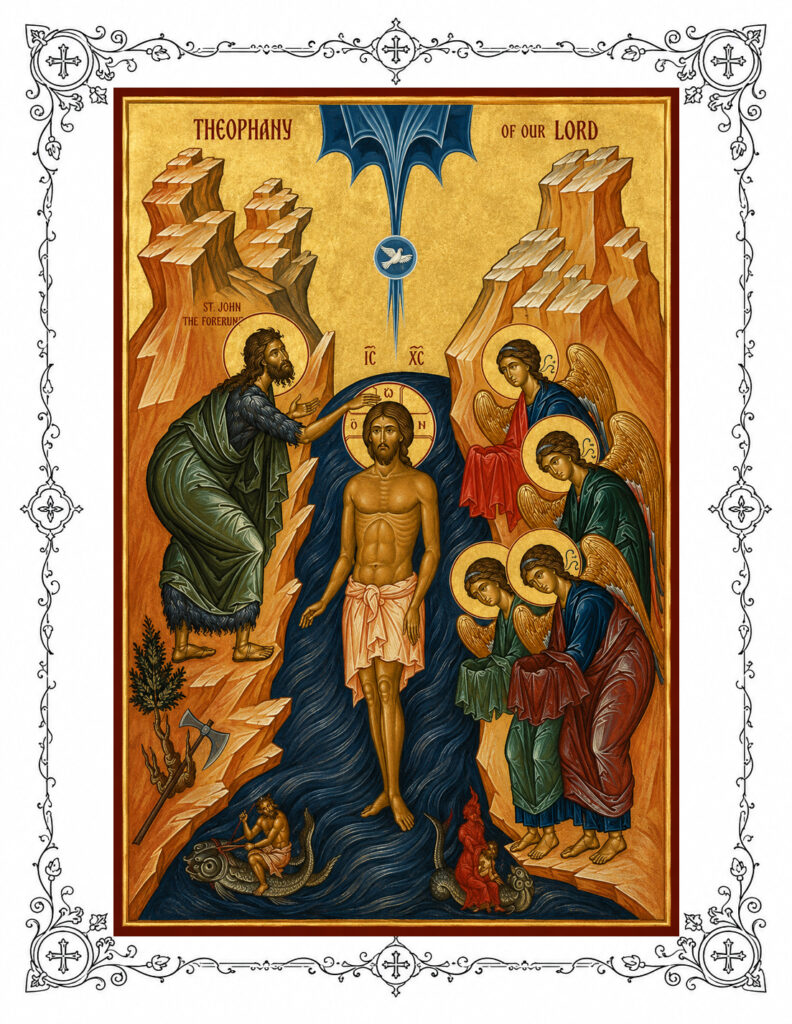
Liturgical Connections: The theme of waters divided and ordered appears in the blessing of waters at Theophany, where the Church celebrates Christ’s baptism as a sanctification of the material creation. The prayers recall God’s creative acts over the primordial waters, connecting the Genesis account to the new creation inaugurated in Christ. The firmament holding back waters also evokes the crossing of the Red Sea, commemorated in Paschal hymnography as a type of baptism and salvation.
Spiritual Application: For Orthodox spirituality, this verse speaks to the necessity of proper boundaries and order in the spiritual life. Just as God separated waters to create habitable space, the ascetic life involves establishing boundaries that create space for communion with God. The nous must be distinguished from the passions, the spiritual from the merely carnal, not through destruction but through proper ordering under divine grace.
The faithful confidence expressed in the phrase “and it was so” reminds believers that God’s word never returns void. What He speaks, He accomplishes. This becomes a foundation for trust in divine promises throughout salvation history, culminating in the Word made flesh who speaks and demons flee, who commands and the dead rise.
The Book of Leviticus receives its English title from the Latin Vulgate, which is derived from the Greek Septuagint (LXX) title Leuitikon (Λευιτικόν), meaning “Levitical” or “pertaining to the Levites.”

The Book of Exodus receives its English title from the Greek Septuagint (LXX), where it is called Exodos (Ἔξοδος), meaning “departure” or “exit.” This name was chosen because the central

I. Date and Authorship Holy Tradition of the Orthodox Church, affirmed by the Fathers and the liturgical usage of the Church from the earliest centuries, attributes the Book of Genesis

Does Hebrews 11 on the Maccabees Show Stronger Alignment with 4 Maccabees than 2 Maccabees? Hebrews 11 (the famous “Hall of Faith” chapter) does not explicitly mention the Maccabees by