Introduction to the book of Leviticus
The Book of Leviticus receives its English title from the Latin Vulgate, which is derived from the Greek Septuagint (LXX) title Leuitikon (Λευιτικόν), meaning “Levitical” or “pertaining to the Levites.”
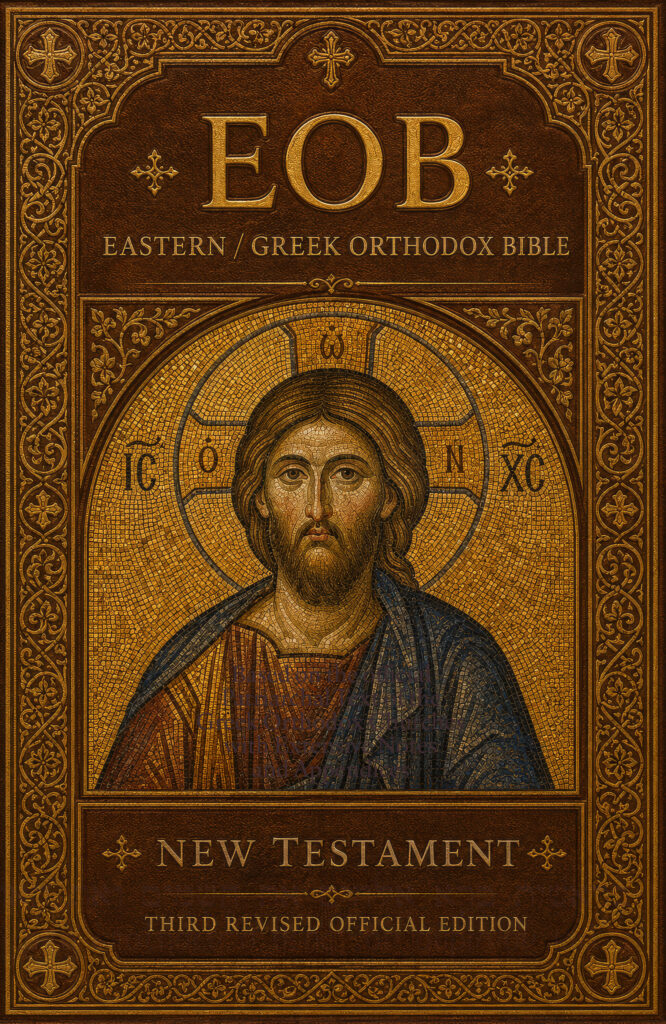
EOB: Official Site of the Eastern / Greek Orthodox Bible (Old and New Testament)
EOB (Eastern / Greek Orthodox Bible):
EOB Footnote:
KJV (King James Version):
WEB (World English Bible):
Benton LXX (Vaticanus):
Douai-Rheims (Vulgate):
Apostoliki Diakonia (LXX):
YLT (Young Literal Translation )(MT):
BBE (Bible in Basic English):
EOB Commentary:
Genesis 10:11
From that land he went to Assyria and built Nineveh, Rehoboth-Ir, Calah.
This verse marks a significant moment in the Table of Nations, describing the expansion of Nimrod’s kingdom from Babel into Assyria. The founding of Nineveh carries profound typological weight throughout Scripture and resonates deeply within Orthodox tradition.
Christological and Prophetic Significance:
Nineveh becomes the great city to which the Prophet Jonah is sent, prefiguring Christ’s descent into Hades and His resurrection. Our Lord Himself draws this connection explicitly when He declares that just as Jonah was three days in the belly of the whale, so the Son of Man would be three days in the heart of the earth. The Ninevites who repented at Jonah’s preaching stand as a type of the Gentiles who would receive the Gospel, while condemning those who rejected Christ despite witnessing greater signs. Thus this verse, recording Nineveh’s foundation, plants the seed for one of the most important Old Testament types of the Resurrection.
Patristic Interpretation:
Saint John Chrysostom observes that the spread of Nimrod’s dominion demonstrates how quickly humanity, even after the Flood, turned toward empire-building and the consolidation of power apart from God. The Fathers generally viewed Assyria and its cities as representing worldly power that would ultimately be humbled before the Lord. Saint Ephrem the Syrian, himself from the region of ancient Assyria, saw in the eventual destruction of Nineveh a warning against pride and a testimony to God’s patience with sinners who repent.
Liturgical Connections:
The Book of Jonah is read in its entirety at Vesperal Liturgy on Holy Saturday, making the city of Nineveh liturgically present at the very moment the Church commemorates Christ’s victory over death. The repentance of Nineveh also features in the hymnography of Great Lent, held up as an example of genuine metanoia that the faithful are called to emulate.
Spiritual Themes:
Orthodox spirituality draws from this passage the understanding that God’s providence extends over all nations from their very foundations. Even cities built by those who rebel against God become instruments of His saving economy. Nineveh, founded in the shadow of Babel’s pride, would later humble itself in sackcloth and ashes. This transformation from a city of hunters and warriors to a city of penitents illustrates the Orthodox teaching that no person or nation is beyond the reach of divine mercy. The geographical expansion described here also anticipates the universal scope of salvation that would be accomplished in Christ and proclaimed to all nations.
The Book of Leviticus receives its English title from the Latin Vulgate, which is derived from the Greek Septuagint (LXX) title Leuitikon (Λευιτικόν), meaning “Levitical” or “pertaining to the Levites.”

The Book of Exodus receives its English title from the Greek Septuagint (LXX), where it is called Exodos (Ἔξοδος), meaning “departure” or “exit.” This name was chosen because the central

I. Date and Authorship Holy Tradition of the Orthodox Church, affirmed by the Fathers and the liturgical usage of the Church from the earliest centuries, attributes the Book of Genesis

Does Hebrews 11 on the Maccabees Show Stronger Alignment with 4 Maccabees than 2 Maccabees? Hebrews 11 (the famous “Hall of Faith” chapter) does not explicitly mention the Maccabees by