Introduction to the book of Leviticus
The Book of Leviticus receives its English title from the Latin Vulgate, which is derived from the Greek Septuagint (LXX) title Leuitikon (Λευιτικόν), meaning “Levitical” or “pertaining to the Levites.”
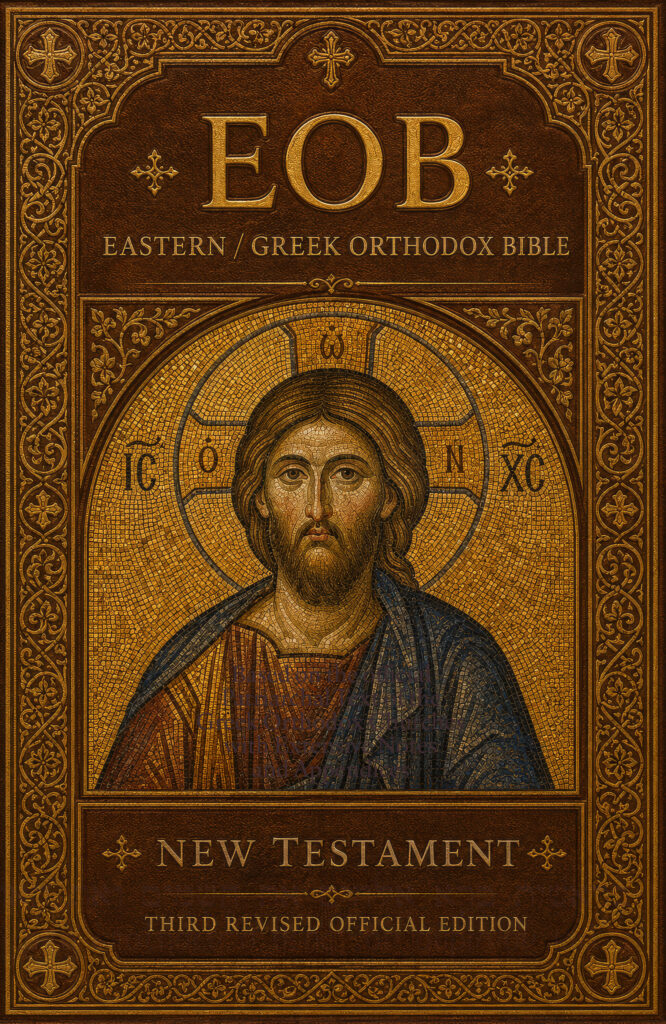
EOB: Official Site of the Eastern / Greek Orthodox Bible (Old and New Testament)
EOB (Eastern / Greek Orthodox Bible):
EOB Footnote:
KJV (King James Version):
WEB (World English Bible):
Benton LXX (Vaticanus):
Douai-Rheims (Vulgate):
Apostoliki Diakonia (LXX):
YLT (Young Literal Translation )(MT):
BBE (Bible in Basic English):
EOB Commentary:
Genesis 10:8 Commentary
The Figure of Nimrod and His Spiritual Significance
This verse introduces Nimrod, whose name derives from the Hebrew root marad, meaning “to rebel.” The Fathers understood this etymology as spiritually significant, seeing in Nimrod a type of rebellion against God that would culminate in the Tower of Babel narrative that follows. Saint John Chrysostom notes that Nimrod’s description as a “mighty one” (gibbor) on earth stands in contrast to those who seek to be mighty before God, suggesting a purely earthly and carnal ambition.
Patristic Interpretation
The phrase “mighty hunter before the Lord” received considerable attention from the Fathers. Saint Ephrem the Syrian interprets this hunting not merely as the pursuit of animals but as a hunting of men’s souls, drawing them away from the worship of the true God. This reading sees Nimrod as establishing the first organized system of domination over other human beings, introducing tyranny into human society after the Flood. Saint Augustine in the City of God similarly views Nimrod as the founder of Babylon, that great symbol of worldly power opposed to the City of God.
Typological Significance
In Orthodox typology, Nimrod stands as an antitype to Christ. Where Nimrod hunted men for domination and established an earthly kingdom through force, Christ the Good Shepherd seeks the lost sheep for salvation and establishes His Kingdom through self-sacrificial love. The contrast is profound: Nimrod’s might was exercised over others, while Christ’s might was exercised for others, even unto death on the Cross.
The connection to Babylon is particularly significant for New Testament interpretation. The Book of Revelation’s portrayal of Babylon as the great harlot and enemy of God’s people finds its roots in this Nimrodian foundation. The spirit of Nimrod—rebellion against God clothed in impressive worldly power—continues throughout salvation history until its final defeat.
Liturgical and Spiritual Connections
While Nimrod is not directly referenced in Orthodox liturgical texts, the spiritual themes present in this verse permeate Orthodox hymnography. The contrast between earthly might and heavenly humility appears throughout the services, particularly in hymns celebrating the martyrs who overcame worldly tyrants through spiritual strength. The Akathist Hymn’s celebration of Christ’s victory over the “tyrant” (the devil) echoes this ancient pattern of divine power overcoming rebellious earthly might.
For Orthodox spirituality, Nimrod serves as a warning against the passion of vainglory and the desire for domination. The ascetical tradition consistently teaches that true spiritual greatness comes through humility and service, the very opposite of the Nimrodian path. As the Lord Himself taught, whoever would be great must become the servant of all.
The Book of Leviticus receives its English title from the Latin Vulgate, which is derived from the Greek Septuagint (LXX) title Leuitikon (Λευιτικόν), meaning “Levitical” or “pertaining to the Levites.”

The Book of Exodus receives its English title from the Greek Septuagint (LXX), where it is called Exodos (Ἔξοδος), meaning “departure” or “exit.” This name was chosen because the central

I. Date and Authorship Holy Tradition of the Orthodox Church, affirmed by the Fathers and the liturgical usage of the Church from the earliest centuries, attributes the Book of Genesis

Does Hebrews 11 on the Maccabees Show Stronger Alignment with 4 Maccabees than 2 Maccabees? Hebrews 11 (the famous “Hall of Faith” chapter) does not explicitly mention the Maccabees by