Introduction to the book of Leviticus
The Book of Leviticus receives its English title from the Latin Vulgate, which is derived from the Greek Septuagint (LXX) title Leuitikon (Λευιτικόν), meaning “Levitical” or “pertaining to the Levites.”
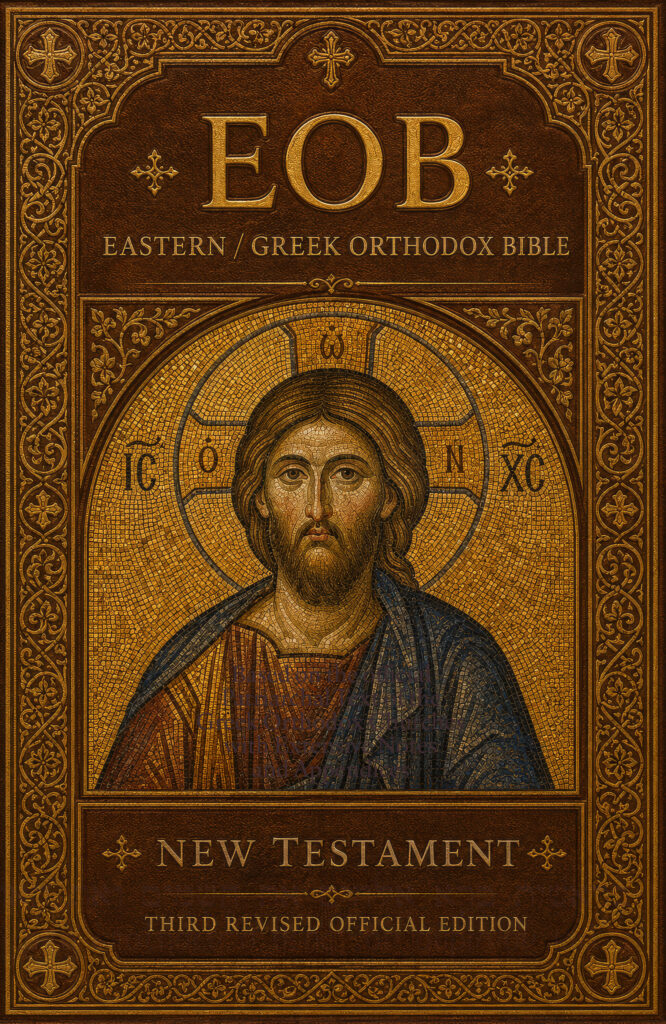
EOB: Official Site of the Eastern / Greek Orthodox Bible (Old and New Testament)
EOB (Eastern / Greek Orthodox Bible):
EOB Footnote:
KJV (King James Version):
WEB (World English Bible):
Benton LXX (Vaticanus):
Douai-Rheims (Vulgate):
Apostoliki Diakonia (LXX):
YLT (Young Literal Translation )(MT):
BBE (Bible in Basic English):
EOB Commentary:
Arphaxad and the Line of Promise
Genesis 11:12 continues the genealogy from Shem to Abram, recording that Arphaxad lived thirty-five years and begot Salah (or Cainan and then Salah, according to the Septuagint). While this verse appears to be a simple genealogical notation, it carries significant weight within the Orthodox understanding of sacred history and Christology.
The Septuagint Tradition and the Genealogy of Christ
The Orthodox Church follows the Septuagint text, which includes Cainan between Arphaxad and Salah. This reading is confirmed by the Gospel of Luke (3:36), where the evangelist traces the genealogy of Christ through this same line. The inclusion of Cainan in the Septuagint demonstrates the providential preservation of the text that would later serve as the scriptural foundation for the New Testament writers. Saint Luke, writing under divine inspiration, validated the Septuagint tradition, which the Church has consistently maintained.
Christological Significance
Every name in this genealogy represents a link in the chain connecting Adam to Christ. Arphaxad, whose name some Fathers interpreted as meaning “healing” or “releasing,” stands as an ancestor of the Messiah according to the flesh. The careful recording of ages and generations demonstrates God’s meticulous providence in preserving the line through which salvation would come. The Fathers saw in these genealogies not mere historical record but the unfolding of the divine economy.
Patristic Reflection
Saint Augustine noted that these genealogies trace the City of God through history, showing how the promise given to Adam and renewed to Noah continued through Shem’s line. The specificity of years served to anchor sacred history in real time, countering any tendency toward mythologizing the faith.
Liturgical Connection
During the Nativity season, the Church reads the genealogies with great solemnity, recognizing that each ancestor participated in bearing the promise forward. The names recited in these readings become a litany of faith, each generation trusting in the coming redemption without seeing its fulfillment.
Spiritual Application
For Orthodox believers, this verse reminds us that we too are links in a chain of faith. Just as Arphaxad faithfully lived his years and transmitted life and promise to the next generation, we are called to receive the tradition handed to us and transmit it faithfully to those who follow.
The Book of Leviticus receives its English title from the Latin Vulgate, which is derived from the Greek Septuagint (LXX) title Leuitikon (Λευιτικόν), meaning “Levitical” or “pertaining to the Levites.”

The Book of Exodus receives its English title from the Greek Septuagint (LXX), where it is called Exodos (Ἔξοδος), meaning “departure” or “exit.” This name was chosen because the central

I. Date and Authorship Holy Tradition of the Orthodox Church, affirmed by the Fathers and the liturgical usage of the Church from the earliest centuries, attributes the Book of Genesis

Does Hebrews 11 on the Maccabees Show Stronger Alignment with 4 Maccabees than 2 Maccabees? Hebrews 11 (the famous “Hall of Faith” chapter) does not explicitly mention the Maccabees by