Introduction to the book of Leviticus
The Book of Leviticus receives its English title from the Latin Vulgate, which is derived from the Greek Septuagint (LXX) title Leuitikon (Λευιτικόν), meaning “Levitical” or “pertaining to the Levites.”
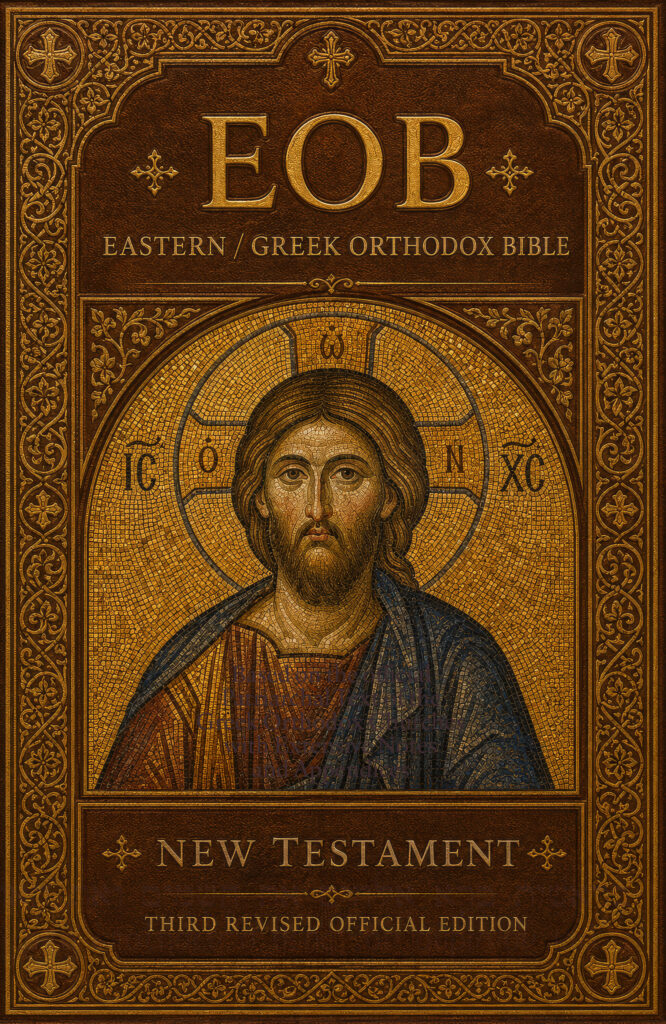
EOB: Official Site of the Eastern / Greek Orthodox Bible (Old and New Testament)
EOB (Eastern / Greek Orthodox Bible):
EOB Footnote:
KJV (King James Version):
WEB (World English Bible):
Benton LXX (Vaticanus):
Douai-Rheims (Vulgate):
Apostoliki Diakonia (LXX):
YLT (Young Literal Translation )(MT):
BBE (Bible in Basic English):
EOB Commentary:
Eber and the Lineage of Promise
Genesis 11:16 records that Eber lived thirty-four years and begot Peleg, continuing the genealogical thread from Shem to Abraham. While this verse appears as a simple chronological marker, the figure of Eber carries profound significance within the Orthodox understanding of sacred history.
Patristic Significance: The Church Fathers recognized Eber as the eponymous ancestor from whom the designation “Hebrew” derives. Saint Jerome and other patristic commentators noted this etymological connection, seeing in Eber a preservation of the faithful line through which God’s promises would be transmitted. Saint Ephrem the Syrian observed that the name Eber means “one who crosses over” or “one from beyond,” prefiguring the pilgrim character of Abraham and ultimately of all who journey toward the heavenly Jerusalem.
Christological Dimensions: The genealogy passing through Eber finds its ultimate fulfillment in the Gospel of Luke, where the evangelist traces Christ’s lineage back through this very patriarch (Luke 3:35). The Orthodox Church understands these genealogies not as mere historical records but as testimonies to the Incarnation’s preparation throughout human history. Each generation preserved the line through which the Theotokos would come, and through her, the God-Man Himself.
The Tower of Babel and Pentecost: Eber’s son Peleg, whose name means “division,” was born in the generation when the earth was divided at Babel. The Orthodox liturgical tradition, particularly in the services of Pentecost, draws a direct connection between the confusion of tongues at Babel and their reunification through the Holy Spirit. The kontakion of Pentecost proclaims that when the Most High descended and confused the tongues, He divided the nations, but when He distributed the tongues of fire, He called all to unity. Eber’s genealogical position at this pivotal moment reminds us that even amid humanity’s scattering, God preserved a lineage of blessing.
Spiritual Application: The Orthodox spiritual tradition sees in these genealogies a testimony to God’s patient providence. Generation after generation, the faithful line continued despite human sinfulness and cosmic upheaval. This patience of God, spanning centuries and millennia, reveals the depth of divine love that would ultimately manifest in the Incarnation. For the Orthodox believer, contemplating these genealogies cultivates the virtue of hope, recognizing that God works through ordinary human generations to accomplish extraordinary salvation.
The Book of Leviticus receives its English title from the Latin Vulgate, which is derived from the Greek Septuagint (LXX) title Leuitikon (Λευιτικόν), meaning “Levitical” or “pertaining to the Levites.”

The Book of Exodus receives its English title from the Greek Septuagint (LXX), where it is called Exodos (Ἔξοδος), meaning “departure” or “exit.” This name was chosen because the central

I. Date and Authorship Holy Tradition of the Orthodox Church, affirmed by the Fathers and the liturgical usage of the Church from the earliest centuries, attributes the Book of Genesis

Does Hebrews 11 on the Maccabees Show Stronger Alignment with 4 Maccabees than 2 Maccabees? Hebrews 11 (the famous “Hall of Faith” chapter) does not explicitly mention the Maccabees by