Introduction to the book of Leviticus
The Book of Leviticus receives its English title from the Latin Vulgate, which is derived from the Greek Septuagint (LXX) title Leuitikon (Λευιτικόν), meaning “Levitical” or “pertaining to the Levites.”
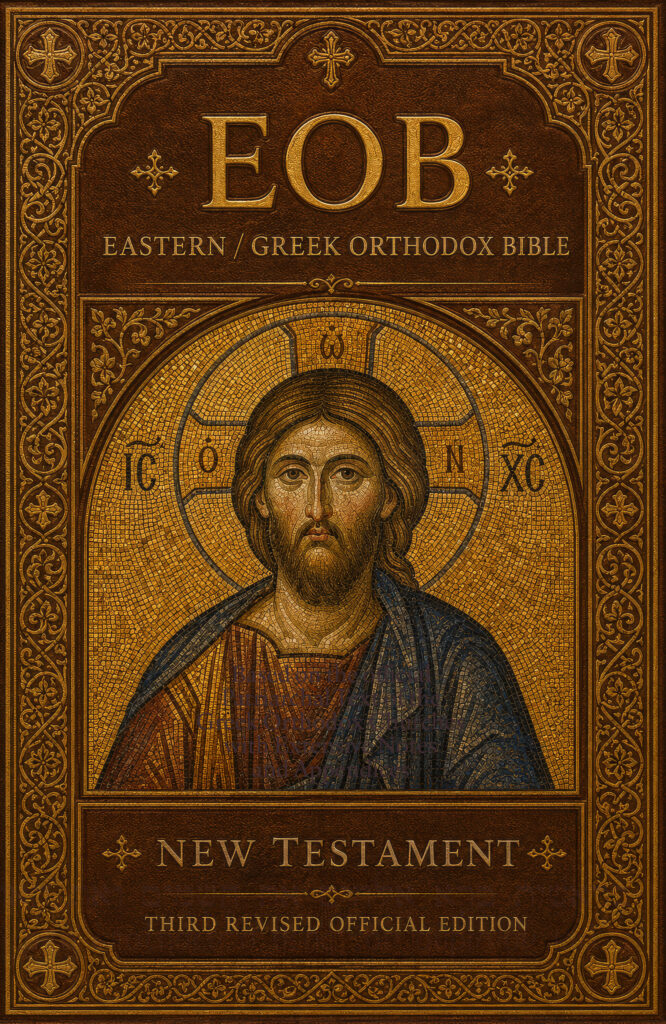
EOB: Official Site of the Eastern / Greek Orthodox Bible (Old and New Testament)
EOB (Eastern / Greek Orthodox Bible):
EOB Footnote:
KJV (King James Version):
WEB (World English Bible):
Benton LXX (Vaticanus):
Douai-Rheims (Vulgate):
Apostoliki Diakonia (LXX):
YLT (Young Literal Translation )(MT):
BBE (Bible in Basic English):
EOB Commentary:
Commentary on Genesis 11:4
The Tower and the City: Pride Against Heaven
This verse reveals the fundamental spiritual disease that afflicted humanity after the Flood—the same pride that caused the original fall. The builders declare their intention to make a name for themselves and to avoid being scattered, directly opposing God’s command to fill the earth. Their tower reaching to heaven represents not architectural ambition but spiritual rebellion, an attempt to storm the heavenly realm through human effort alone.
Patristic Interpretation: Saint John Chrysostom observes that the phrase “let us make a name for ourselves” exposes the root sin of vainglory (kenodoxia). The Fathers consistently interpret Babel as humanity’s collective attempt to achieve salvation and glory apart from God. Saint Ephrem the Syrian notes that the tower builders sought to create their own memorial rather than waiting upon God’s blessing, contrasting sharply with Abraham who would receive a great name as divine gift rather than human achievement.
Christological and Ecclesiological Significance: The Church Fathers draw a profound contrast between Babel and Pentecost. At Babel, humanity united in pride and was scattered through the confusion of tongues. At Pentecost, the Holy Spirit descended and the Apostles spoke in diverse languages, yet all understood—unity restored through divine grace rather than human presumption. The kontakion for Pentecost explicitly references this reversal: “When the Most High came down and confused the tongues, He divided the nations; but when He distributed the tongues of fire, He called all to unity.”
The tower reaching to heaven through human construction stands in opposition to Christ who descends from heaven to unite humanity to God. Where Babel represents ascent through pride, the Incarnation represents divine condescension through love. The Church herself becomes the true city and tower—not built of bricks but of living stones, with Christ as the cornerstone.
Liturgical Connections: The Pentecost services repeatedly invoke the Babel narrative as the antitype fulfilled in the descent of the Spirit. The reversal of Babel’s curse demonstrates that what humanity could not achieve through technological and collective effort, God accomplishes through grace. The Church’s unity amid linguistic and cultural diversity witnesses to this Pentecostal healing.
Spiritual Application: For Orthodox spiritual life, Babel warns against the subtle pride that seeks spiritual achievement through human effort alone. The ascetic tradition consistently teaches that true ascent to God comes through humility and divine grace, not through the construction of our own spiritual towers. The Jesus Prayer and the entire hesychast tradition emphasize receptivity to God’s descending grace rather than proud spiritual climbing.
The Book of Leviticus receives its English title from the Latin Vulgate, which is derived from the Greek Septuagint (LXX) title Leuitikon (Λευιτικόν), meaning “Levitical” or “pertaining to the Levites.”

The Book of Exodus receives its English title from the Greek Septuagint (LXX), where it is called Exodos (Ἔξοδος), meaning “departure” or “exit.” This name was chosen because the central

I. Date and Authorship Holy Tradition of the Orthodox Church, affirmed by the Fathers and the liturgical usage of the Church from the earliest centuries, attributes the Book of Genesis

Does Hebrews 11 on the Maccabees Show Stronger Alignment with 4 Maccabees than 2 Maccabees? Hebrews 11 (the famous “Hall of Faith” chapter) does not explicitly mention the Maccabees by