Introduction to the book of Leviticus
The Book of Leviticus receives its English title from the Latin Vulgate, which is derived from the Greek Septuagint (LXX) title Leuitikon (Λευιτικόν), meaning “Levitical” or “pertaining to the Levites.”
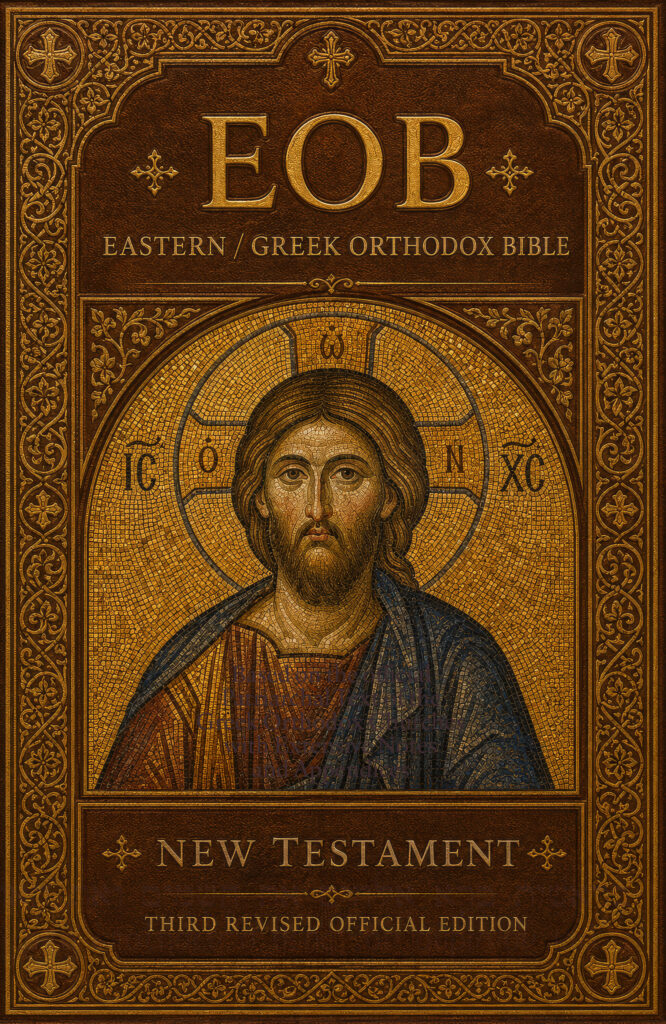
EOB: Official Site of the Eastern / Greek Orthodox Bible (Old and New Testament)
EOB (Eastern / Greek Orthodox Bible):
EOB Footnote:
KJV (King James Version):
WEB (World English Bible):
Benton LXX (Vaticanus):
Douai-Rheims (Vulgate):
Apostoliki Diakonia (LXX):
YLT (Young Literal Translation )(MT):
BBE (Bible in Basic English):
EOB Commentary:
Commentary on Genesis 11:7
The Divine Council and the Holy Trinity
This verse presents one of the most significant theological moments in the Old Testament, as God speaks in the plural: “Come, let Us go down and confuse their language.” The Fathers of the Church consistently understood this plural address as a revelation of the Holy Trinity operating in unity. Saint John Chrysostom emphasizes that this is not God consulting with angels, for angels do not share in divine creative and judicial acts. Rather, the Father speaks to the Son and the Holy Spirit, the three Persons acting in perfect harmony.
Patristic Interpretation
Saint Basil the Great and other Cappadocian Fathers saw in this verse a clear pre-figuration of Trinitarian theology. The singular verb forms combined with plural pronouns throughout Genesis (as in “Let Us make man” in Genesis 1:26) demonstrate the unity of essence and distinction of Persons. Saint Irenaeus of Lyon argued against Gnostic interpretations by insisting that the “Us” refers to the Son and Spirit, who are the “two hands” of the Father in all divine operations.
Pentecost as Reversal
The Orthodox liturgical tradition draws a profound connection between Babel and Pentecost. The Kontakion of Pentecost explicitly states: “When the Most High came down and confused the tongues, He divided the nations. When He distributed the tongues of fire, He called all to unity.” At Babel, linguistic confusion scattered humanity in pride; at Pentecost, the Holy Spirit united humanity through the gift of tongues in humility. The descent of God at Babel brought judgment, while the descent of the Spirit at Pentecost brought redemption and the birth of the Church.
Christological Dimensions
The divine “coming down” (katabasis) at Babel anticipates the ultimate descent of the Son of God in the Incarnation. However, while at Babel God descends to scatter, in Christ God descends to gather. Christ Himself declares that He will draw all people to Himself (John 12:32). The Church Fathers understood this typologically: what was broken at Babel is restored in Christ and His Body, the Church, where “there is neither Greek nor Jew” (Colossians 3:11).
Liturgical Significance
During the Vespers of Pentecost, the Church reads this passage from Genesis, making explicit the theological connection between the two events. The kneeling prayers of Pentecost celebrate the restoration of human unity through the Spirit, directly contrasting with the division at Babel. Orthodox hymnography celebrates that the confusion of tongues has been healed by the “theology of the fishermen,” the apostolic preaching that transcends all linguistic barriers through divine grace.
The Book of Leviticus receives its English title from the Latin Vulgate, which is derived from the Greek Septuagint (LXX) title Leuitikon (Λευιτικόν), meaning “Levitical” or “pertaining to the Levites.”

The Book of Exodus receives its English title from the Greek Septuagint (LXX), where it is called Exodos (Ἔξοδος), meaning “departure” or “exit.” This name was chosen because the central

I. Date and Authorship Holy Tradition of the Orthodox Church, affirmed by the Fathers and the liturgical usage of the Church from the earliest centuries, attributes the Book of Genesis

Does Hebrews 11 on the Maccabees Show Stronger Alignment with 4 Maccabees than 2 Maccabees? Hebrews 11 (the famous “Hall of Faith” chapter) does not explicitly mention the Maccabees by