Introduction to the book of Leviticus
The Book of Leviticus receives its English title from the Latin Vulgate, which is derived from the Greek Septuagint (LXX) title Leuitikon (Λευιτικόν), meaning “Levitical” or “pertaining to the Levites.”
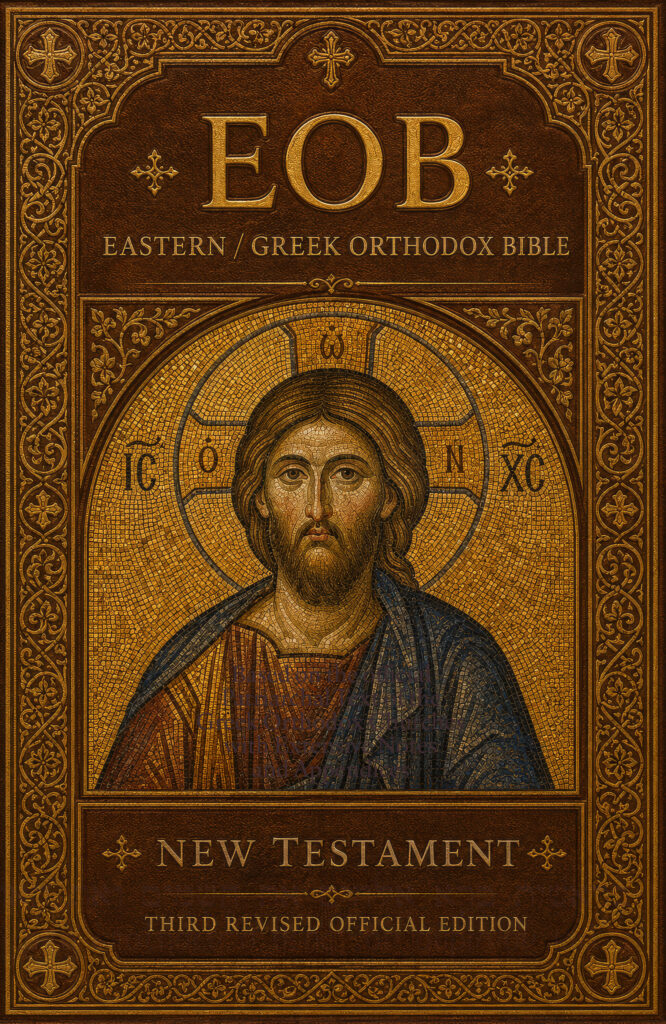
EOB: Official Site of the Eastern / Greek Orthodox Bible (Old and New Testament)
EOB (Eastern / Greek Orthodox Bible):
EOB Footnote:
KJV (King James Version):
WEB (World English Bible):
Benton LXX (Vaticanus):
Douai-Rheims (Vulgate):
Apostoliki Diakonia (LXX):
YLT (Young Literal Translation )(MT):
BBE (Bible in Basic English):
EOB Commentary:
Genesis 2:1 – Commentary
The Completion of Creation and Its Theological Significance
This verse marks a pivotal transition in the creation narrative, declaring that the heavens and earth were completed along with all their host (tsaba in Hebrew). The term “host” encompasses the entirety of created beings—celestial bodies, angels, living creatures, and all that fills creation. The Septuagint renders this as kosmos, emphasizing the ordered beauty and arrangement of all things.
Patristic Interpretation
Saint Basil the Great, in his Hexaemeron, reflects on the completeness indicated here, noting that God brought forth creation in its fullness, lacking nothing. The Fathers understood this completion not as God ceasing from inability but as the perfection of His creative work. Saint John Chrysostom emphasizes that the word “finished” (sunetelesthēsan) indicates that everything necessary for creation’s purpose was accomplished, pointing toward the eschatological completion of all things in Christ.
Christological Reading
The Church Fathers consistently read this verse in light of the New Covenant. Just as creation was completed through the Word, so too the new creation finds its completion in Christ. The Gospel of John opens with deliberate echoes of Genesis, and Christ’s words from the Cross—”It is finished” (tetelestai)—deliberately mirror the completion language of Genesis 2:1. What was begun in the first creation reaches its ultimate fulfillment in the Paschal mystery.
Liturgical Connections
This verse finds resonance in the Orthodox liturgical tradition, particularly in the services of Great and Holy Saturday. The Church contemplates Christ’s Sabbath rest in the tomb as the completion of salvation, paralleling God’s rest after creation. The Vespers hymns of Holy Saturday speak of Christ resting from His saving work, just as God rested from creation. The connection between the first Sabbath and Christ’s entombment reveals the deep typological reading the Church maintains.
Additionally, the phrase “all their host” is echoed in the Cherubic Hymn, where the faithful join the heavenly hosts in worship. The liturgy constantly reminds us that earthly worship participates in the cosmic praise offered by all creation to its Creator.
Spiritual Significance
For Orthodox spirituality, this verse speaks to the theme of divine completion and rest. The spiritual life moves toward theosis, the completion of the human person in God. Just as creation was brought to its intended fullness, so the Christian journey aims toward the eschatological rest promised to the faithful. The Sabbath rest foreshadowed here finds its fulfillment not merely in weekly observance but in eternal communion with God, the true rest toward which all creation groans and labors.
The Book of Leviticus receives its English title from the Latin Vulgate, which is derived from the Greek Septuagint (LXX) title Leuitikon (Λευιτικόν), meaning “Levitical” or “pertaining to the Levites.”

The Book of Exodus receives its English title from the Greek Septuagint (LXX), where it is called Exodos (Ἔξοδος), meaning “departure” or “exit.” This name was chosen because the central

I. Date and Authorship Holy Tradition of the Orthodox Church, affirmed by the Fathers and the liturgical usage of the Church from the earliest centuries, attributes the Book of Genesis

Does Hebrews 11 on the Maccabees Show Stronger Alignment with 4 Maccabees than 2 Maccabees? Hebrews 11 (the famous “Hall of Faith” chapter) does not explicitly mention the Maccabees by